Ukraine’s European backers have urged Kyiv to reject Russia’s demand to cede all of the Donbas. Kaja Kallas, the EU high representative for foreign affairs, has called trading Ukrainian territory for peace a “trap.” German Chancellor Friedrich Merz, French President Emmanuel Macron, and European Commission President Ursula von der Leyen have repeatedly declared that “international borders must not be changed by force.” Some worry that giving in to Putin now will, as happened after a previous generation of European leaders made a deal with Hitler in Munich in 1938, only whet the Russian leader’s appetite for more Ukrainian and even NATO territory down the road.
A more reasonable objection is that the remaining Ukrainian-held Donbas “fortress cities” of Kramatorsk and Sloviansk constitute critical links in Ukraine’s defense. Urban warfare is costly, making cities highly defensible, and in today’s drone-dominated battlefield, they offer cover and protection as concentration points for troops. Given Ukraine’s manpower woes, defending fortified islands may seem like a good option. But preserving the Donbas fortress cities is no reason to continue the war. It is possible to protect territory farther behind the frontline without them with dedicated fortifications. Russia has also demonstrated that even fortress cities can be surrounded, isolated, and cleared through the infiltration of small units, as it has done recently in Chasiv Yar, Huliapole, Pokrovsk, and Siversk—and may yet succeed in doing in Kostiantynivka and Kupyansk.
The loss of the rest of Donetsk, although assuredly a blow to Ukrainian self-esteem, would not necessarily open the door to Kyiv for Moscow. Between October 2024 and October 2025, the Russians took control of 1,703 square miles of Ukrainian territory. The remainder of unoccupied Ukraine east of the Dnieper River consists of 57,066 square miles of territory. At last year’s rate of Russian advance, it would take more than 30 years for Moscow to complete such a conquest.
Western European panic notwithstanding, Russia essentially claiming victory in the Donbas would pose little threat to the rest of the continent. The Donbas is not the Sudetenland because the current Russian tactics are nothing like the blitzkrieg, which garnered Nazi Germany huge chunks of territory very quickly. It would take Russia decades to conquer the rest of Ukraine, so any direct threat to most other countries in Europe would manifest itself far into the future.
Yet there can be little doubt that Russia can achieve more limited aims by force of arms. Roughly 2,866 square miles of Donetsk remain under Kyiv’s control. If Russian forces continue at last year’s rate of advance, they could take it in a year and a half, a reasonable time frame. They may also grab more chunks of Kharkiv, Sumy, and Zaporizhzhia. Doing so would cost Russia additional blood and treasure, to be sure, but it would impose greater relative costs on Ukraine, which Kyiv can ill afford.
The Ukrainians and their allies must now ask themselves what another year of war will achieve and at what price. There is evidence of a growing sense among senior Ukrainian officials, including Kirill Budanov, the presidential chief of staff and former head of military intelligence, that although Ukrainian deep strikes and attacks on Moscow’s “shadow fleet” of oil tankers—the unmarked vessels Russia uses to evade sanctions—hurt Russia, they will not end the war any time soon.
With its larger objectives out of reach, Ukraine faces the prospect of ceding territory, which would be painful for Kyiv. But it does not have to mean the end of Ukraine as an independent country. A Ukraine shorn of its eastern regions could continue Kyiv’s westward-looking state-building project. Even before the Russian invasion in 2022, Ukraine was already shifting its economic center of gravity away from the rust-belt Donbas and toward the postindustrial center and west. And with comprehensive political and economic reforms; a serious anticorruption effort, especially in the military sector; and a campaign to construct defensive positions optimized for drones and low-density warfare and to invest substantial funds and organizational effort into battlefield innovations, Ukraine could be in a stronger position to protect itself were it attacked again. Accepting a bad peace deal now would at least give Kyiv this chance at a better future. Rejecting one now would only prolong a costly and losing war.
src: click (FA)
EVERYBODY knew it. They fucking smiled and kept silent.
edit: Es gibt aber natürlich auch wiender gute Nachrichten. Der Standard spielt heute ein lustiges Spiel. Es nennt sich, wie lange kann unsere Redaktion das aus der Öfentlichkeit raushalten:
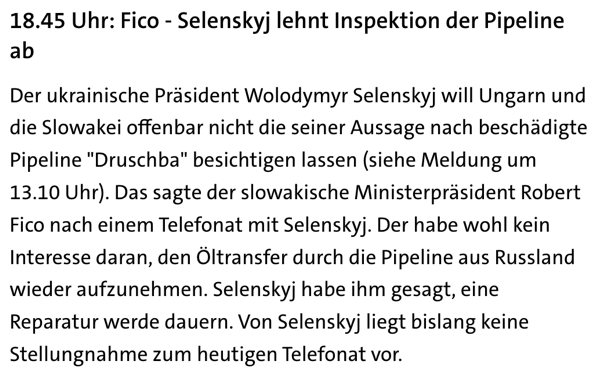
src: click
Aber das macht ja nichts, das ist eh nur Wahlbeeinflussung in Ungarn.

