Unklare Hoffnungen
Während am Budapester Donauufer bei der Tisza-Wahlparty die Sektkorken knallen, darf man schon die Frage stellen, was nun von Magyar zu erwarten ist. Allzu reichhaltig an Themen war der Wahlkampf nämlich nicht. Während Orbán sein Programm herunterspulte, das im Wesentlichen darin bestand, Brüssel und Kyjiw Kriegstreiberei vorzuwerfen, setzte Magyar in erster Linie auf den Kampf gegen die grassierende Korruption.
In manchen Punkten, etwa bei der restriktiven Migrationspolitik, wird sich Magyars Linie vermutlich nicht allzu sehr von jener Orbáns unterscheiden. Dennoch kann man auch hier zumindest rhetorische Mäßigung erwarten: Im Wahlkampf hat sich der 45-Jährige als guter Redner erwiesen, der die Massen begeistern kann – allerdings als Redner, der zur Sachlichkeit neigt und auf aufpeitschende Emotionalisierung gerne verzichtet.
Signal nach Brüssel
Was sich aber Politikerinnen und Politiker quer durch Europa vor allem fragen, ist: Wie wird Magyar in der EU auftreten? Der Wahlsieger kennt Brüssel, er hat dort bereits in diplomatischer Mission sein Land vertreten – damals noch als Mitglied von Orbáns Fidesz. Und er ist für Tisza aktuell Mitglied des Europäischen Parlaments. Orbán ist in der EU häufig als Spaltpilz aufgetreten, hat seine Partner brüskiert und provoziert. Auch Magyar wird – und soll – nicht in allem mit allen einer Meinung sein. Aber einen neuen Stil Ungarns im Kreis der EU-27 darf man sich in jedem Fall erwarten.Magyar selbst hat das noch am Wahlabend angedeutet, als er auf einen zufälligen Jahrestag hinwies: Am 12. April 2003, also genau vor 23 Jahren, hatten die Ungarinnen und Ungarn sich in einem Referendum für den Beitritt zur Europäischen Union entschieden. Es ist eine Koinzidenz, die Magyar auch unerwähnt hätte lassen können. Dass er sie trotzdem erwähnte, war ein freundlicher Gruß an seine künftigen Partner im Europäischen Rat.
src: click
Ehm, eeehm,…
Wie sag mas ihnen…
Behutsam, oder?
Hier:
Beating (Authoritarian) Populism with (Democratic) Populism
Orbán’s Anticipated Defeat and the Danger of Unlimited Single Party-Rule
src: click (verfassungsblog.de)
In line with the median voter theorem, Tisza has adopted ideologically centrally located positions across a range of sensitive policy issues. These included a neutral stance on last year’s banned Budapest Pride march, in which Tisza did not participate; its rejection of the EU-financed 90 billion-euro loan to Ukraine that they opposed in the European Parliament; as well as its pledge not to adopt the European pact on migration and asylum if a Tisza government were formed, on a sovereigntist anti-migration basis.
Tisza did not only adopt the political central ground ideologically, distancing itself from parties of the “old opposition”, but it also refused to cooperate with any of them or, in fact, with any personality with an independent political standing. Neither parties of the old opposition, nor independent members of parliament and leaders of municipalities have been considered as potential allies by Tisza. This is a politically rational strategy by Tisza due to the logic of the majoritarian electoral system, which can transform relative majorities into absolute ones, small absolute majorities into large ones, whereas at the margin it can generate two-thirds (in parliament: constitutional, in municipalities: qualified) majorities. Moreover, Tisza has also justified this position morally, claiming that the “old opposition” had all the way collaborated with the regime, and whoever does not vote for Tisza ultimately supports the maintenance of Orbán’s rule. Through this, Tisza has been urging a complete dismissal of incumbent political elites regardless of the actual political role one has played so far, in a truly populist fashion.
By the virtue of its political success – attained through hard work amidst increasingly beneficial political conditions – Tisza is getting close to a decisive electoral victory, and even a two-thirds constitutional majority in parliament might not be out of its reach. On the one hand, this may provide ideal conditions for re-establishing democratic institutions. On the other hand, being equipped with a two-thirds majority would imply that Tisza is effectively not constrained by any democratic controls. Next to the proliferation of populist attitudes, generating a “populist voter trap” described in the previous section, this is the other trap Hungary may fall into. The trap of autocratic institutions that can only be altered by a large enough mandate that, if exists, can make its possessors exempt from obeying the rules they wanted to introduce in the first place.
16 years ago, upon taking over government with his first two-thirds constitutional majority, Viktor Orbán consolidated his power through autocratization, effectively eliminating the set of depoliticized institutional constraints on which Hungarian liberal democracy in 1990-2010 rested. We do not know how Péter Magyar will approach the same task if he is given a similar chance on 12 April 2026. Independently of the size of his governing majority, though, he cannot adopt the same autocratic practices Fidesz chose to follow in the past 16 years if he is to keep his most important electoral promise: the re-democratization of Hungary.
Ja aber! Die Wahlversprechen!
Genau!
Wir wollen die EU Gelder wieder lukrieren, in dem wir checks and ballances wieder herstellen, und?
Was bedeutet das?
Nun, die eigenen Leute in die Institutionen setzten!
Wegen checks and balances!
Das wird Magyar sicher schwer fallen…
Magyar and his party have not only been successful politically, but also highly interesting from an analytical standpoint. Authors have examined the collective psychological needs Magyar responded to and analysed him as a charismatic actor equipped with sophisticated social media skills. Qualitative research claimed that Tisza engaged in “transformative repolarization” of the political space instead of “reciprocal polarization” and “disruptive escalation” that the “old opposition” had pursued since the early 2010s.
Most recently, Andrea Szabó and her co-authors showed how Tisza has reconfigured the distribution of populist attitudes across government and opposition electorates. They reported the proliferation of “leader-centred representation,” implying that “[b]y 2025, preferences for strong, personalised leadership are broadly shared across partisan publics, including among voters who disagree fundamentally over which leader should govern.” Today’s Hungary, they claim, is characterized by a “hybrid populist electorate” in which “populist demand is not confined to regime supporters but extends across partisan blocs once opposition realignment creates a credible anti-incumbent pole.” In other words – I add – the rise of Tisza mobilizes populist attitudes on the opposition side, no longer leaving them the prerogative of those in power for 16 years. On the one hand, this is very good news as it makes the opposition electorally more competitive than it has ever been since 2010. On the other hand, Szabó and her co-authors explain, this constitutes a “populist voter trap” that prevents the prospected regime change from ending the period of populism-driven politics.
Gut, ganz so schlimm ist es nicht es gibt ja auch die anderen Wahlversprechen, …
das Gesundheitssystem auszubauen -- während Ugarn in eine Phase fiskalen Sparens eintritt, und …
sich zu LGBT Themen ambivalent zu verhalten.
Und natürlich den wichtigen Tweet, meine Regierung wird pro EU und pro NATO!
Das Daumendrücken kann beginnen.
Etwas noch - wenn wir an die kürzliche Analyse denken, dass das GDP in Ungarn über beinahe 15 Jahre exakt gleich gewachsen ist wie das Polens (in percent growth), bis auf eine 0.2% Delle aus der Pandemie raus, in der Russland weniger schnell subventioniert hat als die EU, … nun, das liest sich beim Verfassungsblog so:
Throughout most of the 2010s, economic growth was robust, employment and real wages grew, and huge amounts of EU funds were flowing into Hungary. As a consequence, a broad range of activist government policies could be pursued alongside conservative fiscal policies while keeping external economic vulnerability low.
This changed in the 2020s, when Covid, alienation from the EU mainstream, a fundamental deterioration in the global business environment, and a loosening fiscal stance before the 2022 elections altered the situation dramatically. Just like in 2006-10, pre-election fiscal expansion was followed by post-election stabilization needs, occurring amidst decreasing EU financing as the EU Commission suspended most Hungarian development funding as part of its renewed rule of law procedure. The economy fell into recession, inflation accelerated, and real wages dropped in 2023. This was followed by two more years of near economic stagnation, during which financing extensive government clienteles without EU money – its primary source in the previous decade – became increasingly difficult for the regime. As the resulting political vacuum could not be filled by the discredited “old opposition”, a new political alternative was needed.
Aber wieso der Magyar dieses politische Signal an die EU und die Nato gesendet hat, … das hätt er laut dem Standard auch lassen können.
Gell?
Genau.….….
Man könnt auch sagen, jetzt wo Russland nicht mehr so flüssig ist, …
Die NZZ hats ordentlich formuliert:
Ein nationales Trauma, das sich heute an Grossungarn-Stickern auf Autohecks manifestiert. Linke Politiker lehnen viele ab, die Erinnerung an die korrupten Kommunisten sitzt zu tief.
Fidesz bediente diese Sehnsüchte geschickt. Sie versprach Stabilität, nationalen Stolz und eine Abkehr von der liberalen Westpolitik, die viele als Bedrohung der ungarischen Identität empfanden. Auch die Wirtschaft brummte: Ausländische Konzerne wurden mit Subventionen und billiger russischer Energie ins Land gelockt, die Mittelschicht mit grosszügiger Familienförderung gebunden. Löhne und Wohlstand stiegen.
Doch das Modell hat einen Haken: Es wird hauptsächlich mit EU-Subventionen finanziert. Seit der letzten Wahl hält die EU jedoch Milliarden wegen Bedenken über mögliche Korruption zurück.
src: click
Nicht vergessen Ungarn war bei weitem nicht das ärmste Land der EU nach purchase power parity (billiges Gas, Öl und billiger Wohnraum, da Orbans Mehrkind Politik gekratert ist).
Problem? Die Abhängigkeit vom Russischen Öl besteht weiter, die (Pipeline-)Infrastrukur bedingts weiter, die Langzeitverträge sind in Place.
Aber die 28 Milliarden, die wegen Bestrafung des autokratischen Regimes bei der EU parken, … sind die Zukunft der jungen Ungarn, die Magyar mit Wachstumsversprechen mobilisieren konnte. Tollste Wahlbeteiligung evar!
Nichts desto trotz, dass Magyar gleich einen Staatsbesuch in Polen angekündigt hat, hat alle versöhnlich gestimmt - und ja - diese Reise, wird interessant.
Ein Problem haben wir noch, … Der Standard Leser hat schon wieder nicht verstanden was eine zwei Drittel Mehrheit ist.
Ach ja, der lebendige Parlamentarismus Ungarns unter zwei Drittel Mehrheit.
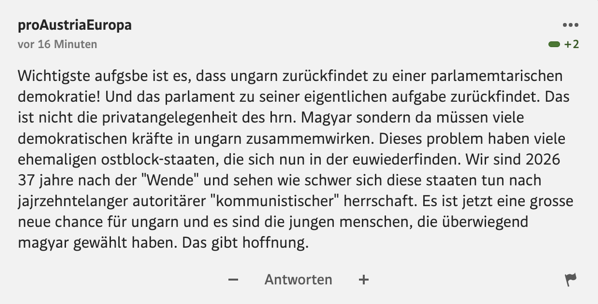
Bei dem Fidez sich an die Institutionen krallt, weil die nächsten Wahlen sicher kommen, und Magyar in einer Periode fiskalischen Sparens übernimmt, …

