How many journalists in the EU?
2019, there were almost 0.4 million journalists in the 21 EU Member States
src: click (European Comission)
How many people in the EU 2019?
EU population up to over 513 million on 1 January 2019
src: click (European Comission)
Wolfram Alpha, what percentage is 400000 out of 513 million?
Result: 0.07797%
How many Journalists were killed in Gaza?
175 (src: Democracy Now, Middle East Monitor)
How many people killed in Gaza?
As of 4 October 2024, over 43,000 people (41,802 Palestinian and 1,706 Israeli) have been reported as killed in the Israel–Hamas war
src: click (Wikipedia)
Wolfram Alpha, what percentage is 175 out of 41802?
Result: 0.4186%
0.4186/0.07797 = 5.37
Im Gaza Streifen werden Journalisten 5.4 mal häufiger getötet, als es nach dem Bevölkerungsschlüssel für entwickelte Demokratien wahrscheinlich wäre.
Es gibt aber natürlich auch wieder gute Nachrichten, Israel hat gerade wieder eine Massenvertreibung im Norden des Gaza Streifens angeordnet, und kein österreichischen Medium berichtet darüber, weil ’s is ja aktuell Jahrestag des Hamas Massakers, da kann man das schon mal unter den Tisch fallen lassen. Gell?
For the first time in months, Israel sent a column of tanks into northern Gaza and launched major operations there, surrounding Jabalia, the largest of strip’s eight historic refugee camps, as strikes hit a mosque and a school in attacks that killed 24 and wounded nearly 100, according to the local Hamas-controlled government.
The escalation in Gaza came after Israel’s attention largely had refocused toward its incursion into southern Lebanon, the largest military operation there since 2006. It appeared to defy analysts who said Israel would not attempt to fight a two-front war in both Lebanon and Gaza, as well as a tit-for-tat battle of airstrikes with Iran.
But on Sunday, Israel issued a new blanket evacuation order for all of the northern Gaza Strip, where hundreds of thousands of civilians remain, as a military spokesperson declared a “new phase of the war” against Hamas.
src: click (The Guardian)
Gut, sowas fällt schon mal unter den Tisch und geht verloren, wenn man am selben Tag Hetz Artikel gegen die empathielose Kulturlinke schreiben muss, nicht Standard? (Hier der Newsfeed des Standards vom Sonntag: click, hier der vom Montag: click)
Wie die “woke” Kulturlinke mit dem 7. Oktober moralisch scheiterte
Mit dem empathielos hingenommenen Hamas-Angriff auf israelische Zivilisten müsse sich die postkoloniale “Wokeness” selbstkritisch revidieren, findet der Autor Jens Balzer
src: click
Gut man kann jetzt nicht alles berichten - Moment, was ist Artikel Nummer eins derzeit im Standard?
Nahost
Hunderte Menschen bei Gedenken an Hamas-Opfer am Wiener Ballhausplatz
Am Jahrestag des Hamas-Überfalls setzte Israel seine Angriffe auf Gaza und im Libanon fort. Die Armee kündigte eine Aufstockung der Soldaten im Libanon an
src: click
Hunderte! Da musste der Standard einfach Prioritäten setzen, und Hetzartikel veröffentlichen.
Jetzt ist es aber auch gut dass der Standard so gut exzellent über die Angriffe auf den Libanon berichtet, da muss er das was aktuell in Gaza passiert gar nicht mehr in seine Berichterstattung aufnehmen.
Die Trauer um die Opfer und Geiseln ist ja mal wieder so riesig, dass in Israel die Angehörigen der Geiseln (100 verbleiben, davon vermutete 70 noch am Leben) wieder Strassenblockaden veranstalten müssen um gesellschaftlich überhaupt noch eine Rolle zu spielen, aber was haben wir uns Vergeltung für die Toten und Vergewaltigten geschworen…
Deshalb machen wir das alles ja… Zu ihrem Gedenken, auf das das niemals mehr passiere! Weil die Entmenschlichung der Einwohner Gaza, bei denen Hamas Sozialfunktionen übernommen hatte dabei ja so sehr hilft. Moment ich hör grad, nein, das Gegenteil ist der Fall, und aufgrund der starken sozialen Einbindnung der Terror-Organisation in das tägliche Leben der Einwohner des Gaza Streifens läßt sich die Hamas garnicht militärisch besiegen, naja - macht ja nichts redet ja eh keiner mehr drüber -- jetzt am Jahrestag, wos doch bereits gegen den Libanon geht!
Dabei waren uns doch die Getöteten und Vergewaltigten so wichtig!
Moment, ich höre gerade die systematischen Vergewaltigungen werden von Al Jazeera als nicht objektivierbar und “highly questionable” bezeichnet.
October 7 reveals widespread human rights abuses by Hamas fighters and others who followed them through the fence from the Gaza Strip and draws up a comprehensive list of those killed.
But the investigation by the I-Unit, which examined hours of footage from CCTV, dashcams, personal phones and headcams of killed Hamas fighters, has also found that many of the stories that came out in the days following the attack were false.
These include claims of atrocities such as the mass killing and beheading of babies as well as allegations of widespread and systematic rape – stories that were used repeatedly by politicians in Israel and the West to justify the ferocity of the subsequent bombardment of the Gaza Strip, which has so far killed nearly 32,000 people.
‘Cannot tell whether they are gunmen or hostages’
After a thorough analysis of all available data, the I-Unit concluded that claims by the Israeli army that it found eight burned babies at a house in Kibbutz Be’eri were untrue. The analysis found that there were no babies in the house, and the 12 people inside were almost certainly killed by Israeli forces when they stormed the building.
This was one of a number of incidents where the police and army appear to have killed Israeli citizens. The I-Unit identified 19 such victims, but the true figure is likely to be higher. It also identified 27 captives who died between their homes and the Gaza fence in circumstances that have not been explained.
Gun camera footage from Israeli Apache helicopters shows numerous strikes on vehicles and individuals making their way back to Gaza.
“My concern with this footage is we cannot tell whether they are Hamas gunmen or …. hostages. And I don’t believe the helicopter pilot, or the machine gun operator would be able to tell either,” said Chris Cobb-Smith, a British army veteran and human rights researcher.
The film features an interview with Yossi Landau, the southern commander of Zaka, a volunteer organisation tasked with collecting bodies after the October 7 violence. The I-Unit confronts Landau with evidence that many of the stories of atrocities Zaka relayed to the media were highly questionable.
The I-Unit also examined claims that widespread sexual violence had occurred on October 7. It concluded that while isolated rapes may have taken place, there was insufficient evidence to support allegations that rape had been “widespread and systematic”.
“To show that it was widespread and systematic, we would need a lot more evidence than has come to light to date and a lot more corroborative evidence than is being put out there,” says Madeleine Rees, general secretary of the Women’s International League for Peace and Freedom.
src: click (Al Jazeera)
Gut, das muss man jetzt natürlich auch wieder nicht in den deutschsprachigen Medien berichten, ich mein - es stehen ja hunderte Menschen zum Jahrestag am Ballhausplatz.
Da muss man Prioritäten setzen
Wie man im deutschsprachigen Journalismus eben Prioritäten setzt.
Hmmm… 100.000e neue Vertriebene in Gaza, 100e Leute am Ballhaus Platz, worüber wird der Standard wohl berichten.
Genau! Na natürlich über das Erste garnicht, und über das Zweite gleich im ersten Artikel auf der Hauptseite natürlich!
Und vielleicht findet der Rauscher auch wieder ein rotes Höschen in seinem Insta-Feed, dann kann er ja noch weitere zwei Artikel über diesen Vorfall, und wie sehr es ihn zerrüttet hat das sehen zu müssen schreiben, also zusätzlich zu den zweien die der Rauscher darüber bereits geschrieben hat.
edit: Oh, mea culpa! Der Standard hat berichtet, ich habe es nur überlesen!
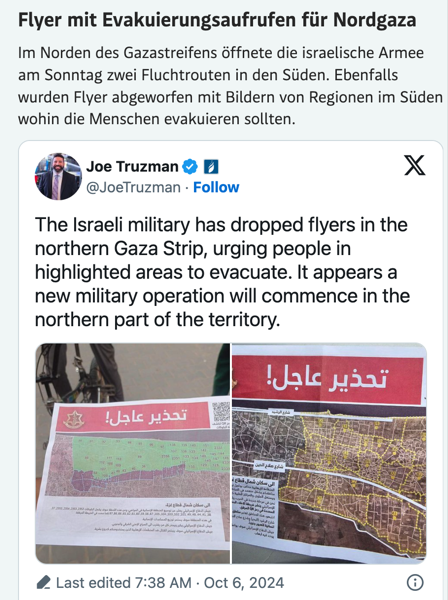
Nun wie hat der Standard gemeint, wäre es wohl am angemessensten die erneute Vertreibung von 100.000en Palästinensern zu berichten. Nun, in der angemessensten aller Formen natürlich. Zwei Sätze in einem Ticker, gefolgt von einen Tweet wo man sich die Regionen von nem Handycam Photo zusammensuchen kann - also wenn man interessiert ist. Bevölkerungszahlen muss man natürlich auch keine nennen (Betroffene), man ist schließlich unter Freunden. Auch ein Hoch auf das Passiv -- “it appears that an operation will commence, that will dislocate a few houndreds of thousands”. Da spricht eben noch eine Zeitung die Probleme direkt an.
src: click