Rainer Munz missrepräsentiert heute die Analysen von Foreign Affairs und der New York Times - und die NTV Moderatorin “lernt so viel davon”.
Zur Klarstellung, der Deal war nie final.
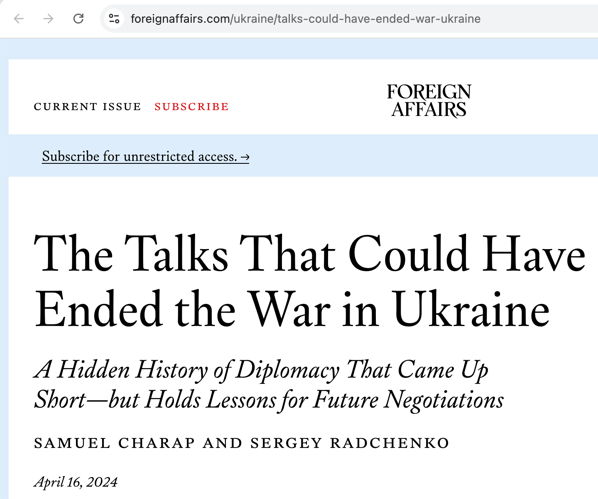
src: click
A final agreement proved elusive, however, for a number of reasons. Kyiv’s Western partners were reluctant to be drawn into a negotiation with Russia, particularly one that would have created new commitments for them to ensure Ukraine’s security. The public mood in Ukraine hardened with the discovery of Russian atrocities at Irpin and Bucha. And with the failure of Russia’s encirclement of Kyiv, President Volodymyr Zelensky became more confident that, with sufficient Western support, he could win the war on the battlefield. Finally, although the parties’ attempt to resolve long-standing disputes over the security architecture offered the prospect of a lasting resolution to the war and enduring regional stability, they aimed too high, too soon. They tried to deliver an overarching settlement even as a basic cease-fire proved out of reach.
NEIN! Ja ist denn das die Möglichkeit…
Hier die New York Times:
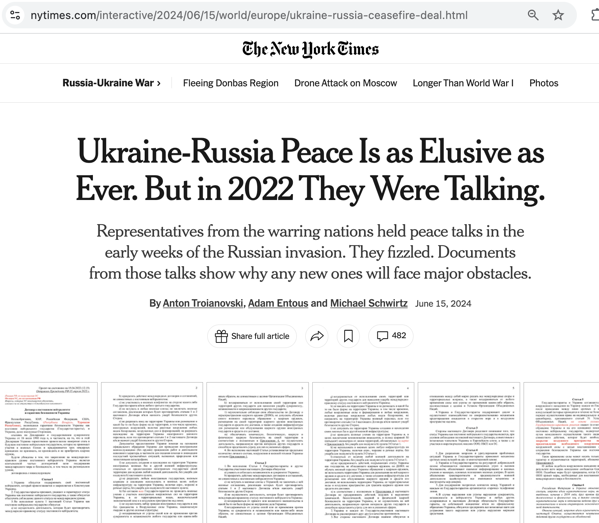
src: click
Leaders in Poland — early and strong supporters of Ukraine — feared that Germany or France might try to persuade the Ukrainians to accept Russia’s terms, according to a European diplomat, and wanted to prevent that from happening.
To that end, when Poland’s president, Andrzej Duda, met with NATO leaders in Brussels on March 24, he held up the March 17 text, said the diplomat, who was present.
“Which of you would sign it?” Mr. Duda asked his counterparts, the diplomat said.
None of the NATO leaders spoke up.
A Breakthrough in Istanbul?
A few days later, on March 29, Russia and Ukraine’s representatives met at an Istanbul palace on the Bosporus. To some, the talks felt like a breakthrough driven by Russia’s battlefield struggles.After each military setback, a member of Ukraine’s negotiating team said, Mr. Putin “reduced his demands.”
In Istanbul, the Russians seemed to endorse Ukraine’s model of neutrality and security guarantees and put less emphasis on their territorial demands. Afterward, Mr. Medinsky, Russia’s lead negotiator, said Ukraine’s offer of neutrality meant it was “ready to fulfill those principal demands that Russia insisted on for all the past years.”
Ukraine summarized the proposed deal in a two-page document it called the Istanbul Communiqué, which it never published. The status of Crimea was to be decided over a 10- or 15-year period, with Ukraine promising not to try to retake the peninsula by force; Mr. Zelensky and Mr. Putin would meet in person to finalize a peace treaty and strike a deal on how much Ukrainian territory Russia would continue to occupy.
[…]
The communiqué, provided to The Times by a Ukrainian negotiator, described a mechanism in which other countries would intervene militarily if Ukraine were attacked again — a concept that the Ukrainians pointedly designated as Article 5, a reference to the mutual defense agreement in Article 5 of the NATO treaty.
But Russian officials sent mixed signals in public on whether the Kremlin was really ready to sign onto the deal. The Russians and Ukrainians returned to hourslong negotiating sessions by video call, exchanging treaty drafts via WhatsApp, negotiators said.
‘The Boss’
In early April, after Russia withdrew from the outskirts of Kyiv, images of massacred civilians in the suburb of Bucha, some with their hands tied with white cloth, shocked the world. For Ukrainians, the idea that their country could strike a compromise with Russia seemed more remote than ever.But Mr. Zelensky, visiting Bucha on April 4, said the talks would go on, even as Russia dismissed the Bucha atrocities as a staged “provocation.”
[…]
“We didn’t know if Putin was serious,” said the former senior U.S. official. “We couldn’t tell, on either side of the fence, whether these people who were talking were empowered.”
One Ukrainian negotiator said he believed the negotiations were a bluff on Mr. Putin’s part, but two others described them as serious.
On April 15, five days after Mr. Abramovich told the Ukrainians about his meeting with Mr. Putin, the Russian negotiators sent a 17-page draft treaty to their president’s desk.
Sticking Points
Similar to the month-earlier version, the April 15 draft includes text in red highlighting issues in dispute. But such markings are almost entirely absent from the treaty’s first pages, where points of agreement emerged.Negotiators agreed that Ukraine would declare itself permanently neutral, though it would be allowed to join the European Union.
Russia dropped its earlier objections to Ukraine’s full-fledged E.U. membership.
“The Parties to this Treaty share the understanding that Ukraine’s status as a permanently neutral state is, subject to the provisions of this Treaty, compatible with Ukraine’s possible membership in the European Union.”Much of the treaty would “not apply” to Crimea and another to-be-determined swath of Ukraine — meaning that Kyiv would accept Russian occupation of part of its territory without recognizing Russian sovereignty over it.
But crucial sticking points remained. Russia wanted the firing range of Ukraine’s missiles to be limited to 25 miles, while Ukraine wanted 174 miles — enough to hit targets across Crimea. Russia still wanted Ukraine to repeal laws related to language and national identity, and to pull back Ukrainian troops as part of a cease-fire.
Russia’s ceasefire proposal declared that Ukraine would need to withdraw its troops on its own territory.
“Ukraine carries out the withdrawal (return) of units of its armed forces, other armed formations, weapons and military equipment to places of permanent deployment or to places agreed upon with the Russian Federation.”The biggest problem, however, came in Article 5. It stated that, in the event of another armed attack on Ukraine, the “guarantor states” that would sign the treaty — Great Britain, China, Russia, the United States and France — would come to Ukraine’s defense.
src: click
An was ist es gescheitert, Herr Munz?
Daran, das Putin von der Ukraine viel zu geringe Armee Zahlen gefordert hat, als dass die Ukraine überleben hätte können!
Sie wissen schon, dem Teil:
A former senior U.S. official who was briefed on the negotiations, noting how Russian forces were being repelled across northern Ukraine, said Mr. Putin seemed to be “salivating” at the deal.
American officials were alarmed at the terms. In meetings with their Ukrainian counterparts, the senior official recalled, “We quietly said, ‘You understand this is unilateral disarmament, right?’”
Vom 24. März.
Leaders in Poland — early and strong supporters of Ukraine — feared that Germany or France might try to persuade the Ukrainians to accept Russia’s terms, according to a European diplomat, and wanted to prevent that from happening.
To that end, when Poland’s president, Andrzej Duda, met with NATO leaders in Brussels on March 24, he held up the March 17 text, said the diplomat, who was present.
Und das war der Sticking point in der Draft Version vom 15. April (einer der letzten):
To the Ukrainians’ dismay, there was a crucial departure from what Ukrainian negotiators said was discussed in Istanbul. Russia inserted a clause saying that all guarantor states, including Russia, had to approve the response if Ukraine were attacked. In effect, Moscow could invade Ukraine again and then veto any military intervention on Ukraine’s behalf — a seemingly absurd condition that Kyiv quickly identified as a dealbreaker.
With that change, a member of the Ukrainian negotiating team said, “we had no interest in continuing the talks.”
Ich wüsste garnicht wo ich mich informieren sollte - wenn es nicht das Außenreporter Netzwerk von NTV geben würde.

