In der allseits beliebten Rubrik: “Wauzi will nur spielen.”
Nato schickt Sonderbeauftragten nach Kiew und Nato baut zivile Präsenz weiter au
Die Nato baut ihre zivile Präsenz in der von Russland angegriffenen Ukraine aus. Wie ein Sprecher bestätigte, haben die 32 Bündnisstaaten beschlossen, eine Art Sonderbeauftragten in die Hauptstadt Kiew zu entsenden. Der ranghohe Beamte soll dort die politische und praktische Unterstützung des Bündnisses steuern.
Hintergrund ist insbesondere, dass die Nato beim Gipfeltreffen in der kommenden Woche in Washington den Startschuss für einen neuen Einsatz zur Koordinierung von Waffenlieferungen und Ausbildungsaktivitäten für die ukrainischen Streitkräfte geben will. Das Hauptquartier dafür soll in Wiesbaden in Deutschland aufgebaut werden.
Wer den neuen Nato-Posten in Kiew bekommen soll, war aus dem Bündnis zunächst nicht zu erfahren. Weitere Details werde man nach der offiziellen Auswahl kommunizieren, hieß es. Zuerst hatte das “Wall Street Journal” über die Pläne berichtet.
Die Nato hat bereits seit knapp einem Jahrzehnt eine offizielle Vertretung in Kiew, die auch ein seit Ende der 90er-Jahre existierendes Verbindungsbüro und ein Informations- und Dokumentationszentrum steuert. Sie kümmert sich unter anderem um Kontakte mit ukrainischen Ministerien und Behörden und soll den politischen Dialog und die praktische Zusammenarbeit zwischen der Nato fördern. Zudem berät sie Behörden über Aktivitäten zur Unterstützung der Nato -Ukraine-Partnerschaft und Reformen im Sicherheits- und Verteidigungssektor. Auch dafür soll es künftig mehr Personal geben.
Die NATO baut also jetzt “ihre zivile Präsenz” in der Ukraine aus, während die Ukraine gleichzeitig “militärisch so sehr an die NATO Standards herangeführt werden soll, dass ein Beitritt, dann im Schnell verfahren passieren kann und nicht über die üblichen langwierigen Prozederes erfolgen muss.” Die dauern ja auch so lang…
Point 5: Ukraine has to join Nato - otherwise we can not be sure Russia wont attack Ukraine again!
For that to happen, Ukraine has to be closely brought up to Nato standards, so that “WHENTHETIMEISRIGHT” in a Moment of weakness for russia, when Turkey can be convinced as well, the actual joining process can happen without the normal path of action, in a quicktrack fashion, within a few weeks. “This is the only way to just and permanent peace.”
Aber das passiere ja nur (“Hintergrund”, laut Standard), da die NATO jetzt von der Ramstein Kontaktgruppe die militärische Leitung des Ukrainekriegs übernimmt (Anti-Trump Maßnahme), wofür das Headquarter in Wiesbaden in Deutschland bleiben soll.
Dont worry, Der Standard is just a bit lost in his own narrative.
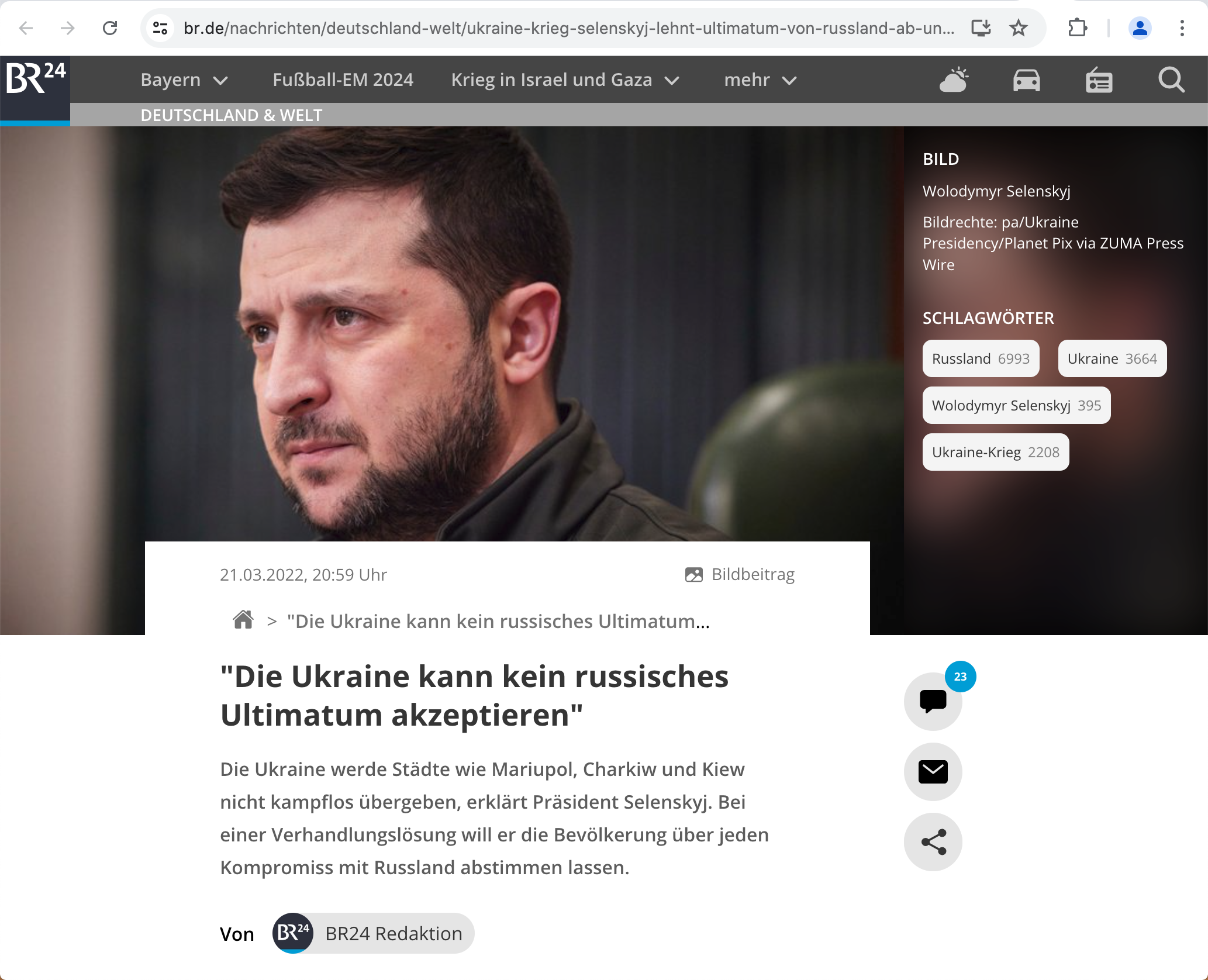
Wann spricht Selenksyj eigentlich das erste Mal von “russischen Ultimaten”?
“Die Ukraine kann kein russisches Ultimatum akzeptieren”
Die Ukraine werde Städte wie Mariupol, Charkiw und Kiew nicht kampflos übergeben, erklärt Präsident Selenskyj. Bei einer Verhandlungslösung will er die Bevölkerung über jeden Kompromiss mit Russland abstimmen lassen.
Von BR24 Redaktion
Über dieses Thema berichtet: BR24 am 21.03.2022 um 18:30 Uhr.
Die Ukraine wird sich nach den Worten ihres Staatschefs Wolodymyr Selenskyj nicht auf “russische Ultimaten” zur Beendigung des Krieges einlassen. “Die Ukraine kann kein russisches Ultimatum akzeptieren”, sagte Selenskyj der Nachrichten-Website Suspilne.
Moskau wolle unter anderem die “Übergabe” der Städte Mariupol, Charkiw und Kiew durch die Ukraine erreichen, sagte Selenskyj. Dem könnten aber “weder die Menschen in Charkiw noch die in Mariupol oder Kiew noch ich, der Präsident”, nachkommen. In der Nacht zum Montag hatte die Ukraine ein Ultimatum Russlands zur Kapitulation in der belagerten Hafenstadt Mariupol zurückgewiesen.
Heute ist diese Phrase (“Ultimaten”) in der ukrainischen Propaganda wieder sehr gefragt - wenn man z.B. Katrin Eigendorf (der Intellekt auf zwei Beinen, drei Paletten, neben einer Haubitze, oder wahlweise auch in einem Interviewpanel) vorlügen muss “wie die Ukraine Frieden erreichen will”.
Also erst mal in dem sie noch vier oder mehr Jahre Aufreibungskrieg führt - natürlich.
Ich mein, so viel steht außer Frage - fragen sie doch Gustav Gressel -
Dann aber auch sehr in dem sie bereits im Bürgenstock Endkommunique verankert, dass man nur mit Russland verhandle, wenn Russland die territoriale Integrität der Ukraine in den Grenzen von 1991 akzeptiert, UND die vollständige Souveränität der Ukraine - eine Armee beliebiger Größe, zur Befreiung der Krim aufrechtzuerhalten -
was natürlich NIEUNDUNTERKEINENUMSTÄNDENEINUKRAINISCHESULTIMATUMDARSTELLT…
Also dass die Ukraine das ins Bürgenstock Kommunique aufgenommen hat um damit ihre (seit 2022 bestehende) Position (wir laden Russland erst ein, wenn Russland zustimmt auf der Basis einer Friedensformel zu verhandeln die die territoriale Integrität der Ukraine in den Grenzen von 1991, sowie die von der Ukraine frei wählbare Größe und Ausrichtung (“Wir erobern jetzt die Krim zurück!”) ihres Militärs als Vorbedingungen beinhaltet) international (von 78 Staaten) legitimiert zu bekommen, sag jetzt nicht ich, sagt die von US-AID finanzierte European Pravda, die die Fassungen des Bürgenstock Kommuniques vom 28. Mai und 9. Juni vergleichen konnte:
Ukraine Peace Summit turns hard on Russia. How leaders amended the final decision under criticism
THURSDAY, 13 JUNE 2024 — SERGIYSYDORENKO, EUROPEANPRAVDA
Harsh criticism of the agreed draft resolution of the Peace Summit, voiced both in Ukraine and by Ukraine’s allies, forced the organisers to make concessions. Switzerland, which is organising the Global Peace Summit, sent a radically revised document to all capitals of the participating countries, correcting key issues highlighted by European Pravda.
The updated draft is entirely acceptable for Ukraine. It explicitly calls the war “Russian aggression.” Loopholes that could have paved the way for territorial concessions from Ukraine were removed from the text. Several states that had planned to attend the Peace Summit in Switzerland have decided not to go there after the draft decision was changed in favour of Ukraine.
European Pravda has learned the details of the negotiations and the decision that will be adopted this weekend.
Behind the scenes of the Peace Summit
The timeline of these events is crucial: it shows how urgent the changes that occurred over the past week were.
The idea to hold the Peace Summit in Switzerland was agreed upon at the beginning of the year. On 10 April, Switzerland announced the agreed date and location for the summit. Leaders of about 160 countries, four international organisations (UN, EU, Council of Europe, OSCE), the Pope and the Ecumenical Patriarch were invited to the Bürgenstock Alpine Spa. It was predetermined that Russia would not be present at the first Peace Summit, which Ukraine demanded in the first place.
Both Kyiv and Bern aimed to adopt a decision following the summit. However, the wording needed to be agreed upon by all participants.
Preparation for this document started more than two months ago. European Pravda has the April draft of the joint communiqué, where the summit dates were still tentative. That document was prepared in Kyiv and was entirely acceptable for Ukraine, adhering to the important red lines for Ukrainian society.
However, Switzerland persuaded Ukraine to soften it as much as possible, considering the wishes of all participants. On 28 May, a compromise version was sent from Bern to all capitals, and initially, Kyiv had to agree to it.
Everything changed when the public learned that this draft was dangerous for Ukraine.
The discussion began with an article by European Pravda, published on 5 June. The next day, on 6 June, Kyiv was forced to make public statements asserting that “Ukraine will not retreat from the Peace Formula.” This fueled discussions in the capitals of Ukraine’s allies, which were also not thrilled with the wording of the Swiss document. At least a few of them contacted Bern with a proposal to revise the joint statement.
On 9 June, Switzerland had sent a completely new draft to all countries. Amending the communiqué took mere days, not months as before.
What has changed
The summit’s decision remains unchanged in format and structure. This is a two-page document dedicated to three issues: nuclear security, food security and the prisoners of war. Key issues that lay outside these points have been addressed though.
Russian Aggression
– Old wording: The May draft decision of the Peace Summit did not mention the word “aggression,” meaning the international crime where Russia is the perpetrator and Ukraine the victim.
– New wording: This has been amended. The joint communiqué now refers to “the aggression of the Russian Federation against Ukraine”.
Territorial Integrity and the UN Charter
– Old wording: the previous summit decision version created a legal window to include Ukraine abandoning part of its territory in the conditions of “sustainable peace with Russia”, if necessary.
– New wording: the new draft decision clearly states that the basis for sustainable peace will be only “a solution based on the principle of respect for the territorial integrity and sovereignty of all states”. [Crimea back to Ukraine, and no neutrality that includes “limitation on military forces”]
Alternative Peace Formulas
– Old wording: the previous draft blurred the meaning of the Peace Formula and opened up space for international discussion of all alternative visions of peace, such as the Chinese-Brazilian one, which envisages a halt to the strengthening of Ukraine’s Armed Forces and a cessation of hostilities.
– New wording: the new wording states that only peace proposals that comply with international law (i.e. an unconditional return of the 1991 borders, unless revised by Ukraine itself) and the UN Charter (in particular, Ukraine’s unconditional [no force limitation] right to continue repelling Russian aggression and liberating the occupied territories) will be taken into account.
Involvement of Russia
– Old wording: the earlier version turned Russia from an aggressor into a participant in peace talks, requiring only vague “confidence-building measures” on nuclear and food security.
– New wording: this section has been rewritten from scratch. The Swiss agreed not to mention Russia at all in the provision on peace talks, instead referring to “all parties”. There is no longer a weakened requirement for “confidence-building measures”, but instead “specific actions” are required. And most importantly, the references to a “second peace summit” that hinted at a commitment to invite Russia to participate have been removed.
Food Security
– New addition: The updated document includes the statement that “attacks on merchant ships in ports and along the entire route, as well as against civilian ports and civilian port infrastructure, are unacceptable”. This falls under the global food security section but applies to all civilian vessels, including container ships or those exporting Ukrainian metals. Continued attacks would block Russia’s participation in peace initiatives.
These significant changes ensure that the new draft of the summit decision is more acceptable to Ukraine, reinforcing its territorial integrity, addressing Russian aggression accurately and maintaining stringent conditions on peace negotiations involving Russia.
The document is acceptable for Ukraine
The Joint Communiqué on a Peace Framework in its new version aligns with Ukraine’s interests. Although there are still minor remarks, the main dangers have been addressed. Currently, the draft is not yet final: there is still a possibility of point changes on 13-14 June. However, European Pravda’s sources are inclined to believe that the updated content of the decision will remain.
Realistic expectations are necessary. This summit will not lead to a breakthrough or end the war. Ukraine is merely taking one of the first steps on a long path. However, it is crucial that this step is in the right direction and does not create new problems.
The higher ambition of the document came at a cost:
several countries have declined to participate in the summit. As of 5 June, Switzerland officially announced that it had “received more than 80 confirmations of attendance at the level of heads of states and governments”, and the total number of confirmed attendees, as reported by officials, exceeded 100. However, in the following days, this phrase had to be removed from the event’s website, and now it reads that “around 90 states have confirmed their participation in the Summit on Peace in Ukraine, most of them at head of state or government level”.
Sources of European Pravda reported that, in reality, about 15 countries have “paused” their attendance. In addition, the number of those who have signalled a demotion from the presidential or prime ministerial level to the level of ministers or even their deputies is in the dozens.
Although it is obvious that due to the recent changes, the summit will be attended by fewer states than initially anticipated by Bankova Street [where the Ukrainian President’s Office is located] eight days ago, it is better to have a summit of like-minded people than to make concessions on issues that are critical for the state.
Dann überzeugt man den blonden Intelligenzbolzen vom ZDF natürlich, dass es sehr wichtig sein wird, jetzt noch weitere Friedensformelkonferenzen abzuhalten, in denen man “Einen Frieden vorbereitet, der nicht mehr von Russischen Ultimaten beeinflusst wird” - bestätigt als Kuleba heute noch mal kurz (siehe Video), dass Russland erst zu Verhandlungen eingeladen wird - wenn es die Vorbedingungen akzeptiert, die seiner Kapitulation gleichkommen…
Und an der Stelle braucht man sie dann wieder, die Phrase, dass die Ukraine keine russischen Ultimaten akzeptieren könne, und deshalb Friedensformelgipfel abhält, zu denen sie Russland sicher auch ganz bald einladen wird.
Nachdem sie die von der Schweiz reinformulierte Zusage, dass Russland zum nächsten Friendensformelgipfel geladen werden soll (Vorversion vom 28. Mai 2024), ansatzlos aus dem Kommunique entfernen hat lassen. Und jetzt auf ihre Vorbedingungen pocht, die Russland anerkennen muss, bevor es auf einen weiteren Gipfel geladen werden kann.
Die wegen denen 15 Staaten (2,2 Milliarden Menschen) ihre Unterschrift unter dem Kommuniquee verweigert haben. Schreibt die European Pravda. Die von USAID finanziert wird.
Achja, Selenskyj wollte im März 2022, natürlich auch die komplette ukrainische Bevölkerung über alle Konzessionen, die Russland in Verhandlungen fordert und fordern könnte abstimmen lassen.
Nur eine Präsidentenwahl im März 2024 ist sich dann wegen des Krieges leider doch nicht ausgegangen.
Warum ich das poste - nun - das ZDF verarscht jetzt die deutsche Bevölkerung auf der gesamten Breite durch.
Die Ukraine will Frieden erreichen, in dem sie militärisch gewinnt, selbst Ultimaten in die Endkommuniques ihrer Friedensformelkonferenzen einbaut (und zwar solche Klescher, dass 15 Staaten (2,2+ Milliarden Menschen) nach der Änderung das Abschluss-Kommuniquees dieses nicht mehr unterzeichnen, und mehr als zwei Dutzend Staaten die Ebene der Teilname auf Ministerialebene runterstufen), gleichzeitig über unsere Journalismuspreisträgerin Katrin Eigendorf “wir müssen auch mit Russland toll und schwer verhandeln, später dann, wenn sie die Krim zurückgegeben haben” Propaganda in der deutschen Bevölkerung streut, und behauptet man arbeite parallel aber an einem sehr wesentlichen Friedensprozess -- der bereits zwei Kernpunkte beinhaltet, denen Russland nur bei einer schweren Niederlage zustimmen würde.
Vergleiche:
Gerhard Mangott am 10. Mai 2024 in einem Interview mit dem Youtube Kanal vakuum https://www.youtube.com/watch?v=psp2zjOgpMk (bitte vetten, ich habe keine Ahnung, wer die sind -) folgendes fest:
Bei 49:56 in:
Gerhard Mangott: “Beide Kriegsparteien betonen allerdings immer dass sie zu Verhandlungen bereit wären nur stellen sie dafür Vorbedingung die für die jeweils andere Seite nicht akzeptabel sind. Die ukrainische Führung sagt wir verhandeln mit Russland aber erst wenn alle russischen Soldaten ukrainisches Territorium verlassen haben, einschließlich der Krim na das wäre gleichbedeutend mit einer desaströsen Kriegsniederlage Russlands - worüber sollte dann noch verhandelt werden und Selenski hat auch gesagt wir sprechen nicht mit Vladimir Putin sondern wir sprechen mit dem nächsten Führer Russlands und das kann dauern und die Ukraine hat dann im Herbst 2022 eine Friedensformel vorgelegt so nennt sie diesen zehn Punkte Plan in dem sie fordert eben Rückzug der russischen Truppen aus dem gesamten Gebiet der Ukraine, Reparationen Russlands an die Ukraine und Andung von Kriegsverbrechen im zivilen und militärischen Bereich. Das sind aus ukrainischer Sicht alles völlig nachvollziehbare Forderungen die Ukraine muss nur sich klar sein so eine Friedensformel die ja gewissermaßen ein Diktatfrieden wäre die ist nur umsetzbar wenn die wenn die Ukraine diesen Krieg vollständig gewinnt - und danach sieht es nun wirklich nicht aus. Russland wiederum sagt ja wir sind bereit zu Verhandlungen aber man betont die ukrainische Führung müsse - wie man das so formuliert die Realitäten am Boden anerkennen nämlich dass die vier Regionen Cherson, Saporisia, Donezk und Luhansk Teil Russlands seien, russisches Staatsgebiet seien und das ist für die Ukraine wieder nicht akzeptabel. Man will dort keine territorialen Zugeständnisse machen, auch die überwiegende Mehrheit der ukrainischen Bevölkerung will das nicht, lehnt dieses Konzept Land für Frieden ab - so sind wir ein in einer Situation wo eben nicht verhandelt wird, sondern weiter gekämpft wird und da gibt es eben manche die sagen es wird sich am Stellungskrieg auch mit neuer westlicher Militär- und Finanzhilfe nicht wesentlich etwas verändern schon gar nicht zu Gunsten der Ukraine und deswegen müssen man nach einer politischen Lösung suchen und es gibt andere sowohl Politiker als auch Kollegen und Kolleginnen die sagen der Westen müsse der Ukraine nur genug Waffen liefern und alle möglichen Waffen liefern dann könne die Ukraine diesen Krieg gewinnen und das ist der Widerstreit dieser beiden Lager und derzeit ist noch immer das Lager dass die letzte Option befürhwortet nämlich eine all in Versorgung der Ukraine mit Waffen und Munition durch den Westen um diesen Krieg zu gewinnen ob das möglich ist daran haben aber viele Militärexperten Zweifel.“
Mehr kann man die Öffentlichkeit wirklich nicht mehr verarschen.
Ah, doch noch - man kann die Anführungszeichen von Ultimaten wegnehmen, die sie im März 2022 bei BR24 noch hatten - weil Ultimaten ja jetzt Teil der ukrainischen “so will die Ukraine zum Frieden kommen” Erzählung sind.
Und damit wichtig.
Und was für die Ukraine wichtig ist, ist natürlich wahr.
Das macht der deutschsprachige Journalismus doch gerne.
Und die Katrin Eigendorf kanns dann ja einfach für die die den Scheiss nicht mehr aushalten mitglauben, nicht?
Dazu vielleicht noch ein Journalismus-Preis, und ein neues Buch, mit einer kleinen Vernissage…?
Diese Gesellschaft ist das absolut grotesk und abartigst Allerletzte.
Ich mein irgendwie müssen sie (also Hyperbole Media, an die das ZDF die Produktion ausgelagert hat) ja das “es ist an Russland gescheitert “Emotions-Narrativ”” etabliert bekommen und das war dann im Video kurz vor Ende genau der richtige Satz dafür…! [Was jetzt nicht bedeutet, dass das russische Narrativ richtig ist - nur die Begründung von ZDFheute ist… Entscheiden sie selbst.]
ZDFheute am 24.06.2024:
Neben all diesen offenen Punkten [im Vorvertrag, soweit waren sie in der Berichterstattung sauber, also 14 Minuten - keine Probleme mit dem Format] gab es außerdem eine wachsende Skepsis auf ukrainischer Seite, wie ernsthaft die Russen überhaupt an einer Lösung interessiert waren.
“We didn’t know if Putin was serious,” said the former senior U.S. official. “We couldn’t tell, on either side of the fence, whether these people who were talking were empowered.”
One Ukrainian negotiator said he believed the negotiations were a bluff on Mr. Putin’s part, but two others described them as serious.”
So schien die russische Delegation z.B selbst gar keinen engen Kontakt zu Putin zu haben - auch sollen ausgehandelte Kompromisse nach Vorlage im Kreml vom russischen Präsidenten abgelehnt worden sein. Sollten diese Verhandlung vielleicht doch eher nur als Ablenkungsmanöver dienen?
But Mr. Zelensky, visiting Bucha on April 4, said the talks would go on, even as Russia dismissed the Bucha atrocities as a staged “provocation.”
“Colleagues, I spoke to RA,” Ukraine’s lead negotiator, Davyd Arakhamia, wrote on April 10 in a WhatsApp message to the Ukrainian team. “He spoke yesterday for an hour and a half with his boss.”
“RA” was Roman Abramovich, the Russian billionaire who played a behind-the-scenes role in the talks. His “boss,” Mr. Putin, was urging the negotiators to concentrate on the key issues and work through them quickly, Mr. Arakhamia wrote. (A member of the WhatsApp group showed that message and others to reporters for The Times.)
A spokesperson for Mr Abramovich said his role “was limited to introducing representatives from both parties to each other” and that following that initial stage, he “was not involved in the process.”
Mr. Arakhamia’s message suggested that Mr. Putin was micromanaging not only Russia’s invasion, but also its peace talks. At another point, Russia’s lead negotiator, Mr. Medinsky, interrupted a video conference by claiming that Mr. Putin was phoning him directly.”
“The boss is calling,” Mr. Medinsky said, according to two Ukrainian negotiators.
Mr. Putin’s involvement and intentions during the 2022 talks were subjects of debate in Kyiv and Washington, Ukrainian and American officials said. Was he truly interested in a deal? Or was he merely trying to bog Ukraine down while his troops regrouped?
“We didn’t know if Putin was serious,” said the former senior U.S. official. “We couldn’t tell, on either side of the fence, whether these people who were talking were empowered.”
One Ukrainian negotiator said he believed the negotiations were a bluff on Mr. Putin’s part, but two others described them as serious.
Gustav Gressel: Im Grunde wollten sie dass die Ukraine kapituliert. Sie haben gesehen dass sie doch stärker ist als sie gedacht haben, und deshalb haben sie gemeint: “Wir lassen Selenski einen Vertrag unterschreiben, der formell ein Waffenstillstand ist, aber informell die Voraussetzungen für eine Machtübernahme durch Russland schafft [bei einem darauffolgenden Angriff im Jahre Schnee, dank geringer Armeegröße in den Verhandlungspositionen Russlands, auch wenn laut ZDF Heute die Sicherheitsgarantien ja noch garnicht fertig verhandelt waren…] indem er die Ukraine in eine sehr aussichtslose Position manövriert und wie die Russen gesehen haben, dass das sich Selenskij nicht drauf einlässt, hat man die Verhandlungen noch fortgesetzt.
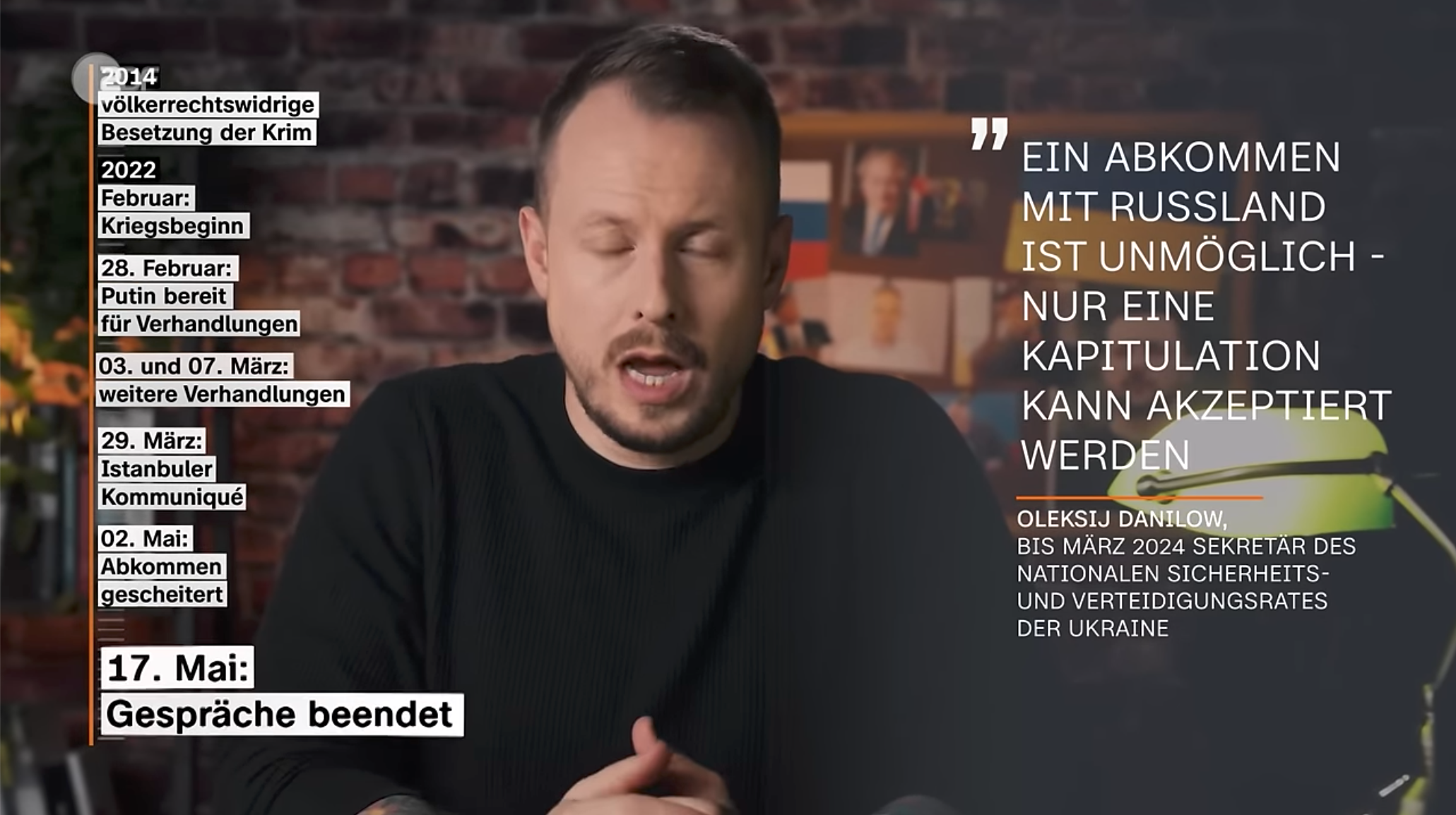
17. Mai 2022 Gespräche beendet - Oleksij Danilow (bis März 2024 Sekretär des Nationalen Sicherheits- und Verteidigungsrats der Ukraine): “Ein Abkommen mit Russland ist unmöglich, nur eine Kapitulation kann akzeptiert werden”
Und ZDFheute widerspricht damit Sabine Adler (langjährige Ost Europa Expertin Deutschlandfunk) am 04. April 2024:
[…] und Johnson hat in der Tat gesagt er findet Verhandlungen überhaupt nicht gut. Die Verhandlungen wurden zunächst auf Eis gelegt und dann passierte im September etwas nämlich es es geschah die Einverleibung nicht nur von den sogenannten Volksrepubliken Lugansk und Donetzk in die Russische Föderation sondern auch Cherson und Saporischschja, die noch nicht mal erobert waren und sie wissen es vielleicht oder sie wissen es nicht - was einverleibt wird hat Verfassungsrang in Russland das heißt also das ist nicht irgendwas, was da beschlossen wurde und gefeiert wurde, sondern das war der damit ist der schriftliche verfassungsmäßige Auftrag diese Gebiete zu erobern, zu erobern und da hat ZelenskiJ nicht die Friedensgespräche abgebrochen sondern er hat gesagt mit Putin verhandle ich nicht mehr!”
Gut, deutschsprachiger Journalismus, was will man machen. Quellenbelege liefern? Sie haben doch nur den Gustav Gressel gefragt, und der hatte das noch so in Erinnerung.….….….…!
Da haben sie daraus dann einen “Background Check” (Format) gemacht, net woar?
Diese Gesellschaft ist das absolut grotesk und abartigst Allerletzte.
20th of June 2024 (Nicht vom Trump thumbnail schocken lassen. :), Kurt Volker war ehemaliger U.S. Special Representative for Ukraine und U.S. Ambassador to NATO in 2008-2009):
Kurt Volker: “Almost all of the Allies leave aside Germany, the US and Hungary, all of the other allies support an invitation for Ukraine to join NATO at the Washington Summit, be an invitation to start accession talks. This is what was in the Rasmusen/Jermak working group paper which I was a part of recommending this approach for NATO, but the US is not in favor of that right now, the Biden Administration is not, nor is Germany - and of course Hungary is a special case we don’t have to go into that. Um but he [Biden, when publicly stating (against US policy) the Ukraine should not be part of Nato] was probably thinking about the pressure that they’re under now. But in my view and again this is just me I’m a private citizen I’m not representing the US government but I don’t see a way that you have a permanent peace in Europe - let alone Ukraine, but a permanent peace in Europe unless Ukraine is a part of NATO. We have to have clear lines, we have to have an absence of gray zones where Putin is tempted to start a war - uh we have to bring Ukraine into NATO as part of the strategy for restoring peace in Europe.”
Context:
Alina Polyakova (President and CEO of the Center for European Policy Analysis (CEPA): I think that signals to me that there is growing agreement that the only way that we can manage Russia is by going back to the Cold War era strategy of containment, that begins first, defeating Russia in Ukraine and second, reestablishing deterance by denial in Europe that means hardening the Eastern flank first and foremost. Third hardening the soft targets of Russian influence across the globe - uh influence operations in the information space, cyber operations that the Russians have become very sophisticated at, pushing back against Russia’s use of PMC’s [private military contractors] to prop up authoritarian governments across the globe and undermine democratic leadership - and fourth, undermining Russian dominance in its former empire, because as long as we have so-called grey zone States a horrible term but, non-allied states that are not part of NATO that are not part of the EU in the European continentthis is what provides fodder for Russian aggression so Moldova is very much under threat as we speak, certainly Bellarus has already become a vassel state of Russia and then we have of course Georgia and the other countries of the Caucasus as well.
[…]
And Russia will come back for NATO.
Hanno Pevkur, Minister of Defence of the Republic of Estonia (30.05.2023):
“What Russia wants to achieve, the political goals, let’s be honest - and they, these political goals of Russia have never changed, they want to have a grey-zone between Russia and NATO, they want to have a control over this grey-zone and this is what they want to achieve. And they want to have some “security guarantees” for themselves, sorry this is not the Free World and this is what Ukraine is fighting for at the moment, that they are fighting for - the Free World and rule-based world and this is why we support Ukraine so this is obvious and then this is why we can never accept this approach of Russia, looking at international law.”
See: [Great and impartial] Friends of Ukraine Roundtable #2
Vlad Vexler of course also widely known for publicaly ridiculing Chomsky -
[Only legit, with great and impartial blue skies over yellow sunflowerfield background.]
Because Chomsky stated that Selenskyj was open to peace negotiations, which obviously wasnt true because according to Vlad Vexler Selenskyj was fighting for the mere survival of Ukraine. Except that it was. (See NYT as of June 15th 2024).
With Vlad Vexler you then get presented this in this way:
Putin’s actions are destroying Russia’s future and increasingly odds that Russia may not exist at all and there isn’t even a more striking Omission in that argument and that is - Ukrainian agency since 2014! Ukraine has come together in a Civic Bond powered by anti-colonial sentiment and it’s only an ungrounded newspaper clipping approach to political understanding that could lead Norm Chomsky to say that Ukraine wants peace more than weapons.
For reference, the Interview Vlad Vexler quotes Chomsky from (and underlies with sinister music) was held in May 2022 - when according to Simon Shuster - you know - that Simon Shuster:
Simon Shuster is a senior correspondent at TIME. He covers international affairs, with a focus on Russia and Ukraine.
Selenkyjs view still was that the Ukraine needed to talk to Putin - to prevent a wider war.
“He also said at the time, days after the Butscha massacre was discovered in early April of 2022, he suggested that Putin might not be fully aware of the warcrimes that his soldiers are committing. And we still need to talk to Putin.
Quite quickly, but certainly over the course of the next weeks that followed, his views, evolved partly under the influence of his advisors. You know this is -- like any administration there are different opinions, and they were discussing what to do, what should be our position in terms of negotiations and -- the possibility of talking to Putin. Is he a monster, is he a statesmen, what is he?! A dictator. And their views evolved quite quickly [but certainly over the course of the next weeks], to the point where I think by the start of summer certainly Selenskyj had decided, that - NO, it is not possible to talk to Putin. (and thats 81 days after Butscha, which became known on April the 1st 2022.)”
src: click (Simon Shuster at the Atlantic Council)
Where at 3min20 in there exists this wonderful passage:
Sprecher: “Seit der Besetzung der Krim 2014 bittet die Ukraine die USA ihr Javelin Panzer-Abwehrraketen zu liefern. Präsident Obama lehnt zuerst ab, weil er eine Eskalation der Spannungen mit Russland befürchtet. Nun [20.06.2017] legt Poroschenenko Trump seinen Wunsch vor.”
[Context: This was the aformentioned “wish” in November of 2019, six months after the Poroschenko presidency, in the early stages of the Selenskyj presidency:
24.11.2019
The aid, including counter-artillery battery radar, night-vision gear and patrol boats, has since [in the later parts of the Trump administration] been unfrozen and is making a real difference to Ukrainian forces fighting Russian-backed separatists in eastern districts.
But it is the Javelin which appears to be a game-changer, Ukraine’s defence minister told CBC News.
“In certain areas, they can make a critical difference,” said Andriy Zagorodnyuk.
Fiona Hill: “Poroschenko schwitzte buchstäblich und wirkte sehr nervös. ich erinnere mich genau an seinen Gesichtsausdruck als er hereinkam - er war sehr beklommen denn für ihn stand viel auf dem Spiel.”
Poroschenko: “Damals gab es bereits die russische Besatzung. Die Krim war besetzt und der Donbas war besetzt.”
H. R. McMaster (National Security Advisor, Trump): “Der Präsident nahm Poroschenko sehr freundlich auf. Er war ein erfolgreicher Geschäftsmann genau wie Trump und auf der Ebene verstanden sie sich.”
Poroschenko: “Ich sagte: Mr President wir brauchen tödliche Waffen. Javelin ist eine sehr wirksame Panzerabwehrrakete.”
H. R. McMaster: “Präsident Poroschenko gelang es Trump die Auswirkungen der russischen Besatzung auf die Ukraine darzulegen. Präsident Trump erkannte die Bedrohung und die Notwendigkeit der Abschreckung”
Poroschenko: “Als ich das Oval Office verließ, war ich wie beflügelt, denn Präsident Trump hatte mir das Javelin System zugesagt. Das war ein großartiger Tag.”
Sprecher: “Doch die Realität sieht anders aus. Als er zwei Wochen später zum G20 Gipfel anreist, hat Trump den Vertrag noch immer nicht unterzeichnet hier soll er Putin erstmals persönlich begegnen.”
Fiona Hill: “Wir erhielten Hinweise von der russischen Delegation, dass Präsident Putin Waffenlieferungen an die Ukraine, vor allem Javelin Raketen sehr kritisch sehen würde.”
John Kelly (Secretary of Homeland Security, Trump): “Der Präsident war sich der Tatsache bewusst dass eine Unterstützung der Ukraine Russland verärgern würde und er wollte wohl oder übel gute Beziehungen zu Putin aufbauen.”
John Kelly: “Trump hegte die trügerische Hoffnung gute persönliche Beziehungen zu Putin seine Haltung mäßigen würden.”
Sprecher: “Das nationale Sicherheitsteam versucht Trump zu überzeugen sein Versprechen an Poroschenko zu halten.”
John Kelly: “Ich machte klar, solange es keinen Angriff gegen die Souveränität der Ukraine gab, werde kein russischer Panzer von Javelin Raketen getroffen und auch kein russischer Soldat von Munition aus den USA.”
H. R. McMaster: “Mein Argument war dass Schwäche Russland provoziert ich glaube Russland hat die Ukraine 2014 angegriffen weil Putin glaubte die Amerikaner würden ohnehin nicht reagieren, deswegen war es wichtig die Verteidigungsfähigkeit der Ukraine die Abschreckung zu stärken. Trump stimmte zu.”
Sprecher: “Ende 2017 gibt Trump den Befehl zur Lieferung tödlicher Waffen [Javelins, the Gamechanger in the Donbas] an die Ukraine.”
Andrej Kelin (former Ambasador of the Russian Federation to the UK): “Aus unserer Sicht hatte Trump mit dieser Entscheidung eine rote Linie überschritten, er wurde dazu überredet Javelin Raketen zu liefern und das war nur der Anfang der Aufrüstung der Ukraine. Der Anfang eines sehr gefährlichen Wegs.”
John Bolton (National Security Advisor): “Putin betrachteten die Lieferung schwerer Waffen an die Ukraine als Bedrohung. Er hielt die Ukraine für ein illegales Staatsgebilde das der Sowjetunion dass Russland zu Unrecht entrissen worden war. Der Zerfall der Sowjetunion war für Putin die größte geopolitische Katastrophe des 20 Jahrhunderts.”
Chomsky of course being the intellectual that then promptly finds out through literary analysis - and promptly also makes public - that this concession -
John Kelly: “Ich machte klar, solange es keinen Angriff gegen die Souveränität der Ukraine gab, werde kein russischer Panzer von jevelin Raketen getroffen und auch kein russischer Soldat von Munition aus den USA.”
- was violated by Ukraine in November of 2021 (or slightly earlier), trying to free the Donbas - referencing this article:
Ukrainian Troops Have Been Firing American-Made Javelin Missiles At Russian-Backed Forces
The disclosure that Ukrainian troops have been employing Javelin missiles in combat comes as fears grow that Russian could launch a new invasion.
JOSEPHTREVITHICK
POSTEDONNOV 22, 2021 6:18 PMEST
The head of Ukraine’s top military intelligence agency has confirmed, for what appears to be the first time, that Ukrainian troops in the country’s eastern Donbass region have fired American-made Javelin anti-tank missiles at Russian or Russian-supported forces. These missiles, along with other advanced weapons that the Ukrainian military has acquired in recent years, such as Turkish Bayraktar TB2 armed drones, would be important factors in the outcome of any future major military confrontation with Russia. Fears are growing that the Kremlin could at least be prepared to launch a new, large-scale invasion of eastern Ukraine as early as January.
Ukrainian Brigadier General Kyrylo Budanov talked about the operational use of Javelins as part of a recent interview with Military Times, which he conducted through an interpreter. Budanov, who runs the Chief Directorate of Intelligence of the Ministry of Defence of Ukraine, also known by its Ukrainian acronym GURMOU, used the opportunity to call for more help from the U.S. government as he sounded like the alarm about the Kremlin’s unusual deployments of large numbers of military units to areas opposite Russia’s borders with Ukraine in recent weeks.
The second big deployment of russian army units on the ukrainian border happens from Oktober to mid November 2021. US delivered Javelins were likely used in Donbas, by the Ukraine, starting from October 2021.
The US then promptly covers this up and two months later allows the Ukraine to distribute Javelins throughout Ukraine more freely - and use them - even without an official Russian invasion being underway (but that was a change from their previous position, that was only implemented in december of 2021):
04. 12. 2021 (Politico) - Can Ukraine deploy U.S.-made weapons against the Russians?
There are no geographic restrictions on the deployment of the missiles, which means Ukrainian forces can transport, distribute and use them any time.
As Russia amasses the highest number of troops on Ukraine’s border since 2014, the question for Kyiv now becomes: Is it time to start putting U.S.-made weapons in the field?
Ukraine purchased 210 Javelin anti-tank missiles and 37 launchers from the U.S. in 2018 for approximately $47 million, and the State Department approved the sale of a second batch of 150 missiles and 10 launch units in late 2019. But with them came a variety of restrictions on their usage, including that they be stored in western Ukraine, far from the front lines.
The Javelin is a shoulder-fired missile that uses infrared guidance to target and destroy an enemy tank from up to 3 miles away. Former President Donald Trump first approved the sale of the weapon to Ukraine after his predecessor, former President Barack Obama, refused the request, due to fears that providing lethal aid to Kyiv would provoke Moscow.
Wess Mitchell, who served as the Trump administration’s top State Department official overseeing European and Eurasian affairs, noted that the Javelins and other lethal weapons are designed not for first use but to deter Moscow from encroaching on Ukrainian territory.
But while Washington urges Kyiv to use the Javelins only for defensive purposes and requires that the weapons be stored in a secure facility away from the conflict, there are no geographic restrictions on the actual deployment of the missiles, U.S. officials said, which means that Ukrainian forces can transport, distribute and use them at any time.
“Javelins are defensive weapons and the United States expects Ukraine to deploy them responsibly and strategically when needed for defensive purposes,” said Pentagon spokesperson Mike Howard.
If the Javelins were to be moved, it doesn’t necessarily mean they’d be used — in Kyiv’s estimation, the threshold for actually firing the weapons has not yet been met, according to two Ukrainians familiar with the discussions. The red line, they said, would be if Russian tanks crossed over into Ukrainian territory.
The current Russian movement in Eastern Europe is exactly the kind of scenario the Javelin sale was designed to counter, said two former senior U.S. defense officials familiar with the agreement.
But while Washington urges Kyiv to use the Javelins only for defensive purposes and requires that the weapons be stored in a secure facility away from the conflict
- but also this was in play at that time:
John Kelly: “Ich machte klar, solange es keinen Angriff gegen die Souveränität der Ukraine gab, werde kein russischer Panzer von jevelin Raketen getroffen und auch kein russischer Soldat von Munition aus den USA.”
So ARTE of course doesnt catch this. But Chomsky does.
So then he gets publicly character assassinated by Vlad Vexler, whom ARTE then also promptly features in their “Truth and Propaganda” Documentary.
As that doesnt work, Chomsky now really gets on the US Propaganda shitlist, getting essentially the shouting down by an idiot treatment - by a Radio Free Europe/Radio liberty employee:
You know - Radio Free Europe/Radio Liberty, the only us american broadcaster that is publicly funded by the US government and strangely enough is only broadcasting abroad - but in the past months, also strangely enough finally had secured enough funding to also expand to romania:
22th of June 2024 here at 24 min in:
Jamie Fly (Former Radio Free Europe / Radio Liberty CEO):
“I think it’s important uh context, historical context for the US Romanian relationship, when I was president of Radio Free Europe/Radio Liberty, we returned uh to Romania, relaunched our Romanian language service - I had many occasions where I was able to visit uh Bucharest and the thing I think Americans need to understand is Romanians LOVE Freedom uh and it’s uh now in their uh DNA uh and that was an important bond given the work of Radio Free Europe uh during the Communist era, and it was - I had this experience in many countries I operated in, but Romania was perhaps the most fervent. When I went to Romania as president of Radio Free Europe, people would describe to me with tears in their eyes the role that American Broadcasting played during a very dark uh period and uh were always asking us to do more there and I was excited that we were able to to return during my tenure um so and I think that relates to why Romania [!] now has staked out such a clear leadership role uh in the region,advancing uh the values that uh us programming certainly represented during that time so it’s it’s great to be uh with you, so maybe I’ll start broadly just with the state of the US Romania uh relationship which you kind of touched on at the end but I was struck by your note that US engagement needs to be basically reliable, predictable and not to get partisan or - not to say make you say anything too undiplomatic but um the US is always distracted uh and even though the US is very engaged uh in support of Ukraine right now, China is uh a growing challenge drawing attention.”
So then Chomsky and I get a stroke.
Chomsky for real, and recovering:
Noam Chomsky Leaves Hospital After Suffering Stroke
The world-renowned linguist and dissident Noam Chomsky was discharged from a São Paulo hospital in Brazil on Tuesday as he continues to recover from a stroke last year that impacted his ability to speak. His wife Valeria recently told a newspaper in Brazil that the 95-year-old Chomsky still follows the news and raises his left arm in anger when he sees images of Israel’s war on Gaza. False reports that Chomsky had died went viral online on Tuesday.
Diese Webseite verwendet Cookies um die Nutzungserfahrung für seine Besucher zu verbessern. Bitte informiere dich bei Gelegenheit darüber wie sich Cookies auf deine Privatsphäre im Web auswirken.