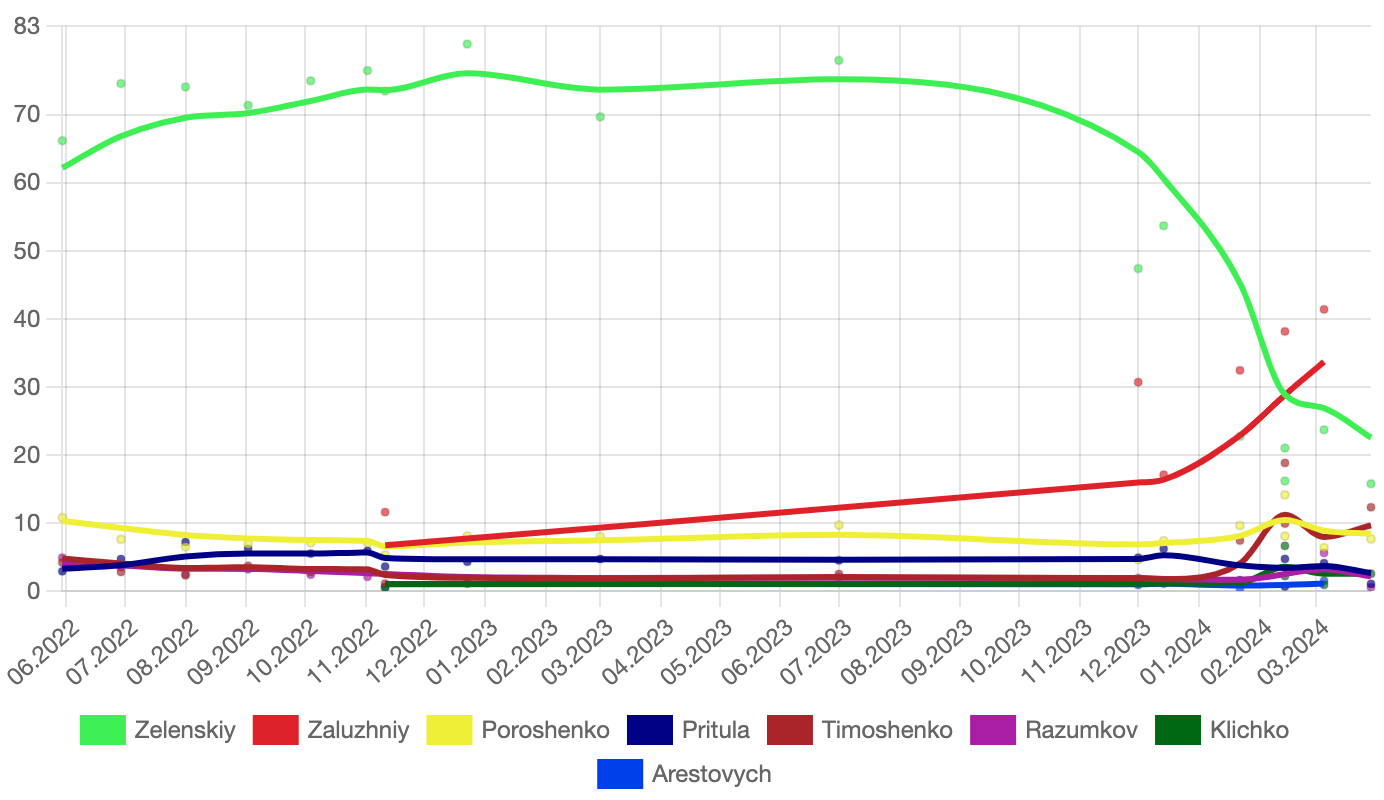
Since the begining of 2024, Valerii Zaluzhniy consistantly polled 10-22 [!] percentage points higher in the politicians ratings, until the LLI poll of March 2024, where suddently he was gone. Not listed as an option anymore.
Well you say, thats only one person, that couldnt possibly represent the Zaluzhniy partys potential polling results!
Have fun as the new ukrainian ambassador to the UK, I’d say.
Yes, of course you say - but thats one person - I mean Selenskyjs popularity ratings couldnt possibly represent the parties potential polling results.
Gut, das müssen die deutschsprachigen Nachrichtenmedien bei ihrer “warum liefern die US denn nicht” Berichterstattung und natürlich auch generell nicht bringen, ich meine das würde die Bevölkerung überfordern.
Propaganda hat aber wieder niemand entdeckt.
Wait, wait - when was the Davyd Arakhamiia Interview broadcast that showed images of the head of the SN party with children and a bride and a groom, while telling the ukrainien audience “of course we cant hold elections this year”? You know this one:
edit: Es gibt aber natürlich auch wieder gute Neuigkeiten:
Türkei stellt Handel mit Israel ein
Die Beziehungen zwischen Israel und der Türkei sind wegen des Kriegs in Gaza angespannt. Nun will Ankara Im- und Exporte zwischen den Ländern stoppen. Israels Außenminister Katz reagiert harsch.
Because the article only shows data from 2020. Referencing a ukrainian source as the primary source for the article (Footnote number 1) thats gone 404 by now.
The article is not flagged as problematic because of that. By Wikipedia statutes it should be (main source is missing).
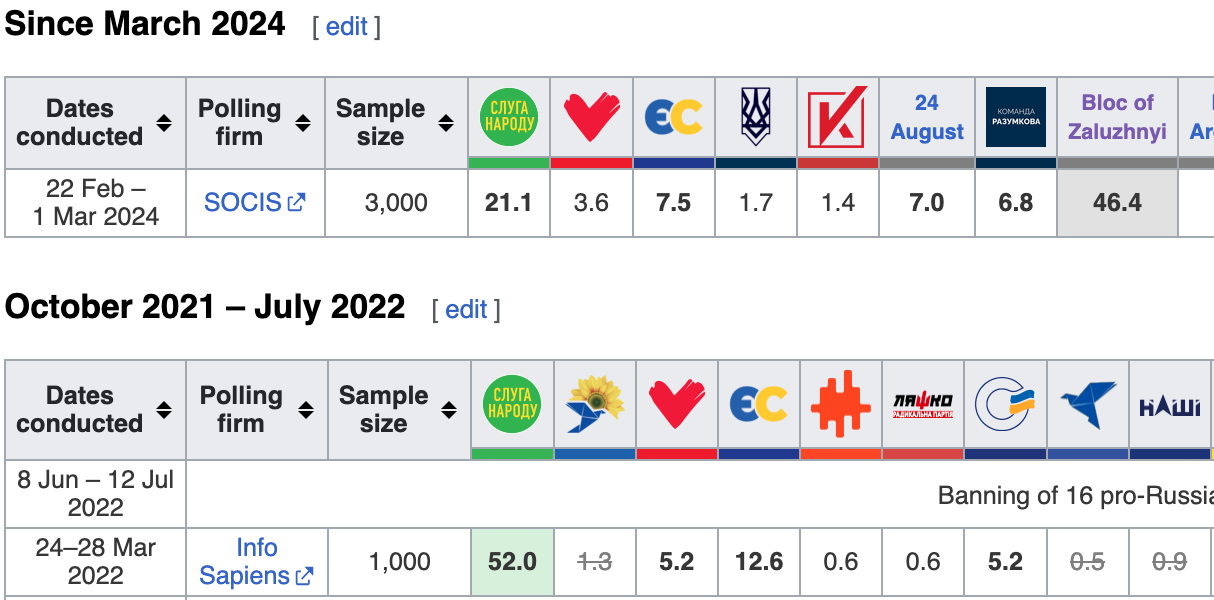
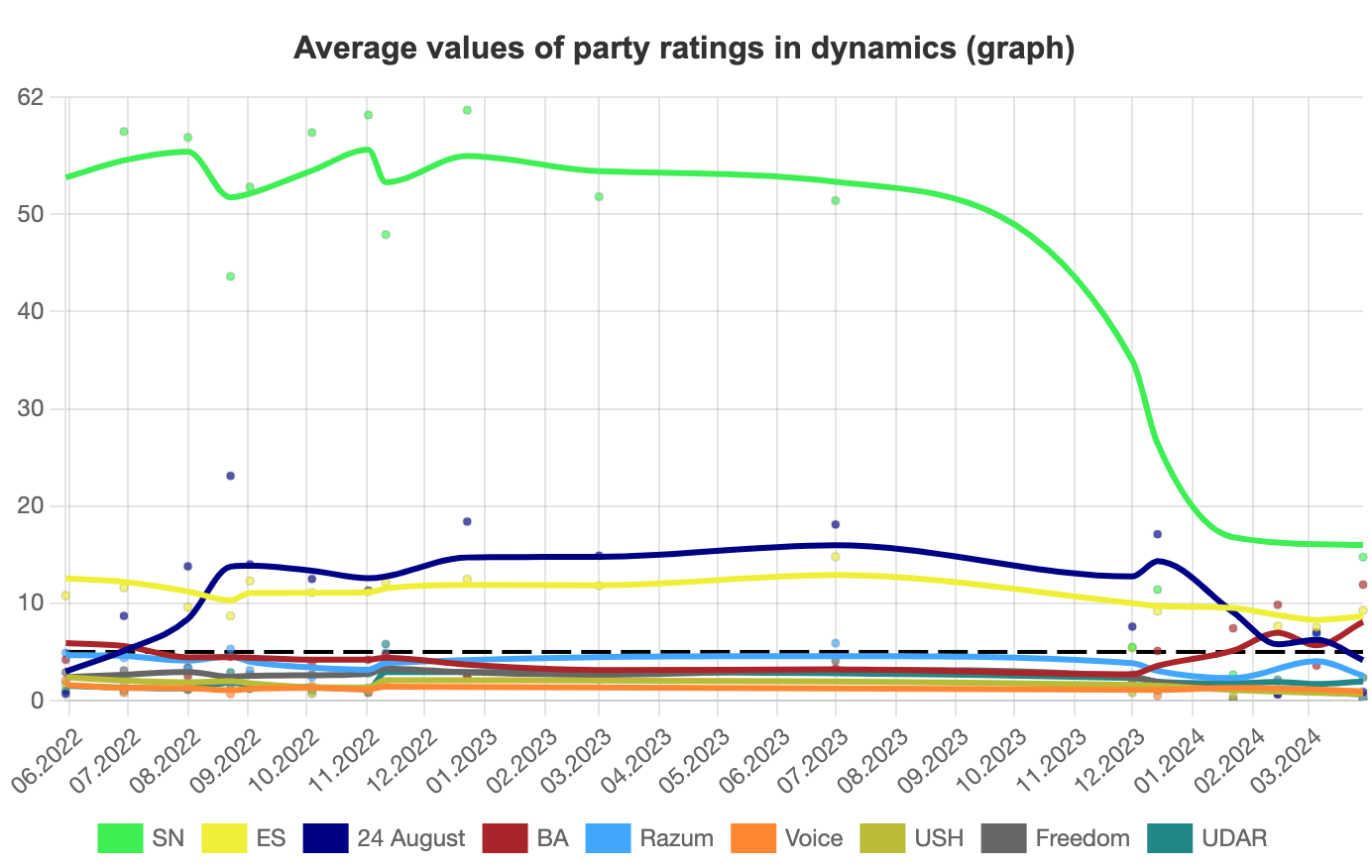
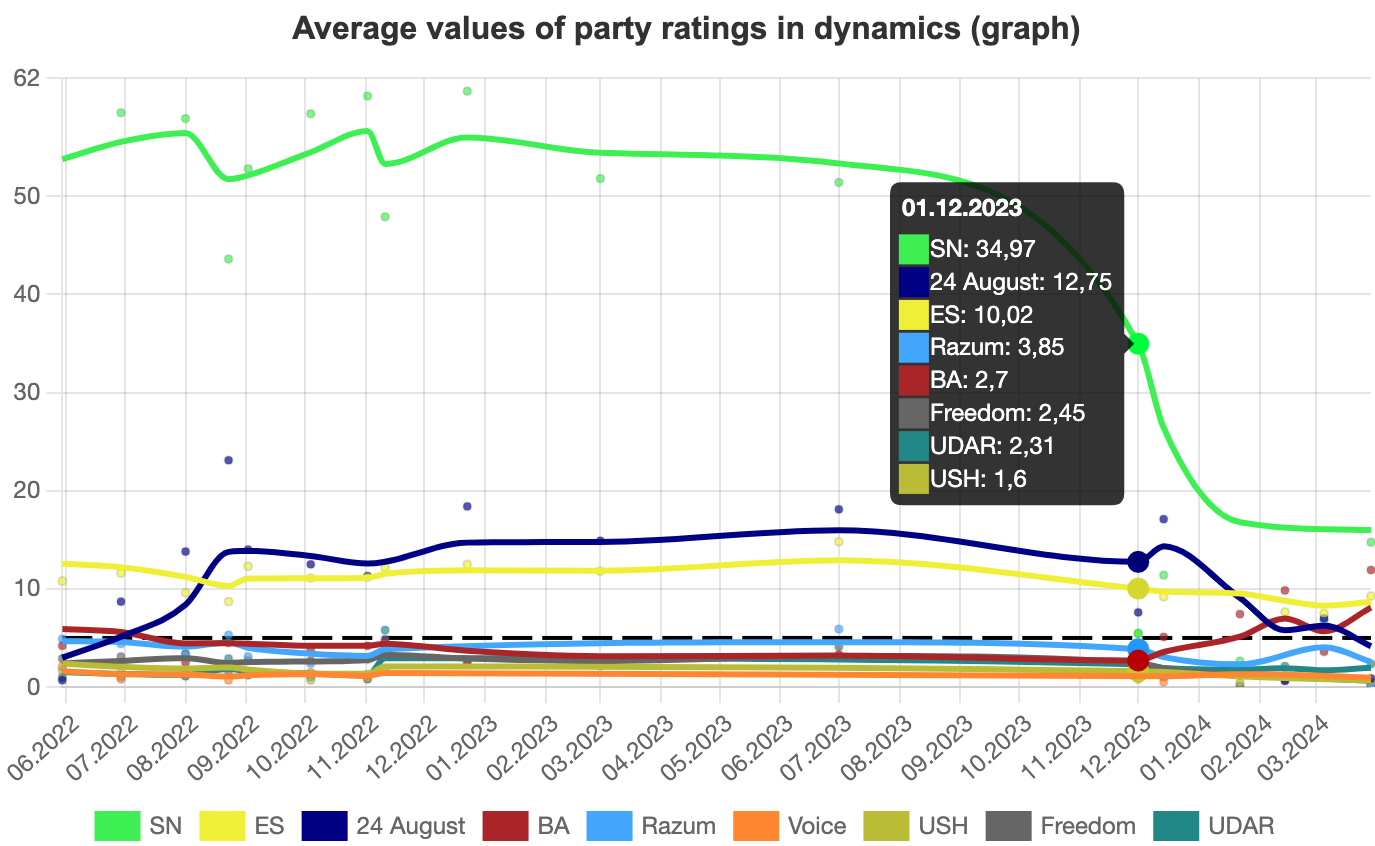
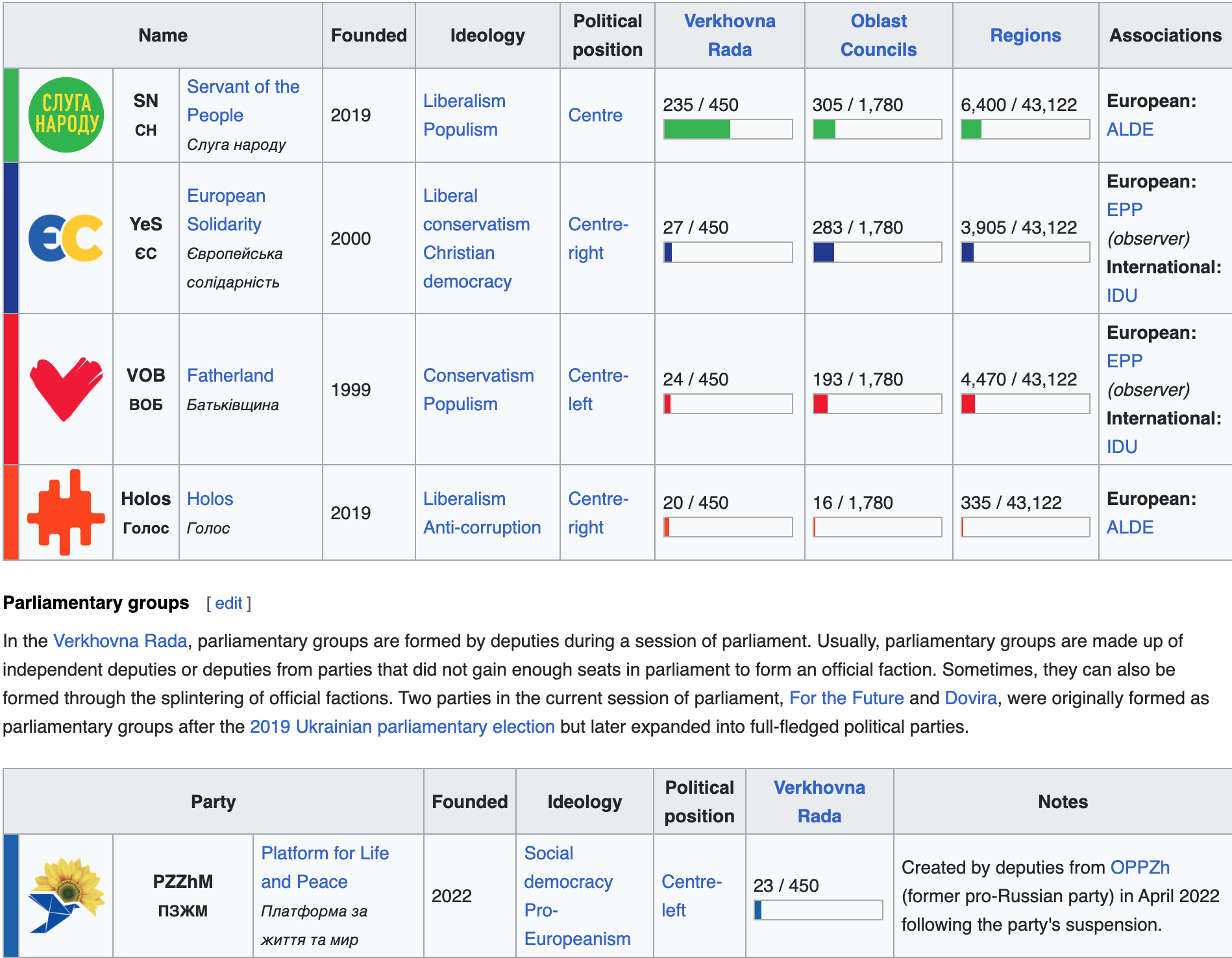
But dont you worry, all is well in the Ukraine of 2020 - where you dont see the 27,3 percentage points drop of SN (Sluha narodu (Слуга народу, zu Deutsch Diener des Volkes)), compaired to 2019 you see in current polling:
Oh, and since the war started, the most edited paragraph was “Mergers and bans (2011–present)”.
Because we all know the war started in 2014, so you dont need an extra category for that. Just one paragraph will do…
On 20 March 2022, President Volodymyr Zelensky announced a ban on 11 political parties for alleged ties with Russia: Opposition Platform — For Life, Party of Shariy, Nashi, Opposition Bloc, Left Opposition, Union of Left Forces, Derzhava, Progressive Socialist Party of Ukraine, Socialist Party of Ukraine, Socialists and Volodymyr Saldo Bloc.[72]
Gut, Propaganda hat wieder niemand entdeckt, was will man machen…
edit: Found it!
If you search for “Opinion polling for the next Ukrainian parliamentary election” you’ll actualy find an up to date entry in the english speaking Wikipedia --
No - no, no joke, thats the actual name of the Wikipedia entry.
So everyone that searches for “parties ukraine” gets the data from 2020, but everyone that searches for “opinion polling for the next Ukrainian parliamentary elections” gets the up to date data!
Neat!
So how many people would know to search for “opinion polling for the next Ukrainian parliamentary elections” in Ukraine…
edit: Oh wait, I lied, the data in the graph there stopped in April of 2022.
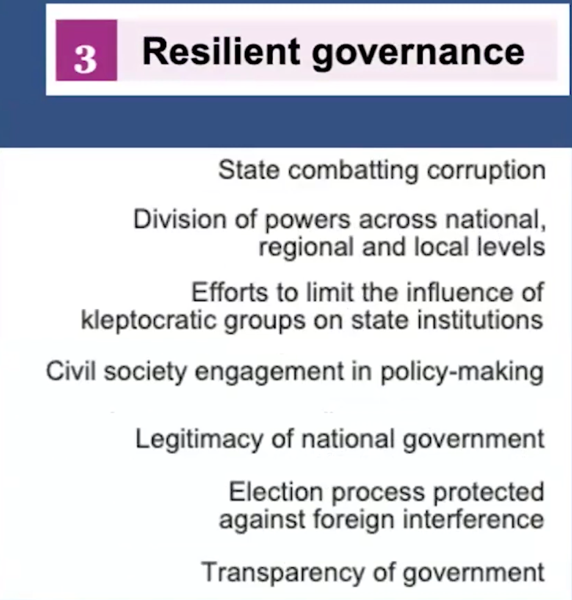
Orysia Lutsevych: I just wanted to uh to to start with this of course image that many of you may know, recognize um some of you don’t but you know where is resilience on on this picture and it really is right here um in the um um trying to uh um uh it’s right here uh this little rooster from um Ukrainian ceramic Factory near Kiew that survived the bombardment of building in banka uh that became by the choice of ukrainians themselves a symbol of resilience and when Natalie you were asking me how do we define resilience what is it if you look at this rooster you may say it’s actually surviving a violent shock is to be able to stand in um a times of um assault on your uh very existence right uh but it is also capacity to prepare for the future disruption right, it’s something that Society should be thinking about and actually recover from shock recover from shock possibly even stronger and that is I would say the highest level of resilience of any society or an individual than before it’s learning from this um violent experience to fortify uh for your systems uh your response to Future adversity and um that is why you know we we were trying to think whether there could be a comprehensive system that could capture what it is that we want to see in the society that is resilient and and of course like you like you said perhaps Ukraine became even like this victim of resilience where a lot of people you know lean back on this hoping that this will help carry out Ukraine throughout the war and um our task in Chatham House, when we look at this concept was to try to suggest some pillars where if we look at the society as a whole and it’s not just as individual how we could look at some of the qualities uh that would tell us how how strong or weak um a certain community is and these are the five pillars we’re looking from human security to cognitive resilience and each of those pillars has seven indicators so overall - there are 35 indicators, we did not test this methodology on Ukraine I would like to make it very clear this was tested in Moldova um it was designed uh to be under the threshold of full scale kinetic War it’s a society that feels pressure from outside to undermine its um its um course and it’s for those sharp powers of malign influence who want to especially in our region is Russia so uh we’ve surveyed um experts independent experts non-government experts about how they see this in Moldova and this is just to illustrate the outcome of this uh based on this survey where you could see in Moldova people feel that human security remains quite vulnerable - weak whereas economic agility remains quite, you know is is more solid so how can we use this and I do believe that when we are looking at Ukraine right now the country at War we can um to a degree um apply this framework and these indicators under each of those criteria so I will just literally briefly say if we’re looking at human security what really helped Ukraine from my understanding is said some communities were prepared they had tabletop exercises not all of them and actually covid cooperation around pandemic helped develop some of these networks I will not go one by one I’ll just mention some of them that I think something to keep in mind for the future if we look at Social cohesion this remains one of the big concerns at the moment with the war and its impact on people um and um for example the way in which um protection of rights of vulnerable minorities of of people impacted by War from veterans to Children uh and the conflicts between those who are fighting who are not fighting who are abroad who are in Ukraine is something that you know risks undermining Ukrainian resilience but overall the the purpose of the mission in Ukraine remains very strong if we look at the governance what we hear and see from uh Ukraine is there’s the real concern about combating corruption it remains an issue where people feel that actually 63% of ukrainians believe it’s a priority because it’s one of those um areas that is wasting resources and also builds a a feeling of Injustice uh in Ukraine so you know if if if we look underneath the governance it’s one of those areas where Ukraine needs much more effort but of course on the upside we look at the transparency of governance governance we’re looking about digitalization of services here Ukraine is a Pioneer and actually being able to deliver a lot of services online in an open way um helped ukrainians in crisis on the go to be able to access services and that that contributes to Ukrainian resilience.
Wait what?!
Beware the rooster?!
Thank you Orysia Lutsevych, deputy director of the Russia and Eurasia Programme and head of the Ukraine Forum at Chatham House.
Of course Orysia Lutsevych is not only a valuable member of the Ukraine Forum at Chatham House, she is also the most valuable connection for feeding ukrainian propaganda straight into the DGAP (Deutsche Gesellschaft für Auswärtige Politik)
Den üblichen Sager “Propaganda hat wieder niemand entdeckt, kann ich diesmal nicht bringen, denn die Aufgabenstellung bei Chatham House war es ja Durchhaltepropaganda zu brainstormen.
Dass dabei nur gequirlte Scheisse rauskommt, liegt an den beteiligten Personen.
Die aber sonst noch passgenau die Deutsche Gesellschaft für Auswärtige Politik briefen.
Einen Conflict of Interest hat natürlich noch niemand entdeckt.
Wir halten fest: Bei Chatham House wird jetzt bereits Durchhalte Propaganda und dafür nutzbare Symbolik für die Ukraine gebrainstormt, nur die deutschen Medien hätten immer noch keine Propaganda entdeckt.
Dass die ukrainische Propagandistin die auch für die Ukraine/DGAP Kommunikation abgestellt ist damit komplett überfordert scheint, ehrt sie beinahe schon.
Gute Nachrichten, ZDF Heute hat wieder einen neuen unbedarften Moderator - und natürlich wieder den Chef-Propagandisten der Münchner Sicherheitskonferenz, Nico Lange im Angebot:
“Die Ukrainer könnten ja bei GPS Signalen “Frequency hopping” machen um den russischen Störsignalen zu entgehen.”
BWAHHAAHAHHAHHHAHA. Ah… Aha.
“Oder Softwareupdates!”
Ahhh…
Also -
Die Satellitensignale der globalen Satellitennavigationssysteme (GNSS) in den Frequenzbereichen 1164 - 1215 MHz, 1215 - 1300 MHz und 1559 - 1610 MHz, wie z. B. NAVSTAR-GPS, GALILEO, GLONASS […]
Meine Güte, ob die Russen das schaffen werden eine Frequenzbreite von drei mal beinahe 100Mhz zu stören?! Ehm. Ja.
Und Frequency hoppen will er!
Also - GPS sendet Uhrzeit. Flugkörper trianguliert im Millisekundenbereich. Rakete hoppt Frequenz. Spoofing schickt Uhrzeit als Signal mit 2 Sekunden Verzögerung als stärkeres Signal auf der bekannten Frequenz - Flugkörper korrigiert nach rechts und jetzt?
Moment, Moment ich habs!
GPS sendet Uhrzeit. Flugkörper trianguliert im Millisekundenbereich. Störsender stört Transmission. Rakete hoppt Frequenz. Bekommt keine Uhrzeit. Flugkörper kann nicht korrigieren und fliegt gerade aus.
Bestechend genial. Und gefixt wird natürlich per Software Update! Und nach so einem Software Update kann so ein GPS Empfänger - die selben Frequenzen empfangen wie vorher. Weil Hardwarelimitation. GPS Signale sind keine Zwei-Wege-Kommunikation, nicht verschlüsselt, und emitieren auf bekannten Frequenzen.
Jetzt aber - also richtig genial - die Raketen hüpfen aus dem bekannten Frequenzspektrum heraus und erhalten dann GPS Uhrzeit Signale - über ein anderes Frequenzspektrum, für das wir repeater über die 300km zum Ziel aufgestellt haben? Oder mit Internet Satelliten Uplink Latenz? Nein, jetzt hab ichs aber, über Wifi! Mit 50Meter Genauigkeit im Stadtbereich! Oder über 5G mit Packet loss! Über Triangulation von Mobilfunksendemasten!
Der hats einfach drauf der Sicherheitsexperte der Münchner Sicherheitskonferenz.
Das ZDF darf wie immer von Profis lernen.
Aber wie macht das eigentlich die US Armee?
In response to these vulnerabilities, the Space Force is hardening what it calls the “GPS enterprise” that includes three segments: satellites in space, the ground control system and user equipment. “We are looking at how we will continue to evolve this architecture into one that is more robust and resilient than it is today,” said Col. Ryan Colburn, director of the spectrum warfare division at the Space and Missile Systems Center.
DoD uses a number of PNT [Position Navigation Timing] technologies to complement GPS or to serve as backup when GPS is degraded or unavailable.
Some military platforms use onboard sensors to track their position and keep time without the use of an external signal. Other PNT technologies use external sources of information other than GPS to determine the position of a platform. Military combat aircraft use GPS paired with inertial navigation systems so if GPS goes out the pilot can still complete the mission. [Yeah, and how do you know when to kick in the inertia based system, when the signal is spoofed…] Inertial sensors and clocks allow a platform to identify its position and keep track of time without an external signal like GPS. Other technologies rely on celestial and magnetic navigation to determine position. [Marschflugkörper, schau auf die Sterne, schau auf die Sterne und schau auf den Mond, dein Leben, ist ein Streben, in die Ferne die keiner bewohnt…] There’s also a growing number of satellites in low Earth orbit that transmit PNT information. [Ah, there is Nico Langes “Softwareupdate”. 😉 ]
None of these alternative PNT technologies, however, has reduced the U.S. military’s dependence on GPS, said the Government Accountability Office in a May report.
“Alternative PNT does not appear to be a particularly high priority for DoD,” said Karen Howard, GAO’s director of science, technology assessment and analytics.
Ich find ja gut, dass ZDF heute immer Experten interviewt, und nie Propagandisten. 🙂
edit:
COUNTERMEASURESTOMAINTAINGPSANDPNTINTEGRITY
The U.S. government has undertaken several significant initiatives to improve the resilience and reliability of its GPS-based systems. The foundational step of these efforts is the GPS modernization program, an ongoing, multibillion-dollar effort to upgrade the system’s features and performance. Along with new satellites, the program includes the deployment of new ground stations. The upgraded infrastructure will add navigation signals for both civilian and military users and will enhance the system’s accuracy and availability.
The system employs M-code, a new military signal in the L1 and L2GPS bands [L1, at 1575.42 MHz, and L2, at 1227.6 MHz] that is intended to improve resistance to spoofing and jamming. In addition to a wide-angle antenna for broad distribution of the signal, the new satellites can deliver M-code to specific locations via spot beam transmissions.By using high-gain directional antennas to aim the signal at a specific region, the satellites can create a much more powerful signal that resists jamming.The M-Code signals also are encrypted using the Modernized Navstar Security Algorithm, which enables military GPS receivers to detect and reject false signals.
The encryption of military GPS signals prevents spoofing. Many GPS receivers still utilize the Selective Availability
Anti-Spoofing Module (SAASM) technology to address jamming and spoofing.
As the GPSIII constellation is launched, U.S. forces will purchase equipment compatible with M-Code signals.But while M-Code provides an effective defense against spoofing, it is still vulnerable to jamming attacks. Other possible measures to protect GPS-based PNT capabilities include Interference Detection and Mitigation solutions. These solutions isolate an anomalous signal that is jamming GPS and replaces it. They use different tools to augment the GPS signal or implement another PNT solution.
Another option is to outfit GPS-enabled systems with anti-jam antennas. [MOUNTTHEDIRECTIONALANTENNAARRAYTOTHECRUISEMISSILE!] These antennas block RF signals coming from near the horizon, where jamming signals typically originate. Instead the antenna’s beam is focused at the zenith, where GPS satellites are located.
Controlled Reception Pattern antennas, or “smart” antennas, can be electrically steered to focus narrow beams directly at GPS satellites, mitigating the denial of GPS signals. Further, smart antennas can track GPS satellites as they move across the sky. While these antennas provide effective defense against jamming, they are larger and more expensive that standard GPS antennas.
Other technologies available today include in-line protection systems. “These don’t require us to physically change our antenna or the GNSS receiver that’s downstream,” Hohman says. “This could be very powerful for applications where it costs a lot of money to update an antenna or to update a GPS receiver. Instead, you could just stick a device in between the antenna and the existing receiver and provide some level of additional protection. [signal decryption, cant use normal GPS for that] That could be a very attractive capability for platforms that aren’t looking to do full renovations on their system.”
Alternative navigation signals offer another option to address jamming and spoofing attacks. The Satellite Time and Location service, which was launched in 2016, uses Iridium satellites in low-earth orbit to provide an encrypted signal for positioning and timing. The signal is 1,000 times stronger than GPS, making it more resistant to jamming and spoofing, and is accurate to 30-50 meters. This compares to an accuracy for GPS of 30 centimeters. [Ah, the power of latency… 🙂 ] Although it doesn’t offer the same precision as the Air Force satellites, this service can provide a reference that enables the detection of GPS spoofing. Further, it can be employed in combination with other measurements to provide navigation capabilities when GPS is denied.
== Shit, the ukrainian minister responsible for helming the department responsible for returning ukrainian children to the Ukraine is complaining, that there are so many cases, mentioning numbers about 100x lower than the officially announced number of children that were kidnapped by russia.
== SHIT, Israel killed nine times more children than russia kidnapped in 2 years of war in only three months - no one ever talk about that --
see also:
Sieben Monate nach Beginn des Krieges zwischen Israel und der Hamas schätzen die Vereinten Nationen die Menge an Trümmern auf 37 Millionen Tonnen. “Im Gazastreifen liegt mehr Schutt als in der Ukraine”, sagte Mungo Birch, Leiter des UNO-Minenräumdienstes (UNMAS), vor Journalisten in Genf. Dabei sei der Gazastreifen nur 40 Kilometer lang und die Front in der Ukraine fast 1.000 Kilometer.
Diese Webseite verwendet Cookies um die Nutzungserfahrung für seine Besucher zu verbessern. Bitte informiere dich bei Gelegenheit darüber wie sich Cookies auf deine Privatsphäre im Web auswirken.