Doch wie weit war wirklich schon ein Friedensvertrag ausgehandelt? Zu 75 Prozent, so beurteilte es später der russische Chefunterhändler Wladimir Medinski. “Es gab keine Einigungen, und wir haben keine Punkte erreicht, wo wir einer Einigung nahekamen”, sagt hingegen der ukrainische Präsidentenberater Mychajlo Podoljak. Und: Paraphiert, also von den Präsidenten unterschrieben, war das Dokument nicht.
Ich meine, komm, wo sollte der Journalismus nachprüfen, wenn er doch viel besser brabbeln und Halbwahrheiten verbreiten kann?
Die bisherigen Leaks stammen aus russischen oder nicht nachvollziehbaren Quellen. Eine davon ist der private Nachrichtendienst von Farida Rustamowa, einer freien, aus Aserbaidschan stammenden russischen Journalistin, die am 29. März einen russischen Text veröffentlichte, den sie angeblich aus Verhandlungskreisen bekommen hatte und der seither in englischer Übersetzung um die Welt geht – als der Inhalt jenes Friedensplans, der da angeblich ausgehandelt und dann von Johnson so erfolgreich torpediert wurde.
Er umfasst zehn Punkte und man findet ihn auf Deutsch bei von der Schulenburg, Emma und sogar in einem SWP-Bericht. Es gibt damit aber einige Probleme: Auch die Financial Times behauptet, Einblick in diesen Plan gehabt zu haben, allerdings hatte ihre Version 15 Punkte. Und als Putin letztes Jahr vor Ramaphosas afrikanischer Delegation damit herumwedelte, sprach er sogar von 18 Punkten, die noch dazu von den Mitgliedern der ukrainischen Delegation damals „paraphiert“ (so sagt er auf Russisch) worden sein sollen.
Das ist wichtig, denn Verträge werden unterschrieben (mit voller Unterschrift). Paraphiert werden in der Regel einzelne Seiten, um zu verhindern, dass jemand nachträglich Seiten einfügt, die nicht ausverhandelt wurden – was Putin im gleichen Atemzug der ukrainischen Seite vorwarf. Weder Rustamowa, noch von der Schulenburg, der sie zitiert, behaupten, das Papier sei unterzeichnet worden. Selbst die russische Nachrichtenagentur Tass behauptet nur, die Ukrainer seien „bereit gewesen, es zu unterzeichnen“. Trotzdem kursiert die Mär vom unterzeichneten Friedensvertrag seither im Internet.
Das alles muss überhaupt nicht heißen, dass es einen solchen Text gar nicht gegeben hat oder einige oder alle verbreiteten Versionen gefälscht sind. Es gibt eine Menge anderer möglicher Interpretationen: dass unterschiedliche Versionen zu unterschiedlichen Zeitpunkten geleakt wurden und der Entwurf zunächst weniger Punkte hatte als zu dem Moment, als er paraphiert wurde (wenn er es wurde), dass einige Versionen aufgesetzt, aber dann von beiden Seiten verworfen (aber von einer Seite dann geleakt) wurden. Wesentliche Teile des Inhalts wurden anschließend von Teilnehmern beider Delegationen in Interviews bestätigt. Betrachtet man die, wird es erst so richtig interessant. […]
src: click (Berliner Zeitung -- mit einem Titel der die Kollegen vom ARD Facktenchecker aufmacht: Friedensvertrag für die Ukraine: Warum auch die ARD-Faktenchecker Unrecht haben)
Remarkably, however, the two sides continued to work around the clock on a treaty that Putin and Zelensky were supposed to sign during a summit to be held in the not-too-distant future.
The sides were actively exchanging drafts with each other and, it appears, beginning to share them with other parties. (In his February 2023 interview, Bennett reported seeing 17 or 18 working drafts of the agreement; Lukashenko also reported seeing at least one.) We have closely scrutinized two of these drafts, one that is dated April 12 and another dated April 15, which participants in the talks told us was the last one exchanged between the parties. They are broadly similar but contain important differences—and both show that the communiqué had not resolved some key issues.
[…]
In the end, it remains unclear whether these provisions would have been a deal-breaker. The lead Ukrainian negotiator, Arakhamia, later downplayed their importance. As he put it in a November 2023 interview on a Ukrainian television news program, Russia had “hoped until the last moment that they [could] squeeze us to sign such an agreement, that we [would] adopt neutrality. This was the biggest thing for them. They were ready to finish the war if we, like Finland [during the Cold War], adopted neutrality and undertook not to join NATO.”
[…]
Despite these substantial disagreements, the April 15 draft suggests that the treaty would be signed within two weeks. Granted, that date might have shifted, but it shows that the two teams planned to move fast. “We were very close in mid-April 2022 to finalizing the war with a peace settlement,” one of the Ukrainian negotiators, Oleksandr Chalyi, recounted at a public appearance in December 2023. “[A] week after Putin started his aggression, he concluded he had made a huge mistake and tried to do everything possible to conclude an agreement with Ukraine.”
[…]
In the 2023 interview, Arakhamia ruffled some feathers by seeming to hold Johnson responsible for the outcome. “When we returned from Istanbul,” he said, “Boris Johnson came to Kyiv and said that we won’t sign anything at all with [the Russians]—and let’s just keep fighting.”
Since then, Putin has repeatedly used Arakhamia’s remarks to blame the West for the collapse of the talks and demonstrate Ukraine’s subordination to its supporters. Notwithstanding Putin’s manipulative spin, Arakhamia was pointing to a real problem: the communiqué described a multilateral framework that would require Western willingness to engage diplomatically with Russia and consider a genuine security guarantee for Ukraine. Neither was a priority for the United States and its allies at the time.
src: click (Foreign Affairs)
Und jetzt noch Putin dazu:
Tucker Carlson: Sie sagen, Sie wollen eine Verhandlungslösung für die Geschehnisse in der Ukraine.
Putin: Wir hatten in Istanbul [im März 2022] ein grosses Dokument unterbreitet, das der Leiter der ukrainischen Delegation paraphiert hat. Er hat seine Unterschrift auf einige der Bestimmungen gesetzt, nicht auf alle. Dann hat er selbst gesagt: «Wir waren bereit, dieses Dokument zu unterzeichnen, aber Mr. Johnson, der damalige Premierminister Grossbritanniens, riet uns davon ab. Es sei besser, gegen Russland zu kämpfen. Sie würden uns alle Mittel dazu geben, um das zurückzuholen, was wir während der Auseinandersetzungen mit Russland verloren hätten.»
Der Leiter der Verhandlungsgruppe, [Dawyd] Arachamija, ist immer noch Vorsitzender der Fraktion der Regierungspartei, der Partei des Präsidenten in der Rada. Er hatte seine vorläufige Unterschrift unter das Dokument gesetzt, das ich erwähnte.
src: click (böse Seite, nicht zitierwürdig, Vorsicht. Aber das Interview schau ich mir jetzt nicht nochmal an..)
Vielleicht Putin hier (DW)?
Putin: “It’s not us but the leadership of Ukraine has announced that they will not conduct any negotiations, moreover the current president of Ukraine signed a corresponding decree prohibiting these negotiations, therefore I understand your concern I share it and of course we are ready to consider any of your proposals, …
Dieser Verdammte Russe schon wieder, behauptet schon wieder die Verträge wären von den beiden Präsidenten paraphiert gewesen!
Achso ja, behauptet der ja garnicht…
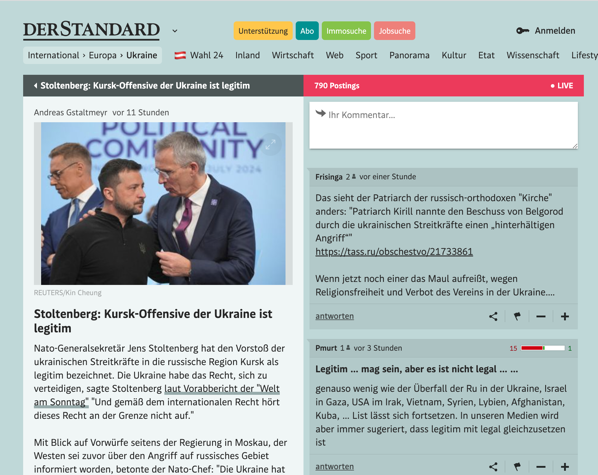
Shit, Fuck, der Standard mal wieder - beim Erfinden seiner Parallelrealität.
Naja, so ein overspecific non denial denial im Standard ist aber auch ganz was schönes. Einfach immer schön gradeaus, an der Realität vorbei.
So informieren wir die Österreicher.
Diese Gesellschaft ist das absolut grotesk und abartigst Allerletzte.
Zelenskyy: Surprise invasion aimed to restore Ukraine ‘territorial integrity’
Another one of those develishly clever Selenskyj plans!
“Today he [Selenskyj] said, they are going to hold it indefinitely.” [DEFENSIVEOPERATIONCONFIRMED!]
Last develishly clever Selensky plan of course having been:
Journalist: “Mr. President um I’ve made trips into Ukraine since the war broke out and it’s quite surprising to see you here back home in Singapore so my question is, what you brought what brought you here all the way? Is there a certain objective that you came with to rally more on the Asian Nations?”
Cleverest president in the world Selenskyj: “Now thank you for the question, we need the support of Asian countries it is much needed. We respect each voice, each territory, each of the countries in region, we want Asia to know what is going on in Ukraine, we want Asia to support the end of the war. We want Asian leaders to attend the peace Summit. We know that many Asian countries do not support Ukraine with Weaponry. We have never pressured them never demanded it we always ask for first and foremost political support, humanitarian support, support of our people, civilians our children. Today once again Russia unfortunately, I underscore it, yet again because for you to understand that for us it is very painful and a bit strange unfortunately, regrettably Russia using Chinese influence on the region using Chinese diplomats also does everything to disrupt peace Summit regrettably this is unfortunate that such big independent powerful country as China is an instrument for Putin.
[A bit later then in diplomatic cycles it perspired, that china had told other countries, that in his expectation, Selenskyj great peace formula plan would prolong and even elongate this war -- and that was the extent of it. Such Putin puppet, China. Much. Much wow.]
[…]
Journalist: Mr. President so which countries you were able to convince you to join the Peace summit and Ukraine has too little Military Support to win this war, do you believe in a diplomatic solution and what would have to happen in concrete terms.
Most intelligentest president in the world Selenskyj: Thank you for the question, I have not met with all the countries I will still meet with the leader of Singapore, I with Indonesia with them and I’m sure that these countries will be represented on the summit, but I cannot reply on behalf of these countries that is my personal opinion and then further it is the choice of every country and I’m always open with this we respect every position. But but but this position has to be clear there is no slavery, there is no no forcing to anything we we we are discussing the details, we are telling what what what what we have the the losses we have and the plan to the end of the war it is possible to end the war in diplomatic way, if the world unites and isolates Russia, if after our peace Summit Russia makes some conference and there will be represented a lot of countries, then this would mean that the world is divided and I think that this is a bad tendency and that is why I said this way about Russia and and about the representatives of some other countries, that they are working to disrupt the peace Summit, they they should not disrupt our peace they should deal with their own country.”
Ukraine Peace Summit turns hard on Russia. How leaders amended the final decision under criticism
THURSDAY, 13 JUNE 2024 — SERGIYSYDORENKO, EUROPEANPRAVDA
Harsh criticism of the agreed draft resolution of the Peace Summit, voiced both in Ukraine and by Ukraine’s allies, forced the organisers [thats Switzerland btw.] to make concessions. Switzerland, which is organising the Global Peace Summit, sent a radically revised document to all capitals of the participating countries, correcting key issues highlighted by European Pravda.
The updated draft is entirely acceptable for Ukraine. It explicitly calls the war “Russian aggression.” Loopholes that could have paved the way for territorial concessions from Ukraine were removed from the text. Several states that had planned to attend the Peace Summit in Switzerland have decided not to go there after the draft decision was changed in favour of Ukraine.
European Pravda has learned the details of the negotiations and the decision that will be adopted this weekend.
Behind the scenes of the Peace Summit
The timeline of these events is crucial: it shows how urgent the changes that occurred over the past week were.
The idea to hold the Peace Summit in Switzerland was agreed upon at the beginning of the year. On 10 April, Switzerland announced the agreed date and location for the summit. Leaders of about 160 countries, four international organisations (UN, EU, Council of Europe, OSCE), the Pope and the Ecumenical Patriarch were invited to the Bürgenstock Alpine Spa. It was predetermined that Russia would not be present at the first Peace Summit, which Ukraine demanded in the first place.
Both Kyiv and Bern aimed to adopt a decision following the summit. However, the wording needed to be agreed upon by all participants.
Preparation for this document started more than two months ago. European Pravda has the April draft of the joint communiqué, where the summit dates were still tentative. That document was prepared in Kyiv and was entirely acceptable for Ukraine, adhering to the important red lines for Ukrainian society.
However, Switzerland persuaded Ukraine to soften it as much as possible, considering the wishes of all participants. On 28 May, a compromise version was sent from Bern to all capitals, and initially, Kyiv had to agree to it.
Everything changed when the public learned that this draft was dangerous for Ukraine.
The discussion began with an article by European Pravda, published on 5 June. The next day, on 6 June, Kyiv was forced to make public statements asserting that “Ukraine will not retreat from the Peace Formula.” This fueled discussions in the capitals of Ukraine’s allies, which were also not thrilled with the wording of the Swiss document. At least a few of them contacted Bern with a proposal to revise the joint statement.
On 9 June, Switzerland had sent a completely new draft to all countries. Amending the communiqué took mere days, not months as before.
What has changed
The summit’s decision remains unchanged in format and structure. This is a two-page document dedicated to three issues: nuclear security, food security and the prisoners of war. Key issues that lay outside these points have been addressed though.
Russian Aggression
– Old wording: The May draft decision of the Peace Summit did not mention the word “aggression,” meaning the international crime where Russia is the perpetrator and Ukraine the victim.
– New wording: This has been amended. The joint communiqué now refers to “the aggression of the Russian Federation against Ukraine”.
Territorial Integrity and the UN Charter
– Old wording: the previous summit decision version created a legal window to include Ukraine abandoning part of its territory in the conditions of “sustainable peace with Russia”, if necessary.
– New wording: the new draft decision clearly states that the basis for sustainable peace will be only “a solution based on the principle of respect for the territorial integrity and sovereignty of all states”. [Crimea back to Ukraine, and no neutrality that includes “limitation on military forces”]
Alternative Peace Formulas
– Old wording: the previous draft blurred the meaning of the Peace Formula and opened up space for international discussion of all alternative visions of peace, such as the Chinese-Brazilian one, which envisages a halt to the strengthening of Ukraine’s Armed Forces and a cessation of hostilities.
– New wording: the new wording states that only peace proposals that comply with international law (i.e. an unconditional return of the 1991 borders, unless revised by Ukraine itself) and the UN Charter (in particular, Ukraine’s unconditional [no force limitation] right to continue repelling Russian aggression and liberating the occupied territories) will be taken into account.
Involvement of Russia
– Old wording: the earlier version turned Russia from an aggressor into a participant in peace talks, requiring only vague “confidence-building measures” on nuclear and food security.
– New wording: this section has been rewritten from scratch. The Swiss agreed not to mention Russia at all in the provision on peace talks, instead referring to “all parties”. There is no longer a weakened requirement for “confidence-building measures”, but instead “specific actions” are required. And most importantly, the references to a “second peace summit” that hinted at a commitment to invite Russia to participate have been removed.
Food Security
– New addition: The updated document includes the statement that “attacks on merchant ships in ports and along the entire route, as well as against civilian ports and civilian port infrastructure, are unacceptable”. This falls under the global food security section but applies to all civilian vessels, including container ships or those exporting Ukrainian metals. Continued attacks would block Russia’s participation in peace initiatives.
These significant changes ensure that the new draft of the summit decision is more acceptable to Ukraine, reinforcing its territorial integrity, addressing Russian aggression accurately and maintaining stringent conditions on peace negotiations involving Russia.
The document is acceptable for Ukraine
The Joint Communiqué on a Peace Framework in its new version aligns with Ukraine’s interests. Although there are still minor remarks, the main dangers have been addressed. Currently, the draft is not yet final: there is still a possibility of point changes on 13-14 June. However, European Pravda’s sources are inclined to believe that the updated content of the decision will remain.
Realistic expectations are necessary. This summit will not lead to a breakthrough or end the war. Ukraine is merely taking one of the first steps on a long path. However, it is crucial that this step is in the right direction and does not create new problems.
The higher ambition of the document came at a cost:
several countries have declined to participate in the summit. As of 5 June, Switzerland officially announced that it had “received more than 80 confirmations of attendance at the level of heads of states and governments”, and the total number of confirmed attendees, as reported by officials, exceeded 100. However, in the following days, this phrase had to be removed from the event’s website, and now it reads that “around 90 states have confirmed their participation in the Summit on Peace in Ukraine, most of them at head of state or government level”.
Sources of European Pravda reported that, in reality, about 15 countries have “paused” their attendance. In addition, the number of those who have signalled a demotion from the presidential or prime ministerial level to the level of ministers or even their deputies is in the dozens.
Although it is obvious that due to the recent changes, the summit will be attended by fewer states than initially anticipated by Bankova Street [where the Ukrainian President’s Office is located] eight days ago, it is better to have a summit of like-minded people than to make concessions on issues that are critical for the state.
Followed by this other develishly clever plan:
Moderator: “CNN’s Oren Liebermann is live for us at the Pentagon. Oren what more do we know about what these meetings are going to entail?”
Lieberman: “Phil, the push to use U.S. weapons to hit targets longer range, deeper in Russia has been a very public and private campaign on the part of Ukraine, stretching from Ukrainian President Volodymyr Zelensky and on down. It’ll be Andrey Yermak, the head of the office of the President of Ukraine and the defense minister, who will be here for meetings tomorrow with Biden administration officials to present a priority list of targets that they want to hit with long range U.S. weapons deeper inside of Russia. They need a green light from the white House to be able to do that. And that’s their goal here. So far, the Biden administration hasn’t changed its position. In fact, U.S. weapons can only be used inside of Russia in a very small area north of Ukraine, inside of Russia. And they have used those weapons to that effect. The Kursk offensive has been carried out effectively within that restriction from the U.S., but they say they need to be able to target military assets and high value targets deeper inside of Russia to change the course of the war. President Volodymyr Zelensky talked about this yesterday:
Selenskyj: “We continue to insist that their determination now lifting the restrictions on long range strikes for Ukraine now, will help us to end the war as soon as possible and a fair way for Ukraine and the world as a whole.”
Lieberman: Ukraine has used its medium range assets, its medium range weapons, to target and carry out cross-border attacks. But Russia has simply moved their high value assets farther back, farther away from the front line, and they’re out of range of Ukraines current weaponry within the restrictions placed upon them by the US. That’s why they say it’s so important to get these restrictions eased or outright lifted. And that’s their goal here.”
Moderator: “Oren, you make a great point in the sense that this has been a public campaign that has been going on for a while from top Ukrainian officials, including President Zelensky. do we have any sense right now that because of some reason or another, the U.S. is actually considering changing the restrictions?”
Lieberman: “So far, the administration and the Pentagon have been clear that the restrictions remain in place.”
Moderator: “But, Phil, you and I have seen this so many times over the course of the war, especially when Ukraine carries out a very public slap campaign that the Biden administration will say, no, no, no, no, no. And then suddenly, yes. We saw it with patriots. We saw it with ATACAMS. We saw it with Abrams tanks.”
Lieberman: “And that’s what Ukraine is hoping for here, that the public and private pressure campaign that, that perhaps a comprehensive list of targets of what they want to hit to make that clear to the white House, that that will build up enough pressure and convince administration officials that finally, they will go from all of those no’s to the yes that Ukraine is hoping for.
Preceded of course by Selenskyjs first develishly clever plan, exactly one month after the start of the war:
Czech Television Moderator: “Dear Mr, president, these are historically hard times. But the Ukraine also is unified as never before. Do you see this as a change only in Ukraine, or maybe also in europe. And what is at the center of this change?”
Cleverstest president in the world Selenskyj: “The world will change, it has already changed, politicians are already afraid of their people, they are afraid of social responsibility. They see, that people are reacting differently. And in many countries, people support us 100%, but their leaders, do not support us 100%, for one reason or another. I’m not saying here who is right [?!?!], but it means, that social and public opinion will be stronger than any leader in the world. That is to say, we are all seeing changes and processes. Changes that not only lead to theoretical, but to popular democracy, popular democracy is not a revolution - democracy is first and foremost, power of the people. If you want to be the leader of your society, you have to be the leader of society, not to command, but to be a leader and live with them in the same spirit. Therefore [?!] it seems to me, that this popular democracy is taking place in the world, and that this will lead to certain security alliances [?!], I am confident, that there will be new security alliances in the future. This does not mean, that its necessary to leave any union. It does not mean, that it is necessary to destroy things that work. No it does not mean that. People just want peace, tranquility, stability and most importantly - confidence. Here, in all these challenges, confidence. Be it the new Covid, or god forbid, war. A person who lives, pays taxes, resides here, was born or came here, is a citizen of the world for peace. And this person must know, that they must be protected in this country. And if this person leaves for another country, this person will be protected there. The person will not suffer. The world is just facing such a challenge. It will either accept this model, and come to such alliances, or there will be a change of many world leaders, and their societies will find proper people for themselves.”
God, this ukraine really is run, by the most devilishly cleverest president in the whole world!
Good, western, democratic world of course.
Ah, da kann der Krieg ja endlich weitergehen. Slava, as always.
Mikhail Zygar, of course is not a bought out nonresident senior fellow at the Atlantic Council’s Eurasia Center by now, you know to fill his gap years - no he is an artistic auteur, ne a columnist of german newspaper Der Spiegel!
Mikhail Zygar is a nonresident senior fellow at the Atlantic Council’s Eurasia Center.
For many months after the war began, I had mental conversations with Zhenya. Every now and then, as I was writing another column for the New York Times or Der Spiegel, I imagined Zhenya and wondered what she would say if she had read it. To me, she symbolized all those who stayed, who still live in Putin’s Russia, live and protest. In my thoughts, Zhenya became the “conscience” of today’s Russia.
edit: Future me: Damit konnte jetzt aber also wirklich keiner rechnen:
10. September 2024, 08.09 Uhr: Bericht - Keine Gespräche mit Kiew vor Rückzug ukrainischer Streitkräfte
Russland wird keine Verhandlungen mit der Ukraine führen, bis sich seine Streitkräfte aus russischen Gebieten zurückgezogen haben. Das bereichtet die Nachrichtenagentur Tass unter Berufung auf den russischen Sekretär des Nationalen Sicherheitsrates, Sergej Schoigu.
Fast hatte Wladimir Putin den Namen seines Erzfeindes Alexej Nawalny schon vergessen. Doch dann gab es Pläne für einen Gefangenenaustausch. Und das durfte nicht sein.
[…]
Offenbar hörte Putin nach einer langen Pause erst Anfang Februar dieses Jahres zum ersten Mal wieder von Nawalny. Damals teilte Roman Abramowitsch, einst Oligarch und heute der einzige ständig funktionierende Kommunikationskanal zwischen Russland und dem Westen, Putin mit, dass man sich auf den endgültigen Gefangenenaustausch geeinigt habe. Der Westen sei bereit, fünf gegen fünf auszutauschen: Es handele sich um Spione, politische Gefangene, den Mörder Wadim Krassikow, den amerikanischen Journalisten Evan Gershkovich und – für Putin überraschend – Alexej Nawalny.
Das konnte Putin nicht glauben: Gab es wirklich ein Land, das die Freilassung Nawalnys forderte? Brauchte ihn wirklich jemand? Erinnerte man sich noch an ihn?
Die bejahende Antwort wurde zu einem Urteil. Genauer gesagt zunächst zu einer Erinnerung. In der Tat hatte Putin lange geglaubt, Nawalny sei tot. Er betrachtete das Fehlen von Informationen über Nawalny, die von den Sicherheitsdiensten ängstlich verheimlicht wurden, als Zeichen dafür, dass Nawalny der Vergangenheit angehörte. Als er jedoch erfuhr, dass Nawalny noch am Leben war, immer noch wichtig, immer noch ein Faktor in der internationalen Politik, da zögerte Putin nicht.
Laut Christo Grozev wusste er zu dem Zeitpunkt, als der Moderator Tucker Carlson ihn im Interview aufforderte, Evan Gershkovich freizulassen, bereits von dem vorgeschlagenen Austauschprogramm. Und er war eindeutig nicht glücklich darüber. Putin stimmte dem Tausch zu – aber nur unter der Bedingung, dass Nawalny nicht in den Plan einbezogen werden würde. Er wollte den Mann, der ihn vor dem ganzen Land, vor der ganzen Welt gedemütigt hatte, nicht freilassen.
Deshalb befahl er, Nawalny sofort loszuwerden – damit er die Verhandlungen über einen Austausch fortsetzen und nie wieder an den Mann denken musste, dessen Namen er nie ausgesprochen hatte.
Aber es ist wie mit dem Fluch in Shakespeares Drama »Macbeth«: Nun wird Putin diesen Namen nie wieder vergessen können.
Anmerkung der Redaktion: In einer vorherigen Version dieses Textes wurde Christo Grozev als Mitarbeiter Nawalnys bezeichnet. Das ist unzutreffend und war nie der Fall. Wir haben die entsprechende Stelle korrigiert.
edit: Also never make the mistake to believe Chodorkowski, that what the russian opposition can deliver is a to “form a vision of the future”, because thats Timothy Snyders job of course, talking to Zygar here:
Zygar then reproduces large junks of the same propagana in front of an international audience (not talking about his book btw, just about his public appearance in this video):
And that bags him his Atlantic Council Fellowship.
Zygar having been addressed by US propagandists in the first place, because he is THE popular public spokespeace INTO the russian expat community on youtube.
Looks like a youtuber, behaves like a youtuber, has the credentials of having been a Co-Founder on TV Rain, now thats someone you should have
Anne Applebaum,
Timothy Snyder and
Fiona Hill
fill with preproduced narratives, like the one that Snyder feeds him in the first video of course.
I mean look at him, the eternal youtuber, and credentials of having been on the founding team of TV Rain? Never saw a better candidate for an Atlantic Council fellowship in my lifetime. And how well he repeats the lines initially fed to him by Snyder!
Nobody expects the russian opposition!
You know, your typical russians like: Anne Applebaum, Timothy Snyder and Fiona Hill (Brookings Institution) - talking to an impressionable teenager and his youtube audience, because they find it fulfilling, I guess…
And they give such great tips on how the russian expat community can “form a vision of the future of russia” all along the way!
What a bunch of openly helpful people!
Diese Gesellschaft ist das erstklassig Allerbeste, und ihre Pundits, sind alle so human und so überaus hilfsbereit!
Oh - if you dont believe me - watch those videos. 🙂
Grüße ans US foreign policy establishment, bitte.
First question. Is russia really the only danger in the black sea?
Answer given by the panel. Yes.
Explanation: Because it is an encirclement strategy. Aka everyone in the region against russia.
Explanation given by the panel: Yes, because Putin is the new Hitler, and when I talked to Merkel she said to me Putin thought like Alexaner the Great, no he thinks like Nikolas the Great, listen to his war speech he mentioned him in there, and when I was in russia in 2015, everyone told me - we are the perfect slaves, but when I was in Ukraine, they aleready told me, we are fighting for our freedom!
[Btw, if you have a “are they really all that dumb” moment right about now, no. They are dumber. Just watch the video.]
Second question: Is the black sea really that important for russia. Warm water port and all that.
Answer given by Alina Frolova, Former Deputy Minister of Defence of Ukraine on the panel: Yes, economically and for the projection of military power the black sea ports are extremely important for russia. 40% of their exports and a serious percentage of their imports go through the black sea.
CORRECT! THECANDIDATEGETS 1000 POINTSAND A FREEWASHINGMASHINE! IFSOMEONEWOULDHAVEBEENABLETORELAYTHATTOWERNERFASSLABENDOVERTHELASTYEARAND A HALF, THATWOULDHAVEBEENSOHELPFUL! You know to all the diplomacy students in Austria, who learned from Herr Fasslabend, that Sevastopol wasnt at all important to Russia, and that they could just as easily run their economy through Murmansk in the nordic circle (ok, close to the nordic circle).
They couldnt - which really was kind of the main point Zbigniew Brzeziński made in the Grand Chessboard, but who needed to read Brzeziński when they were serving in the austrian foreign service, am I right? Right?
So just as a tale of warning, if ever somone in the vicinity of the Brookings Institution and Fiona Hills position there should come to read this little blog entry. This is what you do to society. Flood it with a bunch of “I know how Putin thinks he thinks like 5 tsars I saw in his office in 2015, when Fiona for the last time was part of a Valdai Discussion Club meeting” crap, implant that thought in people who are too dumb even to relay that correctly and then have to pull out their “Hitler in the black sea” comparisons when they have public panel appearances. In their first answer on a GLOBSEC panel.
Make sure no one registers, that this is all a “get russia out of the black sea” conflict at heart (see Herfried Münkler: https://harlekin.me/allgemein/spaete-erkenntnis/ ) - and then have Alina Frolova, Former Deputy Minister of Defence of Ukraine blow that all up by actually spelling out loud how important its black sea ports historically have been, and still are for russias economy and power projection.
You know, the ones Ukraine insisted Russia had to gift them (!!!!!!!! Venice Commision, see below) with all the military ships docked there, and the ones built there for free as part of “compensation negotiations”.
Before this “unprovoked war” broke out. You know - Ukraine, which wanted nothing more than to join NATO with all its heart, so Victoria Nuland could finally fulfill americas goals in the black sea. (Which the british representative in the Panel will describe to you word for word, just listen to him.)
But dont you worry, the first comment in the GLOBSEC panel about “Bolstering Black Sea Security” (Is russia really the only threat in the black sea. Yes! Says the panel.) will be, that Putin is like Hitler, and not like the Tsar Merkel compared him to, but the other Tsar, that had empirialistic ambitions!
While Herfried Münkler already stated, that russia probably started the war at least partly - to be able to secure (projecting years into the future, when its demographic wouldnt allow for military actions anymore) its influence in the black sea.
Now -- are all political proponents that are featured, by the fucking propagandistic dipshits that produce your media reality -- really that dumb?
No, they are dumber, watch this video.
This is GLOBSEC.
This is the US security industry.
God forbid I once thought the Alpbach panels where intellectually lacking and all about putting people on stage to have their egos stroked.
This is literally the Brookings institution writing the memes into the minds of state representatives which are idiots, and think that adding Hitler to the mix, in the first response they ever produce on an industry panel - would make a better episteme out of it.
Well, he said Hitler, so it must be true…!
This is what the Brookings Institution does to society.
Nevermind that you still need personal connections to get fucking Werner Fasslabend to lie to his public relations students for one and a half years, because that old fucking fool, could be made to believe that Sevastopol wasnt important for russias africa missions.
But for all this year long outrageos bullshit and propaganda -- the US didnt think about briefing Alina Frolova, Former Deputy Minister of Defence of Ukraine on the official propaganda position, so now she just enters the “encircling russia in the black sea” panel, and anwers truthfully. Because shes amongst friends.
Cant make this stuff up. Its insanity in motion.
First speaker gives you the full propaganda loaddown with Tsars and Hitler. Second speaker tells you the full truth, because she was never briefed, that she should downplay the importance of Sevastopol by US foreign policy “experts” targeting western media outlets.
FUUUUUUUUUUCK.
Wie kann man diese Gesellschaft eigentlich noch verarschen?
Gut die Schwarzmeerhäfen wären bei einem Nato Beitritt der Ukraine für Russland weg gewesen, aber ich mein was sind schon 40% der russischen Exporte und ihre gesamte Power Projection into the Mediterenian and Africa for russia…
Nein, also dass ihnen die Nuland das wegnehmen wollte, war ja nie im Leben eine Provokation! Ich weiss garnicht warum Putin die Krim nehmen musste!
Gut, jetzt sagt die Alina Frolova, Former Deputy Minister of Defence of Ukraine sie weiß es, es war, weil Sevastopol so wichtig für Russland war, und der Münkler sagts auch -
aber das müssen die deutschsprachigen Medien ja deswegen nicht der Öffentlichkeit erklären.
Nein, bitte - der Krieg war unprovoziert, auch wenn die Ukraine zu beginn mit US Javelins die russischen Separatisten aus dem Donbas weggeschossen und damit die militärische Lage gedreht hat. Die die Ukraine extra dafür angefragt hat die Lage im Donbas zu drehen (Gamechanger gegen die “Separatisten”). Auch wenn die Javelins zu dem Zeitpunkt nicht freigegeben waren. Genutzt haben sie sie schon. Was die Wasserversorgung (irregation) zur Krim gefährdet hätte, wenn die Ukrainer den Donbas genommen hätten. Was Russland aus der gesamten Ukraine gedrängt hätte (2 Mio. Menschen ohne Wasserversorgung die zornig auf Russland sind) (was bis heute das Kriegsziel der Ukraine ist -- siehe Verhandlungsverlauf in Bürgenstock, siehe Alina Frolova, Former Deputy Minister of Defence of Ukraine in diesem Panel). Was das politische Ziel von Nuland war. (Ukraine zur NATO in seiner tatsächlichen Bedeutung). Aber eine Provokation haben wir ja alle immer noch nirgendwo entdeckt.
Also wo denn?
Wer denn?
Die Venice Commision der europäischen Union?
edit: Sorry - the british represntative on the Panel had to also provide the input, that Putin is also emulating Stalin of course. Please note that down as well.
So thats Hitler, not Alexander the Great, but Nikolas the Great and Stalin. This will be part of the history test of your child.
Also Tobias Ellwood, Security and Defence Consultant, Ellwood Communications - the british representative, also knows, that this is not just about the black sea, this is about Putin “pushing further”, because: “you all played Risk, and the green part is alsways hard to defend, so you attack”.
Thank you, no further proof needed, I think!
This also will be on the history test of your child, believe me.
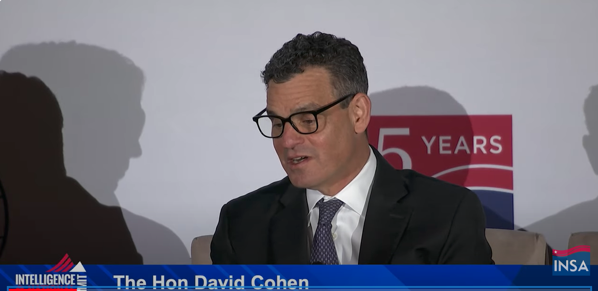
Hosted by the Intelligence & National Security Alliance
at 13:30 min in:
David Cohen is the current Deputy Director CIA
Moderator: Earlier this year the US government was saying you know stalemate continuing Russia was not going to be able to gain significant territory um do we still think that’s the case? David what do you think?
David Cohen: “Look, I think the um so the attack uh you the night before last uh that the Russians mounted on the energy infrastructure in Ukraine and against civilian targets you know is you know sort of sadly more of the same from Putin going after uh civilian targets trying to um you know --- cause essentially widespread uh you know pain and suffering in Ukraine as the fall is now upon us the winter is going to come um and you know he’s going after again going after the the energy infrastructure so I think we will continue to see those sorts of attacks. The ukrainians you know with the help of the United States and others are are you know constantly working to build their air defenses to uh to try to uh address these these attacks from the Russians but in terms of the front line like I think the you know the fighting now uh and it has been for you know a period of of several weeks or longer uh has been focused on this city called Pokrowsk in uh in the Donas um you know the Russians are are making some progress there - they’re making progress there at extraordinary cost the number of lives that they are wasting in this in this effort quite apart from all of the military equipment and all the rest that they’re throwing at it is really is quite extraordinary - for for you know very small incremental gains over time. ---[NOWFINALLYDECIDINGTOANSWERTHEQUESTIONTHATWASPUTTOWARDSHIM, I CANHARDLYBELIEVEIT, ITONLYTOOK A DAYAND A HALFOFSIDETRACKING! ---] They may take Pokrowsk, they may not I think it you know it’s a the ukrainians are continuing to to defend but like at the end of the day - none of it is gamechanging in a strategic sense um and I think we are we have assessed that throughout you know 2024 there would there would be you know some some give and take along the front line and I think we’re going to continue to see that.
vs.
GO!
Battle it out!
GO!
You can do it.
If you have no Idea whats going on here - I have a few pointers.
- As the saying goes, all the intelligence by now is in the private security industry, because they pay better.
- As the saying goes, the fist thing you learn at CIA is lying
- As the saying goes, the second thing you learn at CIA is how to talk yourself out of not having read the briefings or your executive-memos, and still call yourself “the honorable” - to the point where others think thats actually your title…
- Oh and if you are critical minded, and have seen that the Ukrainian defense infrastructure 15km away from Pokrowsk was crumbling in a chaotic manner, because the Ukraine had a few scheduling issues, that surmounted to Russia being able to take a town for free -- well, thats obviously them only being able to advance by a few kms, back and forth, suffering TREMENDOUS losses. Which coincidently is not what David Cohen has picked up from media (not how Strategic Intelligence works), but the Propaganda line western media has picked up from the US services industry.
Horray. Another idiot at work.
Almost makes me long back to the days, where the idiots in this picture could recruit underage hackers, by instilling tropes in them with “911 got to save america fuck yeah” motives stacked to the brim…
The rest of the panel is their top level management talking about which advancements AI will allow them to reach.
“We are developing more of a trust infrastructure, so we can accelerate faster through AI…”
You what now? (Generative AI is not reliable, so you build up a trust infrastructure (Human in the loop), so you can accelerate faster? Amazing. Better not make the AI spit out too many correlations per day!)
Generative AI will help through correlative data analysis. You mean Data Science will help with correlative data analysis, and a chatbot will tell you what to bomb based on those unverified correlations? So now you can call it AI?
Our prompt engineers…
Terrabytes of data from our satellites…
Oh, for fucks sake.
Man weiß immer erst was man an PR-Opfern wie dem Gustav Gressel hat, wenn man sich mal die Konkurrenz in seinem Job angesehen hat.
Dass der sich nicht schämt, der Gressel - in einem Sektor zu arbeiten wo er der einzige Mensch ist der nicht auf Anhieb der ersten Logical fallacy die Füsse küsst, die seinen Weg kreuzt…
ARTE zeigt ENDLICH mal die Chronologie um das ukrainische “If you dont close the sky, mom will cry, if you dont close the sky, he’ll lose home…” Propagandavideo mit Bildern aus Butscha im UN Sicherheitsrat!
Jetzt der blöde Part, sie haben die gesamte von der Ukraine draufgelegte Musikuntermalung (mit besagtem Refrain) entfernt, und respektvolle klassische Musik drunter gelegt.
Ganz im Gegensatz zum Ukrainischen Originalvideo damals.
Erwähnen diese Bearbeitung aber mit keinem Wort.
Gut - das muss ja unter den Historikern wieder niemand wissen, dass die Ukraine keine vollendete Woche nach Butscha mit den Gräulphotos TIEFSTEPROPAGANDA gefahren ist, um ihre Ziele des Eintritts der NATO in den Krieg zu erreichen…
Klar schneidet denen ARTE das Video um.
Sicher doch.
Und wechselt die Musikuntermalung.
Darfs sonst noch was sein?
Was für ein Service!
Diese Gesellschaft ist das absolut grotesk und abartigst Allerletzte.
Meine einzige Originalquelle dazu wurde aus dem Netz genommen, und das Video selbst findet sich aufgrund der in der ARTE Doku angesprochenen “technischen Probleme” an dem Tag in KEINER Aufzeichnung der Sicherheitsratsdebatte die noch auf Youtube zu finden ist. Also bin ich erst mal glücklich -- dass es “für die Historiker” überhaupt noch mal jemand on record setzt, dass es das verfickte “If you dont close the sky, mom will cry, if you dont close the sky, he’ll lose home…” Propaganda video der Ukraine im ersten Auftritt Selenskyjs nach Butscha im Sicherheitsrat gegeben hat.
Bis jetzt war das nicht mal Teil der offiziellen Geschichtsschreibung.
Jetzt seit ARTE zum Glück schon.
NURDASSARTEDASVIDEONEUAUFBEREITET, DIEMUSIKUNTERMALUNGENTFERNT, PASSENDEANTEILNAHMEAUSDRÜCKENDEMUSIKDRUNTERGELEGTHAT - und den Rest einfach verschweigt.
Na Gott sei dank leben wir im Wertewesten, mir ganz viel Qualitätsjournalismus!
edit: Was ARTE leider auch falsch wiedergibt, ist dass es behauptet, Budscha sei der Punkt gewesen ab dem die Ukraine keine Friedensgespräche mehr akzeptieren konnte.
Auch das ist falsch - aber irgendwie muss man ja die fucking scheiss Propaganda in die Bevölkerung gedroschen bekommen.
Selenskyjs views on the Butscha massacre that is.
Says eye witness to the events, Times correspondent [with access] Simon Shuster.
Quite quickly, but certainly over the course of the next weeks that followed.
BWAAAHHAHHAHHHAHAHA.
Under the influence of his advisors.
HAHAHHAHAHHHAHHAHHA.
Wait, wait - but what was the sentence before that - you know for the necessary context!
“He also said at the time, days after the Butscha massacre was discovered in early April of 2022, he suggested that Putin might not be fully aware of the warcrimes that his soldiers might be committing. And we still need to talk to Putin.”
BWAAAHHAHAHHAHHHAHAHA.
Yeah, but that was before the BBC and the entire german media ecosystem systematically didnt report what Reisner noted, that the Ukrainians killed 1000 Russian soldiers (two batallions) with Himars in Butscha, and that the remaining soldiers “went crazy” after that…
Of course you dont report that as german speaking media.
BWAHAHHAHAHAHHAHHHAHHHAH.
Ah. Best laugh I had in two years.
Thank you Atlantic Council!
“He also said at the time, days after the Butscha massacre was discovered in early April of 2022, he suggested that Putin might not be fully aware of the warcrimes that his soldiers are committing. And we still need to talk to Putin.
Quite quickly, but certainly over the course of the next weeks that followed, his views, evolved partly under the influence of his advisors. You know this is -- like any administration there are different opinions, and they were discussing what to do, what should be our position in terms of negotiations and -- the possibility of talking to Putin. (ISITPOSSIBLE?!) Is he a monster, is he a statesmen, what is he?! A dictator. And their views evolved quite quickly [but certainly over the course of the next weeks], to the point where I think by the start of summer certainly Selenskyj had decided, that - NO, it is not possible to talk to Putin.”
ALSOTHANKYOUTOTHEBBCFOROMITINGTHEFACTTHATTHEUKRAINEKILLED 1000 SOLDIERSINBUTSCHA, TWOBATALLIONS, WITHHIMARSANDTHATTHEREMAININGRUSSIANSOLDIERSWENTCRAZYAFTERTHAT. (According to Oberst Markus Reisner.)
ALSOBYTHESTARTOFSUMMERCERTAINLY?
Beginning of April, End of April, Beginning of May, End of May, Beginning of June, 20th of June -- NO, CANTTALKTOPUTIN!
I’M CERTAINOFITNOW! Hes a monster! And this is russias war, not Putins! (Says our hero Selenskyj. According to eye witness to the events, Times reporter Simon Shuster.)
Gut, Propaganda hat natürlich wieder niemand entdeckt…
HAHAHAHHHAHHHAHAHHHAHA
Danke für das verfickte scheiss Follow Up, Atlantic Council.
Und natürlich war und ist der Angriff der Ukraine in Kursk völkerrechtswidrig.
Das macht aber nichts, da wir ja nicht darüber sprechen dürfen (Külturstätten zerstört und geschändet, Artillerie in Stadtzentren und aus Stadtzentren heraus eingesetzt, ohne dass zuvor evakuiert wurde, keine Planung was mit der Zivilbevölkerung passieren soll, auch nicht drei Wochen später, anstattdessen aber gleich mal schön Nachrichtensperre verhängt -- jeder dieser drei Punkte ist völkerrechtswidrig.).
Und wenn ichs ausspreche werd ich öffentlich niedergeprügelt wie ein FUCKING Parriah.
Denn das hier ist ja ein guter völkerrechtswidriger Angriffskrieg. Einer von unseren.
Aber hey, bright eyes - und good news, ein Standardleser hat die PROPAGANDA die österreichische Bevölkerung gedroschen wird, geblickt - und ist dahinter gestiegen.
today: Piotr A. Błazeusz, Commanding General, EUROCORP:
“Putin will never venture into general mobilization. I see him never doing that.”
So, great news for Poland, and the Baltic states - nothing will happen to them, but they can still use the war as a pretext for another four, five years to keep Germanys economy in the gutter!
The sad part is, that Globsec is interviewing idiots again, that when confronted with “apparently Russia attacked Sumi 2000 times in three months” (which is not true in the least even though Selensky repeated it for two weeks straight - and we know that journalism doesnt work anymore these days, to check this stuff) venture into story breaks of how when they were airforce pilots (ANDSTILLUTTERIDIOTS, GODTHEYARESUCHIDIOTS) defense also meant flying offensive operations.
Much wow, much learned, lets all note down: Attack aircraft, not a defensive weapon in the theatre of war.
Wow, much wow.
edit: Moment, ich hab heute einen Artikel in der NZZ gelesen, der das Verhalten der Idioten am Panel perfekt zusammenfasst - drei Minuten Lesezeit, dann spart man sich das Video.
Das Buch «Seelenzauber» ist ein unterhaltsamer Überblick über die Kindertage der Psychotherapie. Es beschreibt das Ringen um die vermeintlich richtige Deutung des Lebens – bis es den Psychologen schliesslich doch noch um die Patienten geht.
Inhalt: Nachdem die Ukraine die Informationsoperation gegen die Baerbock hochgedreht hat (“Sogar die Schaffnerin des Zugs hat mir gesagt, die Ukraine brauche ganz dringend Leo 2s.” Zitat eine Zaubershow Besucherin aus dem Außenamt), hat Scholz seine “wenn die US Abrahams liefert, liefern wir Leos Doktrin erfunden um im Osten Gesicht zu wahren”. Da hat der kurzzeitige Korruptionsskandalüberlebende Olexij Resnikow den Amis gesteckt, sie sollten doch 3 Abrahams liefern, mit denen bewache die Ukraine dann die US Botschaft in Kiev.
Die Amis - inklusive Lloyd Austin hätten dann gelacht und sich auf die Schenkel geklopft. Dann habe Biden pro forma 31 Abrahams gegreenlightet.
Dann haben die deutschsprachigen Qualitätsmedien das Narrativ erfunden, ob Scholz nicht Biden gelegt hat, der gewiffte Fuchs.
Es ist wirklich schwer auch nur eine Begebenheit zu finden in der die deutschsprachigen Qualitätsmedien nicht dem US Außenministerium zuarbeiten.
Nur so eine Beobachtung.
Zurück zum Thema.:
Gut das braucht jetzt natürlich die deutschprachige breite Öffentlichkeit nicht zu erfahren. Ich mein wo kämen wir da hin, wenn wir die deutsche Gesellschaft in einer Demokratie über historische Tatsachen korrekt informieren würden…
Nein, nein -- für die deutschsprachigen Bevölkerungen nur die besten Lügengeschichten bitte. Grüße ans Außenministerium bitte.
edit: Zur Ehrenrettung, der Jabba the Hut der deutschen US Korrespondenten, Karl Doemens, hat es bereits im Februar 2023 angedeutet: click
DW moderator talks to EFF representative asking her why app on phone is attractive to people who want to communicate, especially criminals.
Gets “encryption is legal, forcing a company to break it would be illegal” response. Says thank you - I couldnt have researched that myself - really, …
All the while not clueing in on that the French government might have a case here, if Telegram (30 employees) hasnt responded to takedown notices from within the EU.
But we still cant say -- because five days after the arrest, the actual charges haven’t been released. By France. Oh well - I hope they have fun while we all assume the french legal system is staffed by a bunch of idiots.
And this concludes this part of the long running series - idiot talks to tech person.
edit: Moment, einen hab ich noch:
rbb Mitreden! Zum Thema Raketenstationierung in Deutschland.
Diese Webseite verwendet Cookies um die Nutzungserfahrung für seine Besucher zu verbessern. Bitte informiere dich bei Gelegenheit darüber wie sich Cookies auf deine Privatsphäre im Web auswirken.