So just to get things straight here. The moderator doesnt know what the current end goal of the war is, every reporter questioned dodges the question except for the very invested ukrainian reporter who really conjures up an argument of “we cant loose any cities anymore - because that would mean that more people have to suffer through what Butcha (a liberated city) suffered through”. Now thats great logic, that certainly rectifies an endless war. Without mounting any opposition, or giving any clarification on that argument, naturally.
Half of the panel admits that reporting in their country is one sided, but takes it with a smile.
The german participant has a very succinct way of explaining what good journalistic performance is. “Bild was surprisingly good here, because they went on guided, embeded journalism tours (my wording, but its discussed later on, on the panel) into the warzone, and hired ukrainian journalists, and even journalists from alternative russian media. So thats “good journalism” in her mind. She repeats it three times - hiring people close to one side, and then taking the press trips, organized by one side - makes it, per definition, excellent journalism.
The group then later gets into the discussion that they dont have any reporting on the other sides action, but that would of course only be the case, because russia doesnt allow for embedded journalism on their side of the warzone, and because russia has denied journalists visas who tried to travel into russia for reporting purposes, and has enacted draconian laws against journalists working within the country (up to 25 years of prison for publishing the wrong word).
So one sided reporting is fine I guess (not my interpretation, but the interpretation of three people on the panel).
And to counteract it, and the emotional priming and good/bad narratives, and not explaining any actions taken by political actors in any sort of depth, or providing any sort of context or pro/contra arguments on likely outcomes, that at least one journalist in the panel laments, is totally fine - because journalism will “reflect on it” once the war is over.
Sadly, the moderator doesnt quite understand what that means (“the war being over”, so what state has to be reached), and she has a conceptual problem with it, but after you see half a dozen reporters simply dodge that worry, put into an actual question for the panel, in a row - you start to be ok with it, right?
Oh, and the other reason named for the factual one sidedness of reporting is “we as a nation, and especially the public took a side in this conflict, very early on”.
So any journalistic criteria goes out of the window -- of course. Because we can take sides.
So let me summarize what happens, until journalism finds its way to evaluate its maybe one sided performance, after the war.
Energy costs double. Growth rate is reduced by 0.5% points per year. About 100 people die every day (currently), what “winning the war means” is unclear. But everyone is for it. Because there is no alternative. Because values. We are on the verge of a new global hunger crisis, if the EU and Nato dont get out Ukraines next harvest via land routes going through poland, or shipping from Ukraines black sea ports (Negotiations are in progress at the UN level - because its fairly unlikely, that they will start using the searoute, that the russians just opened (cleared of mines) from Mariupol), we cant talk about initiatives to end this war, if that means, that Ukraine doesnt get total territorial integrity back. Chinas manufacturing sector going offline currently will increase inflation spikes, green transitioning as a project takes the backseat to enabling energy security, and the state minister of foreign affairs of Pakistan just stated in Davos, that if this means, that her country gets into another hunger crisis, sticking to values, to her doesnt seem like the right move here… And of course - talking about compromises right now, would just embolden the aggressor, so we needed to make that a tabu as well. Until the Ukrainian leadership reached their military goals, which are unclear. Or unlikely. Or super fair, but we cant find out, because we cant talk about them, because we need to let them decide, without outside influence. Just with outside weapon shipments.
No worries though, journalism will reevaluate their reporting, once the war is over.
Oh, and one more thing. The Ukrainian journalist in the panel got it established, that “embedded journalism” in conflict zones, really is the only kind of journalism thats even morally rectifiable, because of the inherent danger to lives, and the risk of otherwise retraumatizing people journalists might interview. With those kinds of arguments you can get a “you are so right” out of the critical minds at Presseclub Concordia - every day of the week.
Next time on Presseclub Concordia, we invited two high rank US diplomats to tell us what the US is doing in this war, and what its goals are… (9th of June 4pm MEZ, keep the date.)
Because we didnt watch to see what Nina Khrushcheva stated on this very topic six days ago…
Ich muss jetzt aber nicht heucheln und so tun als sei das alternativlos, oder für die Bevölkerung das Beste, oder die Corporate social Responsibility in Davos, die das einleiten wird, oder bereits eingeleitet hat, oder? Oder muss ich? Ich weiß das heute nicht mehr so genau.
Des is so erstaunlich wie intellektuell elastisch die heutige junge intellektuelle Elite Österreichs so ist…
Stell dir vor du beginnst dein politisches Leben als Eventmanager bei der IG Alpbach Wien (kein Beleg, die IG Webseite auf archive.org auf Änderungen zu durchstöbern, war mir dann doch irgendwie zu stalkerisch…), dann wirst du irgendwann mal Präsident der selben Vereinigung, dann gehst du in die Presse und verlautbarst, dass du als einer von zwei Gründern Fridays for Future Österreich mitgegründet hast “Weil wir sowas in Österreich auch brauchen”, also im Jahr nachdem die Oppenheimer Funds in Alpbach den Kamintalk mit dem Schlussfazit “Zu viele Investoren glauben noch Klimaschutz sei Philanthropie, wir haben noch viel Arbeit vor uns” gehalten haben, als dann Greta populär wurde. Du machst dann (im Jahr darauf) dafür die Facebook PR und freust dich zusammen mit dem Organisator des Forums darüber “dass Fridays for Future (die du ja mitgegründet hast) auch ihren Weg nach Alpbach gefunden haben”, stell dir einfach vor die Qualitätszeitungen schreiben das ab. Stell dir vor, zwei Jahre später sitzt du bei einem Klima Panel in Alpbach, und antwortest auf eine Publikumsfrage, einfach so richtig schön mit ordentlich viel Bravado, dass wenn beim Klimaschutz nichts weitergeht, man die Unternehmen einfach zwingen wird müssen. Stell dir vor dich pfeift dann das Panel zurück, weil das dann für eine Demokratie doch zu aktivistisch war, und muss dann deine Aussagen öffentlich relativieren. Was heißt relativieren… Zurücknehmen. Stell dir vor du gehst dann in deiner Rolle als Klimaaktivist so richtig auf, und wirst fortan von brutkasten.com (die in Alpbach im letzten Jahr engagiert wurden um die Morgenrunden zu produzieren und zu moderieren) als “drei Datenaktivisten und Klimaschützer Johannes Stangl” geführt, weil du Taferl hochhalten und über ökologische Nachhaltigkeit sprechen kannst, wie kein zweiter.
Stell dir vor Alpbach featured dich in ihrem Newsletter, weil du auch auf die COP in Saudi Arabien fahren und von dort berichten wolltest.
Stell dir vor du machst dann mit den Datenaktivisten ein Klimadashboard (immer noch brutkasten) und malst nebenbei Blumen neben Balkengraphen und das gefällt Complexity Science Hub Vienna, also denen die in der Plenary session des EFATEC Programms in Alpbach 2021 den Chair der Debatte zu “The complexity of great green transformations” stellen, also, was heißt stellen, mit ihrem Präsidenten besetzen - also denen gefällt das so gut, dass sie dir gleich eine Forschungsstelle am Institut bereit stellen, damit du dort deinen Doktor machen kannst.
Stell dir vor es vergeht ein Jahr.
Stell dir vor du gibst dann Pressekonferenzen, also - so mehr jetzt, also aktuell, und zwar dazu wie sich die Europäische Union sehr wohl ein Gas Boykott gegen Russland leisten könne - und zwar in indem du der Bevölkerung folgendes rätst:
Laut den Forschern um Anton Pichler und Stefan Thurner lassen sich aus den Ergebnissen klare Empfehlungen ableiten. Durch eine gleichmäßige Verteilung des übrigen Gases in Europa und den Import von Flüssiggas aus den USA oder den Golfstaaten könnte der Wegfall der russischen Importe zu einem großen Teil abgefedert werden.
Insgesamt ergebe sich dadurch für jedes Mitgliedsland ein durchschnittlicher Engpass von 17,4 Prozent. Damit würde es Staaten geben, die ihren Verbrauch reduzieren müssen, obwohl sie selbst kein Gas aus Russland importieren. Trotzdem mache es Sinn, besonders exponierte Länder wie Österreich zu schützen, sagt Mitautor Johannes Stangl. “Die wirtschaftlichen Einbrüche pflanzen sich ja über den gemeinsamen Markt fort.”
Großes Potenzial besteht laut den Forschern auch bei der Umstellung von Gaskraftwerken auf Öl. Insgesamt könnte Österreich damit rund zehn Prozent des Gasverbrauchs reduzieren. Und auch Privathaushalte könnten ihren Beitrag leisten: Senken sie ihre Raumtemperatur um ein Grad, würde Österreich 1,2 Prozent des Verbrauchs einsparen. Indirekt könne man so wirtschaftliche Einbußen verringern und Arbeitsplätze sichern, betonen die Autoren. Daher brauche es Anreize für die Bevölkerung, sich aktiv am Gassparen zu beteiligen.
Verluste in “begrenztem Ausmaß”
Auch wenn die EU-Staaten kooperieren, wären die Verluste durch einen Gaslieferstopp Russlands oder ein Embargo für die österreichische Wirtschaft “spürbar”, sagen die Forscher. Sie würden aber “in begrenztem Ausmaß” ausfallen. Die Produktionsverluste würden sich pro Monat auf 1,11 Milliarden Euro belaufen und wären damit “signifikant kleiner als die wirtschaftlichen Auswirkungen der ersten Welle der Covid-19-Pandemie”.
Seit Kriegsbeginn hat die EU russisches Gas im Wert von rund 24 Milliarden Euro importiert. Vier Milliarden Euro gingen an finanzieller und militärischer Unterstützung an die Ukraine. “Auch Wiederaufbaukosten werden auf Milliarden Euro geschätzt, ganz zu schweigen vom menschlichen Leid in der Ukraine”, sagt Thurner. Angesichts der immensen Schäden des Krieges könne ein EU-weites Embargo daher auch eine “wirtschaftlich vertretbare Strategie sein”.
Mehrere Studien
In den vergangenen Monaten haben auch andere Institute Studien zu einem möglichen Gasstopp veröffentlicht. Im April berechnete etwa die Oesterreichische Nationalbank (OenB), dass ein kompletter Ausfall russischer Gasimporte 3,1 Prozent des Bruttoinlandsprodukts (BIP) kosten würde. Bei einem prognostizierten Wachstum von 3,5 Prozent wäre die Bilanz demnach aber immer noch leicht positiv.
Von einem etwas stärkeren Einbruch ging zuletzt der wirtschaftsliberale Thinktank Agenda Austria aus. In einem “optimistischen Szenario” komme es demnach zu einem Rückgang der Wirtschaftsleistung um 1,5 Prozentpunkte, in einem “pessimistischen Szenario” zu einem Rückgang um 4,5 Prozentpunkte. Die Wirtschaft würde im Fall eines Gasembargos laut Agenda Austria “bestenfalls stagnieren”. (Jakob Pflügl, 24.5.2022)
Ich bin so neidig auf diese Prinzipientreue, dass ich mir gerade die Hand abkaue.
Zeitenwende.
Diese Gesellschaft ist das Letzte.
edit: Es fehlt noch die dumme Frage des Tages, vielleicht an einen Komplexitätsforscher - in Österreich. Ob das den Selenskyj sehr freut wenn dank 20 Jahresverträgen bald kein russisches Gas mehr durch die Ukraine fließt? Wobei, die haben ja selbst Vorkommen… (edit: Für 15 Jahre. 1.09 Billionen / 73 Milliarden )
*räusper*
Die Ukraine ist der sechstgrößte Erdgasverbraucher der Welt, ihr Verbrauch beträgt etwa 73 Milliarden Kubikmeter jährlich. Etwa 25 Prozent ihres Erdgasbedarfs produziert die Ukraine selbst, weitere 40 Prozent bezieht sie über Russland aus Turkmenistan. Der Rest kommt aus russischer Produktion.
Das macht dann die “CEOs für die Ukraine” Initiative des World Economic Forum mit Investments für Green Transitioning in die Ukraine wieder wett.
How dare the german government not tell us, that there is a Nato agreement not to deliver certain kinds of tanks to Ukraine!? We f*cking played the public for suckers for three months to the f*cking point, where anyone asking about if offensive weapons (as per Nato designation, thats a Nato term, that also never was explained to the public, but I f*cking digress) was seen as a moral offense, and now the german government DARES to put out, that there is such an agreement in a public statement!?
Not with this media at the helm! Nobody knows whats what anymore! The media laments. Thats the fault of the government!
I mean we just whipped the public up to demand everything it could, faster, to reach an outcome that it didnt understand, because of a hero, and now you say there are Nato agreements on this?
https://www.youtube.com/watch?v=ZFJsInqHgho
Not while Theo Kroll is in a commenting role!
And all you need to contextualize this news item is a snarky comment, really… Who the f*ck cares, why this agreement was put in place? Not the media, while Theo Kroll is still in a commenting role!
Sorry --- what? Henry Kissinger stated at Davos, that the Ukraine may have to concede some territory to russia in order to bring about lasting peace?
Lets go to our expert for everything and everyone - quickly.
Quote: “Well, the, tho optsh.., it’s ahm, nnn, I hesitate to quarrel with Henry Kissinger, but nevertheless, ..” let me double down on whatever position I’ve put out into the public for the past three months which is, that we, as the UK arent for regime change, but only for endless sanctions, that cant be relaxed unless there is regime change, and that the goal here is to humiliate russia so severely, that it never forgets that it can never have back Crimea for three generations at least, which then is obviously true, after the Ukraine has won the war, because Nato enlargement will prevent Russia from doing so.
So the fundraising effort for a ukrainian Marshall Plan is coming along well in Davos I hear? Look, Børge Brende was almost seen as having humanist tendencies, for the first time ever. Some say - even human tendencies, for the first time ever, …
But then the title of the Davos initiative surfaced… “CEOs for Ukraine.” Not that the Spiegel would comment on that these days - this is a classic news item you copy from asa/dpa and then move on to the next one.
“And it follows news earlier today, that president Selenskyj will not agree to a seize fire deal, that involves giving up any territory.”
YOUDONTSAY?!
News “earlier today” right?
Not for anyone actually following his speeches over the past three months. Like no f*cking journalist out there.
So lets summarize. We have a fixed public political position of “deliver the Ukraine the most bestest offensive attack weapons it could want”, while the country has just extended martial law to the end of august, and that includes a general draft policy (NYT “Ukraine’s Draft Dodgers Face Guilt, Shame and Reproach”). We have outsourced all of Europes decision making to “the Ukrainians have to decide when they want to stop on their own”. We’ve f*cking played the public for a sucker with CONSTANT “no, they just want the pre 24.02. position back”, until this very week. We’ve made a f*cking mockery out of people saying anything against heavy weapon shipments, because we didnt educate anyone, that this was an Atlantic council demand at first, which the Ukraine then copied, pre Butscha - or what supplying offensive weapons means for the development of the f*cking war. We’ve hardly gotten out there, that the US administration is HEAVILY involved in the daily operations of running this war, and went on a public stall out against the ukranian government, when they flirted with “independence of parts of their country” as a way to resolve the conflict - for even a week.
We have canaries in both the CFR and on the media front, that confirm, that the US might have done far too little not to escalate in the beginning (not letting the Ukraine become a part of Nato was never acceptable as a part of negotiations on their part), we have a public that is not educated, that you cant ask for Nato membership (they have no open door policy
European countries that wish to join NATO are initially invited to begin an Intensified Dialogue with the Alliance about their aspirations and related reforms. Aspirants may then be invited to join the Membership Action Plan, a programme which helps nations prepare for possible future membership. Participation does not guarantee membership, but is a key preparation mechanism.
src: click
The NATO, as a defense union is invitation based.), but that talks about it are “extended to you as an invite”, we have it on record, that those discussions in december concerning Nato extension never included european interests, and were unilateraly ended by the US - that month, while diplomatic venues were open until the end of february, but a change in positions was out of the question. On the media front, we have people like Nina Chruschtschowa on Democracy Now confirming that US generals she talks to are now telling her that the scenario they are aiming for now, is to produce a second Afghanistan for the Russian leadership, while the same generals dont say jack sh*t about that to media.
Media in general f*cked the public by telling it bullshit about Selenskyjs position in general and over time - up to and until this very week, and not just media, we have EU advisers to Josep Borrell putting out fake “what the Ukraine wants to contemplate an end of this war is the the borders of 23. 02. back” messaging this f*cking week. (Fake, because that was never the position of the Ukraine. Isn’t now, never was in the past.) Because they f*cking get “informed” through the same transatlantic friendship initiative channels, that dominate their public position.
No one fucking corrects this. No one fucking factchecks any part of it.
Now the media pivots towards “this (retaining the borders of Feburary 23rd would make it possible to engage in seize fire talks is not the defining position) is news from yesterday”, which just simply isnt true, it was inferred by the usual guests in the usual media channels, but it was never declared that way, at one time it was simply stated to be one of the prerequisites (edit: 25. 05.: die Wiener Zeitung schafft es ENDLICH nach drei Monaten in denen es übergangen wurde, die komplette Position Selenskyjs zu bestätigen. Wer den Teil warum Selenskyj sich unbedingt mit Putin treffen muss braucht, findet ihn, vor zwei Monaten, bei Zakaria.) -- but only in a configuration, where Selenskyj would then be able to talk to Putin and dictate to him a peace, where Putin would have all russian military leave the Ukraine and give up Crimea, to be molded into a self governed zone, as part of the Ukraine, for some time - while Selenskyj actively thinks about how to reintegrate the brainwashed people (his words on CNN, not mine)) and just a way to get the public back on track to anything resembling something close to reality -- after all the political positions are now fixed on the national and EU level…
And to summarize this in one paragraph, you only need to know, that the entire german speaking media system f*cking eat up the cool aid from transatlantic thinktank initiatives, for three months in a row, the ECFR pitched positions for a f*cking month that never were in the european interest longterm as “the future concepts for the european union”, and provided the f*cking “the public needs to be brought in line to be in favor of a prolonged war” agenda setting in f*cking headline articles their CEO wrote, which the f*cking newsmedia copied verbatim, without as much as leaving a f*cking word of comment on what they were publishing at a time. Which as part of their job ethics they arent allowed to. This is going agains journalistic best practices. You dont simply let someone else promote agenda setting items for an entire society at large, while giving them a platform, and not commenting in the least. And they did.
Or even shorter, if the US isnt running this war, and the entirety of EU decision makers, and much more the entire german and austrian media system didnt curl themselves up and into a corner and started to put out their emotional storytelling and propaganda for three months straight, failing to even listen to Selenskyj speeches in full -- it would be a f*cking monumental coincidence leading to the same outcome, that took place over the past three months.
Using US friendship initiatives as central incubators for now dominant narratives and positions on the topic, that were invented by other US thinktanks months prior.
Until the f*cking goal of “everyone who wanted to argue for a compromise - is publicly ridiculed and pacifists get hanged for being “oldfashioned” and crazy” and all the decision aspects got delegated to a ukrainian government (that got the “cut all the insane parts out of the speeches they are holding” treatment from the entire media system since the war started), was fulfilled --
and then, after the f*cking G7 meeting, and after you had every german official state in public, that the Ukraine itself has to choose every aspect, of when and how it wants to enter into peace talks, with a public still not noticing that the US is pumping in 12x the funds into a military solution of this war, than the EU, germany and france combined, the curtain drops.
Now Ukraine is “more outspoken, because they now think, they have everything they need to win!”.
Now you’ve gotten what you wanted all along. And everyone even taking the word “seize fire” in their mouth is a F*CKINGPARIA, thanks to german and austrian media.
Because, thats not what the Ukraine wants.
And winning, really is the only way out of it.
Thank you for fulfilling your democratic duty, media system, truly the institutional fourth pillar of democracy.
Diese Gesellschaft ist das Letzte. Das nächste Mal, wenn ihr die Gesellschaft für drei Monate verarschen wollt, setzt euch wenigstens ne lustige Kappe auf, dann hab auch ich dabei meinen Spass…
edit: Oh sorry, I f*cking forgot, the f*cking journalistic questions after f*cking bilateral press conferences between germany and the ukraine (held by Habeck, because - well, he isnt foreign minister, so of course you use him to pump the f*cking messaging on bilateral talks with Kuleba into the german public), that simply got dropped and not answered, when they dared to ask anything about this matter - two weeks ago… I guess some journalistic outlets did try. Its just that the public at large didnt notice, that that might be important work, so who the fuck cares, right?
SLEEPTIGHT! Don’t let the bedbugs bite! HOWMUCHDIDITTAKEFORYOUAS A JOURNALISTTOSWALLOWTHISINDIVIDUALLY? 2000 Euro? 1000 Euro? A dinner with transatlantic friends?
Wir sind mittlerweile auf dem Niveau von du verarscht jetzt einfach nur noch vollkommen die Bevölkerung mit Erzählungen die du dir aus dem Arsch gezogen hat.
Butscha, war für Selenskyj der Grund die Friedensverhandlungen abzubrechen und schwere Waffen zu fordern… weil er Angst hat, dass das in anderen temporär besetzten Gebieten auch so passiert!
Holy FUCKING shit. Borrell Beraterin. Die EU weiß nicht mehr was vor sich geht.
Aber was bei Lanz jetzt vier gegen eine behaupten ist, dass Selenskyj nach Butscha ein “Change of Mind” hatte, weil er ja gesehen habe wie grausam die russischen Soldaten in Butscha agieren, und dann beschlossen hat, nein - also, mit so jemandem kann man nicht verhandeln, der tötet mir zu viele Menschen wahllos in den temporär besetzten Gebieten.
Selenskyj Aussagen zu dem Zeitpunkt waren: Butscha sei ja noch nicht mal sonderlich schlimm, da gäbe es noch deutlich schlimmere Kriegsverbrechen, mit mehr Opfern, Butscha sei ja nur ein Ort von Kriegsverbrechen (und Genozid, aber das haut der einfach mal so raus.. auch vor der Knesset in Israel) unter mehreren (und ich habe nicht den Hauch einer Idee, warum er relativiert hat). Dann ist der Selenskyj an die Öffentlichkeit gegangen, und hat Theorien verbreitet wonach die Russen jetzt Massaker produzieren würden um sie den Ukrainern in die Schuhe zu schieben, so richtig schlimm, mit falsch präparierten Leichen, die von anders wo geholt werden wurden, da habe er Gerüchte gehört.
(Siehe der ganz normale Wahnsinn eines Selenskyj in öffentlichen Ansprachen: click)
Und dann hat er laut EU Kommissionsberaterin bei Lanz seine Meinung geändert. Zu der Meinung die er immer schon vertreten hat (Firedensverhandlungen nur bei vollständiger territorialer Integrität der Ukraine, man könne keine einzige Stadt aufgeben, Waffensstillstandsverhandlungen erst bei russischem Truppenrückzug an die Grenzen des 23.2.). Weil er von Butscha emototional so geschockt war, dass er gewusst hat, das kann er keiner anderen Region in der Ukraine zumuten.
Während er bereits vor Butscha seine Meinung von “Neutralität ist eine Option” zu “Neutralität ist keine Option” geändert hatte (also immer der Chronologie öffentlicher Interviews zur folge), aber Butscha ist da sicher der Grund.
Dass es jetzt keine Friedensverhandlungen mehr gibt.
Übrigens, bei Lanz wieder, erneut, regelmäßig - Selenskyj wolle doch nur die russischen Truppen hinter die Linien des 23.2. zurückdrängen. JA, für Waffenstillstandsverhandlungen, die Bedingungen für Friedensverhandlung sind wieder die vollständige territoriale Integrität der Ukraine, Aufgabe der Krim, …
Und der Bild Reporter spricht von vielen Zeugen mit denen er in Butscha gesprochen hat. Komisch -- meines Wissens gibt es nur drei, von denen medial berichtet wurde, dass sie Säuberungen und Völkermord gesehen haben.
Den einen (ersten) im türkischen Expat Fernsehen in Weißrussland (der Erschießungen nicht direkt gesehen hat, aber wie Männer aus Schutzbunkern hinausgeführt wurden, und der später ihre Leichen auf AP Fotos identifizieren konnte (Hinter einem Haus)). Eine Frau die eine Hinrichtung miterlebt hat. (ca. fünf Tage darauf war die in einer Blinken Rede der komplette emotionale Unterbau, den Vater aus dem Haus vor dem ein Radfahrer getötet wurde, der davon berichtet hat, dass ihm Soldaten gesagt hätten, sein Sohn würde die Probleme (Streitigkeiten) jetzt nicht mehr lösen, der käme nicht mehr wieder -- und eventuell eine Passant der zu Protokoll gegeben hat, russisches Militär hätte in Butscha wahllos auf Gebäude und Autos geschossen, mit Raketenwerfern.
Laut Belingcat Datenbank, hab es einen protokolierten Fall in dem eine ukrainische Familie in einem Auto komplett verbrannt ist, allerdings nicht in Butscha. (Nördlich von Kiew stimmt.))
Für Kriegsverbrechen (Terror, nur Frauen dürften auf die Straßen, Männer würden erschossen, …) gibt es Belege noch und nöcher, für Säuberungen, Völkermord und Vergewaltigungen gibt es genau drei Augenzeugenberichte - in der kompletten medialen Berichterstattung über Butscha.
Wenn der Bildreporter mit noch mehr gesprochen hat, dann hat er medial nicht über sie berichtet.
Now hang me.
edit: Die NYT hat am 11. April noch mehr Berichte veröffentlicht: click
Nochmal, Butscha sei der Grund gewesen, dass das Atlantic Council am 31.3. erstmals schwere Waffen für die Ukraine gefordert hat. Und die ukrainische Regierung (Regierungssprecher) den Wortlaut am 2.4. Übernommen hat, mit dem Spin, die Waffen nicht mehr für Verteidigung, sondern für die Befreiung der temporär besetzten Gebiete zu benötigen. Butscha wurde am 3.4. bekannt.
Und am 11.05 spricht Amnesty International noch von keinen Belegen, dass es Befehle für strukturellen Völkermord gegeben habe: click
Das ist jetzt aber das wovor Selenskyj Angst habe. Also spätestens seit dem 23.03 - siehe click - deswegen existieren jetzt keine Friedensverhandlungen mehr.
23. FUCKING 03.:
By being united, we can stop any aggressor. In this moment, this is why I believe in my meeting with the president of the russian federation. In any format! I’ll repeat it again, and I’ve repeated it and proposed it for several years. I know only one thing. Our future will not forgive us for the loss of our population. Our state will not forgive us for the loss of our people. Our future generations will not forgive us for the loss of our territories. They will ask us - what where we fighting for? I want to know exactly where we are. Who are our friends? And who doubts us? I’m not saying we have enemies in the west. No, there are people who are ready for anything on our behalf, but there are those who are not ready. That is all. Therefore, it is important, when we talk about certain compromises. I said, when I became the president, that we cannot give up any part of our land, because we must do everything for Donbas and Crimea to return. This is not a platitude, all our people believe and think so. The question now is, when can we stop this war? There is no need for russia to shout harsh rhetoric, we have an ultimatum, it will not lead to anything. We have an ultimatum, here are the points, you will fulfill them, and then we will end the war.
[Question from the reporter, not translated.]
This is incorrect, it will lead nowhere. The question doesnt concern only me. This question concerns the fact, that the people in government are united, we are not all going to be able to do that. You cant do that with ultimatums [give in, I suppose]. Ultimatums will not be fulfilled by Ukraine, we just can not comply with it physically. We’ve lost people, our people. How can we do it? All of us will be destroyed. Then their ultimatum will be automatically fulfilled. For example. Give us Charkiw, for example, give us Mariupol, give us Kyiv. Neither Charkiw, or Mariupol or Kyiv residents, nor the president will be able to do this. And we even see it in the occupied cities, in Melitopol in Berdyansk. When they enter, people will notify each other. They raise the flag and people take it down. They killed a man, so people hid and came at night and removed the flag, well - what do you want? To destroy everyone? That is why I said, we will fulfill and ultimatum only when we do not exist. You can automatically capture the city, but you will live there, by yourself. You will work there by yourself. People will either leave the city, or those who cannot leave, will fight to the end. Therefore an ultimatum is a bad thing. Because it will lead to genocide, and the destruction of the ukrainian people. We are so energized right now! Therefore it comes down to the dialog. We are for peace! I repeat it again. Even no matter how difficult it is, it is better than war, and even though we hate these troops, that are out there. The right word is negotiation. Negotiate however you can. But negotiate. Do not execute ultimatums. This is an important point. A compromise can be found in dialog. For me any compromise is irrelevant, because, as you know this hatred will be for every word. For every word. For every demand. For every course. For every guarantor of security. For everyone. You understand, right? Time must pass. Therefore, if they want to end the war, they must agree one seize fire, withdraw troops, then presidents meet, agree, that troops are withdrawn, and that there are certain security guarantors. Here you can find compromise. There are certain guarantors of our security. They must say tomorrow, that they are accepting Ukraine into Nato, and not being unclear anymore. Or say, we are not accepting it now. That is true. And they themselves understand, that they dont want to go with russia. So they do not accept us. The answer is very simple. We already understand everything. “We’re not accepting it” - because they are afraid of russia, thats all. And we need to calm down and say that. [Reaction was caused by the journalist initially asking the question nodding affirmatively, when Zelenskyy went into the “So they do not accept us” part.] Say - we need other security guarantees. There are Nato member states that want to be the guarantors of our security, which unfortunately cant provide us full membership in the alliance. But are ready to do everything that the alliance would have to do, if we were members of the alliance. And I think, thats a normal compromise. Its a compromise for everyone. For the west which does not know what to do with us in the Nato issue, for Ukraine which wants security guarantees, and for russia, which does not want to let nato expand further, and says it has had such agreements with Nato countries, with the west. And so, a compromise must be found in this. Because, this will be the end of the war. For Russia, this is not the end. There is this public letter. I dont know by whom, I dont remember, by the minister of foreign affairs, or by the president of russia. Stop talking to us with phrases like denazification etc. - we immediately said, that this sounds like an ultimatum - and we do not tolerate this. Because as soon as we are accused of nazism, by people, who follow in the footsteps of nazism, then we will not be able to tolerate it. Therefore public rhetoric can be anything, its the business of every state in this world - but this will not be binding rhetoric.
Next question:
Mr. President - a clarification, where are Crimea and Donbas in this?
They will come later, thats why I’m talking about approaches. I’ll finish now. I think, this is a very difficult narrative for everyone. Both crimea and donbas. It will be hard to digest for everyone. And to find a way out we need to take this first step. Which is, as I’ve said, security guarantees. The end of the war. At the same time, we should also agree, that we are resolving the issue of temporary occupied territories. We have to resolve it. But after the end of the war! Why? Because everything is very hot, as I’ve said. Very hot. And so [?!] this blockade will end. And after this blockade, please, lets talk. At the first meeting, with the president of russia - I am ready to raise these issues. They are relevant. For us the occupied territories are important. But I’m sure that this decision will not arise in this meeting, because there is, if we are frank, we’ll have to talk about constitutional changes. Changes in Ukrainian legislation, when it comes to security guarantees. And if we talk about it, it will - in any case be decided, not only by the president, but as it is quite a long process, by both the parliament, and the people of Ukraine […]
edit: Noch mehr FUCKING Lügen der selben Machart bei Illner. FUUUUUUUUUUUUUUUUUUUUUUUUUUUUCK.
https://www.youtube.com/watch?v=XgiiJRp7VQE
Muss es nicht nochmal ausführen, selbes Schema. Exakt selbes Schema.
“Der Präsident der Ukraine hat seine Ziele anders formuliert, noch vor Istanbul hat er sich verhandlungsbereiter gezeigt, und wäre sogar über Minsk 2 hinausgegangen, weil er auch über die Krim und die gesamten zwei Oblaste verhandeln wollte, also Donezk und Lugansk - und jetzt formuliert er, dass er die Russen raus haben möchte aus der Ukrainie, sehen sie einen Unterschied, zwischen dem was der Ukrainische Präsident, auch sein Außenminister, die Amerikaner und die Briten sagen, und dem wie die Westeuropäischen Staatschefs formulieren - also London und Washington vs. Berlin und Paris.”
Das ganze Setup, der gesamte erste Teil ist komplett erlogen. “Man müsse über Donezk, Lugansk und die Krim verhandeln” (bei Selenskyj immer “die temporär besetzten Gebiete”), wurde IMMER (bis auf eine Woche in der sich Selenskyj öffentich über eine Neutralität der Ukraine Gedanken gemacht hat - OHNE zu erwähnen, wie sich das auf diese Gebiete niederschlägt) in folgendem Kontext erwähnt. Diese Gebiete bräuchten einen “Eigenständigkeit” (Selbstverwaltung), allerdings als Teil der Ukraine. Es gab durch die Bank Weg, nicht ein Interview mit Selenskyj, dass nicht auf die “Eigenständigkeit der temporär besetzten Gebiete” abgestellt hat, dass gleichzeitig vergessen hätte die “Unabdingbarkeit der territorialen Integrität der Ukraine” anzusprechen. Die Logik, die ebenfalls formuliert wurde, und das lange, laaaaaange vor Butscha, war - “Selenskyj möchte mit Putin direkt verhandeln, da es um das schwierige Problem der temporär besetzten Gebiete gehe. In diesen seien die Leute gehirngewaschen, desshalb sei das so schwierig. Da wolle man zuerst einmal ihre Eigenständigkeit ausverhandeln, allerdings IMMER nur, nachdem eine oder mehrere Nationen Friedenssicherung in der gesamten Ukraine betreiben, und der letzte russische Soldat das Staatsgebiet der Ukraine verlasen hätte, und immer nur in der Form, dass alle “temporär besetzten Gebiete” immer Teil des ukrainischen Territoriums werden - aber dann mit eigenständigen Parlamenten. Am Anfang. Und nach der Phase wo sich Selenskyj überlegt hat “wie er mit den gehirngewaschenen Leuten dort umgeht” (sein Zitat, nicht meins -) gäbe es dann wieder das Ziel einer politischen Eingliederung, nach Volksabstimmungen.
Ihr verfickten FUCKING Schweine. So stiehlt man sich als Leitmedium nicht aus der Verantwortung.
Zuerst jeden Kontext aus den Selenskyj Interviews wegschneiden, und danach behaupten - er habe halt später seine Meinung geändert, nein hat er nicht. komplette inhaltliche Kongruenz seit dem ersten “Selenskyj will Friedensverhandlungen mit Putin” Interview. Mit Ausnahme der einen Woche in der Selenskyj auch über Neutralität nachgegrübelt hat, und die US dann via WP und CNN ausrichten haben lassen, dass sie die Position der Ukraine nicht mehr verstünden.
Wenn ich als deutschsprachige Medienlandschaft einfach mal komplett versage - kommentier ich das doch einfach im Halbsatz vor einer Frage bei Illner weg - die dann eh nicht mehr aufgegriffen wird.
Der Selenskyj wollte ja sogar mehr hergeben als Minsk 2! EINENSCHEISSDRECKWOLLTEER. Es gibt keine Quelle aus der das ableitbar wäre. Zum Glück gibts eh keinen Faktencheck im Meinungsfersehen.
Am Tag des russischen Angriffes gab es eine Phase in der Russland mit Truppenbewegungen ohne Insignien in bereits von Russland besetze Gebiete (offiziell “Separatistengebiete”) provoziert hat, aber man Russland noch “jede Chance geben wollte diesen Krieg nicht zu beginnen.” (Stoltenberg.) Diese Auslegung war damals die dominante, die UvdL dazu bewogen hat, auf CNN noch nicht von einer Invasion zu sprechen.
Bei der Nato PK zu den Geschehnissen des Tages am Abend sind dann die nordischen Staaten Stoltenberg in die Rede gegrätscht, und haben laut oponiert, sich doch nicht öffentlich vorführen zu lassen, natürlich sei das eine Invasion - das war es schon seit 1994, wir haben Krieg.
Diese Position wurde dann im Laufe des Tages zur dominanten.
Von Selenskyj kam zu diesem Zeitpunkt bereits Provokation pur - Aufrufe an die russische Bevölkerung jetzt auf die Straße zu gehen, und in social Media gegen einen Krieg zu demonstrieren inkludiert, denn nur sie können einen Krieg noch verhindern. Aktiv gerichtet and Mütter, Väter, Künstler, Tiktoker, Wissenschaftler, Doktoren (Figuren in hoher öffentlicher Achtung), Athleten, Musiker, … also die ganze Parade mit der man der Russischen Regierung so richtig schön in die Seite fahren kann, und zwei Stunden später flogen die ersten Raketen. Hurra.
Die deutschsprachigen Medien brachten das als “Selenskyj versuche den Konflikt noch abzuwenden”.
Soviel zum Thema man habe Russland jegliche mögliche Offramp zur Verfügung gestellt.
Was dem 140.000 Truppen Aufmarsch an der Grenze vorangegangen ist war der genemigte Einsatz von US Javelins in den Konfliktregionen im Donbas, der von den US unter Biden erstmals für den “Separitistenkonflikt” innerhalb der Ukraine genemigt wurde, geliefert wurden sie bereits früher, als Defensivwaffen. Die öffentliche Legitimation erfolgte im Dezember, der Einsatz der Waffen bereits im Oktober, ohne dass es eine Rüge der US gab. Der Einsatz dieser Waffen hat den wahrscheinlichen Ausgang des Konfliktes substantiell geändert, daraufhin reagiert Russland mit dem größten Truppenaufmarsch aller Zeiten. Das im Zeitfenster November, Dezember 2021.
Im Dezember gibt es die letzten Verhandlungen bei denen es heute heisst Offramps wurden Russland angeboten und sie wären alle mit überzogenen Forderungen abgelehnt wurden. Die Bemühungen die Situation diplomatisch zu “ändern” wurden im Dezember stark intensiviert.
Dann gibt es die Position von Klaus von Dohnanyi, dem alten Trottel (öffentliche Wahrnehmung) der zu alt ist zu wissen was hier passiert ist, der auf der Auslegung besteht, dass die US hier mit Russland alleine verhandelt hätten. Europa wäre nicht in die Verhandlungen miteinbezogen worden und auf die Schlüsselforderung Russlands (Verhinderung der Ausdehnung der Nato) sei nicht eingegangen worden. Alle andere Auslegungen besagen, Russland hätte hier überbordernde Forderungen gestellt.
Desshalb haben die US von sich aus beschlossen die Gesprächsformate im Dezember zu beenden.
Am 24. Februar hat dann Russland einen Angriffskrieg ausgerufen --
bei dessen Ausrufung die deutschsprachigen Medien Putin als komplett verrückt, mit Lagerkoller und Allmachtsphantasien dargestellt haben (aufgrund vorheriger fragwürdiger geschichtsphilosophischer Postulate) -- Personalisierung der Kriegsgründe volle Breitseite.
Das Zusammenschreien des Auslandsgeheimdienstchefs, der ihn aber auch nie richtig informiert habe (spätere Logik) war einfach nur eine kranke Affekthandlung, kein Zeichen nach außen, obwohl es Julia Ioffe zur Folge auch ein Zeichen nach außen war (PBS, beide Meldungen zwei Tage Unterschied). Die Medien haben sich ein Monat gefragt, warum Putin denn eine Denazifizierung der Ukraine fordert, nur auf den Aspekt, dass hier eine “Outgroup” mit einem “Untermenschen” label Versehen wird, damit man Krieg gegen sie führen kann sind sie nie gekommen.
Der Putin meint das Ernst, der ist komplett durch!
War die Berichterstattung des gesamten ersten Monats, Geschichtswissenschaftler, die in Panels aufgegriffen haben, dass Putin in der Rede nicht nur der Ukraine das Existenzrecht abspricht (mit fragwürdigen, bis wahnsinnigen historischen Vergleichen), sondern gleichzeitig mit Vokablen wie Novorossiya hantiert, die kompatibel zu dem in Russlands Bildungssystem vermittelten Geschichsverständnis über mehrere Jahrzehnte sind wurden einfach ignoriert, der Krieg sei die wahnsinnige Affekthandlung eines Mannes, und das Volk vor allem aber die Führungsriege würde sich wohl hoffentlich kurzfristig gegen ihn erheben und damit den Krieg beenden.
Passiert ist nichts davon.
Wobei, als sich dann auch die Soldatenmütter Initiativen in Russland nicht gegen den Diktator gestellt haben, kam kurzfristig noch schnell heraus, dass Putin die Conscripts für die erste Invasion aus entlegenen Gebieten Russland und nicht aus großen Städten lukriert hatte, damit Protestbewegungen in größeren Städten keine kritische Masse erreichen.
Als dann Putin begonnen hat die Existenz des Krieges über die russisch orthodoxe Kirche und das esoterische Konzept der RUS, in die Bevölkerung einzupflegen, war es es immer noch der wahnsinnige Patriarch, der den noch wahnsinnigeren Führer Russlands im Wahn hält, er müsse einer Allmachtsphantasie zurück zum Weltreich folgen.
Am zehnten Tag nach der Invasion begannen die üblichen Verdächtigen, dh. die konservativen außenpolitischen Thinktanks in den USA (Hoover Institution), damit eigene Vortragsreihen aus dem Boden zu stampfen, bei denen bisher völlig unbekannte Historiker (mit kürzlich erschienenem Buch), sieben gegen niemanden, dagegen argumentieren sollten, warum Russland diesen Schritt nicht gesetzt habe, da es sich von der Nato bedroht sah. Mit Einstiegsfrage, warum hat Mearsheimer unrecht. Der durfte dann noch einmal im Economist publizieren, dann wars eh schon aus.
Prominentestes Argument dieser Diksussionsrunden, Mearsheimer hat nicht recht, denn er vertrete eine “monokausale Theorie” der Konfliktbegründung.
Entgegen dem Novorossiya Narrativ, entgegen dem RUS Narrativ, entgegen dem Entmenschlichungsnarrativ von “Nazis in der Ukraine”, war es aber nie die Idee Russlands nur die Ukraine zu Übernehmen, sondern unter Ausreizung von direkten Natokonflikt Potentialen auch nicht nur die Ukraine, und Georgien und Moldavien, sondern mindestens auch die Baltischen Länder, wenn nicht gar Finnland.
Das aber bereits etwa ein Monat nachdem der Blitzkrieg nicht funktioniert hat, und wir alle Russland ausgelacht haben, dass es keine Städte einnehmen kann, ohne sie komplett zu zerstören.
Nachdem die ersten Thinktanks ausgerechnet hatten, dass Russland für eine Besetzung der Ukraine gegen ihren Willen, wovon wir zu diesem Zeitpunkt alle ausgegangen sind, und wir bis heute ausgehen, in etwa 4 Millionen aktive Truppen in der Ukraine benötige, was mit einer Generalmobilmachung, gerade einmal abgedeckt wäre.
Finnland sollte sich bezüglich eines Natobeitritts nicht bedroht fühlen, wenn in den ersten Monaten nach dem Stellen des Beitrittsansuchen ein Angriff erfolge, denn Russland sei bereits “überdehnt” (overextended) - Standard, vor einer knappen Woche.
Und dennoch ist das das Horrorszenario gegen das wir jetzt vorbauen müssen.
Denn nur so macht die Logik Sinn, dass wir hier nur einen schlimmeren Ausgang verhindern, in dem wir mit einem Aufreibungskrieg, Russlands Kapazität jemals wieder Natostaaten anzugreifen verringern. (Wobei ihre Demographie, mehr so auf failed state hindeute.) Bis auf Atomwaffen natürlich. Die aber jetzt nicht zur Debatte stehen (bin ich auch dafür).
Selenskyj war von Tag eins der Held (wobei sich noch die Frage gestellt hat, welche Art von Held jetzt eigentlich, CNN hat da mal recherchiert.) - jegliche Meldung “die Ukraine setze sich für ein Friedensabkommen ein” wurde in deutschsprachigen Medien sukzessive um den zweiten Teil der Aussage (wir verlangen dabei die vollständige territoriale Integrität der Ukraine inkl. Krim) reduziert. Die Aussagen gab es in den selben Reden die als Quelle für das Zitat referenziert wurden, zusammen mit den militärischen Ehrungen am Ende für Tapferkeit der Verteidiger Mariupols und den Aufbau des Heldenmythos der kämpfenden Soldaten in einer Rede.
Als die Türkei vermittelt hat, wurden 15 Punkte Pläne zu “Ultimaten”, man wollte lieber in Israel verhandeln, wos dann parlamentarische Kritik gab, dass Isreal doch gar kein Interesse hätte in der Weltgemeinschaft als “außerhalb des geeinten Westens” stehend betrachtet zu werden, und das die Vorgabe an Friedensverhandlungen zu arbeiten doch mehr Innenpolitische Gründe hätten. Wurde in deutschsprachigen Medien meines Wissens nach auch nicht darüber berichtet.
Dann kamen diverse Reden Selenskyjs in denen dieser davon gesprochen hat, man könne die Aufgabe keiner einzigen Stadt als Bedingung für Frieden akzeptieren, denn die ukrainische Bevölkerung habe sich dem ja ideologisch entgegengestellt, und für jeden Kompromiss den Selenkyj eingehen müsse - und sei es auch nur die Aufgabe der Position der Nato beitreten zu wollen, brauche Selenskyj eine Volksabstimmung, die einen vollständigen Abzug russischer Truppen voraussetze, und eine intakte Infrastruktur, davor könne er nicht verhandeln.
Dann kamen diverse Selensky Reden über den “eigenständigen, aber als Teil der Ukraine” Status in den “temporär besetzen Gebieten”, über die sich Selenskyj noch Gedanken machen müsse, wie er mit den “gehirngewaschenen Leuten” (Zitat Selenskyj) darin noch umgehe -- das war seine Umschreibung dafür, dass dieser “eigenständige Status - als Teil der Ukraine” über den Zeitraum von etwa einer Generation aufrechterhalten werden müsse (“erst mal, am Anfang”), bevor es zu einer Wiedereingliederung kommen kann.
Dann kamen diverse Selenskyj Reden, dass Staaten die die Ukraine nicht militärisch oder ideologisch unterstützen würden, von populären Revolutionen und Volksaufständen heimgesucht werden würden, denn die Bevölkerungen in diesen Staaten sei schon viel weiter als die Politiker. Wir brauchen mehr Waffen, wir brauchen auch Panzer.
Die Resonanz diesbezüglich war eher verhalten, also gabs dann erst mal eine Pause.
Zeit für Wünsche und Hoffnungen auf einen Papstbesuch.
Und dann am 31. März den Aufruf des Atlantic Councils, die Ukraine würde nicht gewinnen, wenn der Westen nicht mehr Offensivwaffen sende. Was gewinnen zu diesem Zeitpunkt bedeutete wusste niemand. Wurde ja nicht berichtet.
Zwei Tage später wurde diese Position von Sprechern der ukrainischen Regierung aufgegriffen, allerdings mit einem Leichten Spin, man brauche sie nicht um zu gewinnen, sondern lediglich um die aktuelle Position verteidigen zu können.
Zwei Tage später kam Butscha.
Um hier nicht auf Aspekte einzugehen, wie Russlands Position dazu vor dem UN Security Council wurde als reine Propaganda qualifiziert und gleich mal von der Berichterstattung ausgenommen, oder Aspekte wie wer die forensische Untersuchung leitet, oder wie lange es gedauert hat bis internationale forensische Teams unabhängiger Institutionen vor Ort bestätigt wurden, oder wer auf EU Ebene die Untersuchungskommissionen hier koordiniert, oder wem Blinken bereits als einer der Ersten in diesem Zusammenhang sein vollstes Vertrauen ausgesprochen hat -- weil mich das alles als “potentieller Relativierer” den Strick kostet --
Nach Butscha war die öffentliche Meinung einhellig, und als Putin dann gleich noch das Bataillon das dort im Einsatz war geehrt hat, gleich noch doppelt.
Für die Diskussion darüber dass das Atlantic Council vier Tage zuvor erstmals offensive Waffen für die Ukraine gefordert hat, blieb leider keine Kapazität mehr übrig --
in der Öffentlichkeit wurde jetzt einfach nur noch gefragt, warum bist du gegen Waffenlieferungen.
Wobei, zuerst noch nicht, da gabs auch eine Vorgeschichte.
Das war dann aber bereits zu wenig und zu spät, denn bereits am 25.03., ebenfalls vor Butscha, hat der ECFR (its just a Thinktank) öffentlich die Premisse ausgegeben, die europäische Bevölkerung sei auf einen lange anhaltenden Krieg einzuschwören, auf mehr Waffenlieferungen, auf mehr Militärbasen, auf eine EU light für weitere Migliedsstaaten, während man intern daran arbeiten sollte an einer regionalen Ordnung zu bauen, die nicht auf Institutionen, sondern auf einem Gleichgewicht der Kräfte beruht.
Was du halt so an Agenda Setting forderst, wenn der Journalismus nicht mehr weiß, dass er das nicht einfach unkontextualisiert bringen kann, darf, soll. Aber das war ja nicht alles - gefordert wurden Politiker, die jetzt nach vorne treten müssten, um dieses Konzept in der Bevölkerung zu popularisieren.
Die kamen erstmal nicht.
Was kam waren die typischen Pundits, die dann estmalig offen gegen Pazifisten und Kompromis“fetischisten” hetzen durften, denn beide seien im Ukraine Krieg deplatziert, utopisch, und moralisch verwerflich.
Der prominenteste Vertreter dieser Position in Österreich, ist in seiner Jugend in Mercator Nähe aufgewachsen.
Dann hat sich das komplette Mediensystem gleich noch mal selbst verschluckt - (also mehr als, als es sich darauf geeinigt hat, russische Positionen immer Auszusparen, da die allesamt Propaganda wären und desshalb von der Bevölkerung ferngehalten werden müssten, nicht kontextualisiert, ferngehalten) und eine Woche später gab es in Österreich kein Qualitätsmedium mehr das nicht der Meinung war, dass “die Ukraine muss gewinnen” die einzig mögliche mediale Positionierung sein dürfe. Ohne konkret zu wissen was gewinnen bedeutet, denn das müsse ja die Ukraine entscheiden.
Die Wiener Zeitung ist als letztes gefallen.
Gewinnen müssen, weil Verlieren verboten ist
Kompromisse sind die große Stärke der EU. Im Krieg gegen Russland sind plötzlich andere Fähigkeiten gefragt.
Keine Kompromisse mehr, schwerere und Offensivwaffen müssten jetzt her. Hat ja der ECFR gesagt. Und zuvor das Atlantic Council. (Beide vor Butscha.)
Gut, Borrell hat zwei Wochen später noch versucht die Position auf “wir sind für einen schnellen Frieden, aber nicht um jeden Preis” noch etwas abzumildern, aber das war bereits viel zu Wenig, und viel zu spät.
In der Öffentlichkeit drehten bereits seit zwei Wochen die “warum wollt ihr keine Waffen liefern” Narrative gegen die SPD in Deutschland frei, ohne dass sie eine Ahnung davon hatte, dass Deutschland kein 20stel der Finanzierung des Ukrainischen Kriegsbudgets auf die nächsten zwei Jahre ausmacht.
Während sie langsam dahinter gestiegen ist, dass die schwersten Sanktionen aller Zeiten, den Krieg nicht so schnell beenden werden.
Regimechange Narrative (natürlich nur persönliche Meinungen, also bis auf Johnson der offiziell ausspricht, dass eine Normalisierung des politischen Verhältnisses unter Putin nicht mehr möglich sei), waren auch kaum noch in Rotation. Der Putin war auch nicht mehr verrückt, weil mittlerweile laut Umfragen 75% der deutschen Bevölkerung Angst vom Atomkrieg hatten, und man dieses Gefühl nicht mehr so einfach weiter befördern mochte…
Also was ist geblieben? Die Idee von dem schnellen harten Schnitt, der nur nicht schnell und hart genug sein konnte, weil sich Deutschland viel zu langsam bewegt hat.
Dann ging die Breitseite gegen Scholz und zB den ehemaligen Sicherheitsberater Merkels ab - während die noch gegen eine schnellere Aufrüstung der Ukraine waren aus Wahrung deutscher Sicherheitsinteressen.
Das wurde dann schön in der Öffentlichkeit auf “die spielen Putin in die Karten und fürchten sich nur vorm Atomkrieg” verkürzt. Damit hast du dann gleich zwei Probleme auf einmal gelöst, die Angst vorm Atomkrieg reduziert (gut) und Aufrüstung gesichert --
Die Sanktionen sein ja viel zu wenig, und man muss jetzt weitere Massaker verhindern, während man der Ukraine einen drei Fronten Krieg, und jetzt wirklich im Feld, ermöglicht. Für den Rest hätten schnöde Defensivwaffen gereicht. Also es sei denn du argumentierst wie in Mariupol, bei dem die Umzingelung der Stadt durch Haubitzen verhindert werden hätte können. Aber das ist aktuell mehr das Argument der ukrainischen Regierung vor dem US Senat F16 und mobile Multiple Raketenabschusssysteme zu fordern. Die sie aktuell noch nicht bekommen.
Nachdem sich dann endlich alle Medien mit dem European Council on foreign Relations einig waren, kam dann leider die blöde Schwarzer - und der Teil der Intellektuellen, der schon seit Monaten keine ernsthaften Bemühungen zur Konflikdeeskalation gesehen hatte, und die US Logik des “jetzt so viel nerven wie möglich”, ohne eine Beteiligung der UN am Konflikt herbeizuführen” nur so halb prickelnd sah. Und das trotz der Erfolgsmeldungen, wie der Vernichtung mehrerer russischer Kriegsschiffe, trotz den territorialen Gewinnen der Ukraine rund um Kiew und Charkiw, mit denen muss ja was faul sein.
In Österreich stellst du dann als Orientierungshilfe gleich mal Plassnik aus der Brzeziński Ecke als Counterpart zur Verfüngung, und in Deutschland darf sie gleich mal mit “Frieden schaffen mit mehr Waffen” Anton Hofreiter debattieren, damit die Einordnung von vorne her klar ist --
und wenns Habermas nicht gegeben hätte, hätten wir diese Ausrichtung jetzt noch mal schön koordiniert weiterverfolgt.
Leider hatte sich zu diesem Zeitpunkt bereits die komplette deutsche Regierung darauf verständigt, die Entscheidung bezüglich eines Hochdrehens der Gewalteskalationsspirale, eine Definition dessen was Gewinnen bedeutet und jeglche Verantwortung vollständig an die Ukraine abzutreten.
Weil die wolle ja kämpfen.
Und für den Zusammenhalt innerhalb der progressiven Bevölkerung zumindest einen Komiker abzustellen, der Coop-Projekte, mit dem Inhalt “nur Gewinnen ist jetzt wichtig” produziert.
Nur noch einen kurzen Exkurs, zu - die wolle ja kämpfen…
Fürs gemeine Volk gibts immer noch Lanz und Precht:
https://www.youtube.com/watch?v=cWIi3stmpH0
Dazwischen gibts nichts.
Und diese Gesellschaft ist immer noch das Allerletzte.
Jetzt ist für mich nur noch ein Punkt offen - und der ist, warum bin ich mit Medienanalyse so weit weg vom Tagesgeschehen (also schlicht und einfach - was hätte berichtet werden können, was wurde berichtet, wann und wie), während die Leute die einfach nur nach Emotion gehen “wie weit eine Bevölkerung schon ist”, wieder viel weiter sind, und in all dem einfach nur die pure Wonne gesellschaftlichen Wirkens sehen?
Ich beantworte mir die Frage gerne selbst.
Mit - diese Gesellschaft ist das Letzte.
Und mit dem Gewinnen, sollte man wohl besser weitermachen, denn im Krieg ist plötzlich das Verarschen und Gleichschalten der Bevölkerung gefragt --
und den Aspekt dass “die kämpfen für uns” immer auch ein gehöriges maß an Angstnarrativ mit beinhaltet blenden wir lieber aus.
Wichtig ist nur, Putin ist ein ideologischer Einzeltäter auf den man nur so reagieren kann. Weil er nur diese Sprache versteht.
Deshalb haben wir, drei fucking Monate und bis zuletzt, als neben Putin das Problem auf den Teil der russischen Führungselite ausgeweitet wurde der nicht im Verdacht steht zu rebellieren, eine verdammte Persönlichkeitsprofilexegese bis zur Komplettverblödung betrieben. Über lange Tische aus Furcht vor Covid diskutiert (Paul Lendvai war sehr angetan), über versteckte Traumata in der frühen Jugend in Ostdeutschland debattiert, Gegenpositionen auf “die wären dann ja auch Hitlerversteher gewesen” diskreditiert (danke Anton Pelinka), auf dem Niveau von wie wahnsinnig ist der Diktator Soapfernsehen Erzählungen auf das Niveau von Konfliktanalyse gehoben. Die Konfliktforscher außen vorgespart. (Da kam dann einer Mal im Zentrum vor, der dann gesagt hat, auch wenns wahnsinnig klinge, müsse jetzt Finnland auf Russland zugehen, und sagen, wir sind Bereit in die Nato zu gehen, willst du nicht vorher Zugeständnisse machen, dann war er öffentlich eh schon durch.) Den Rauscher zur Komplettverblödung und bis zum fünf-fachen Wiederholen des “auf den müssen unsere Regierungen jetzt hören” Sagers vor den Timothy Synder (Russland betreibe Neokolonialismus. Im Nachbarland. Das auch an die EU angrenzt.) gesetzt, schnell noch von der Bühne aus genamedropt, und sind am Ende bei “sowohl die deutsche Regierung, als auch die deutsche Opposition in Form der CDU/CSU sind der Meinung, dass es sich bei Putins Krieg um Revanchismus handelt” gelandet.
Revanchismus wogegen, können wir noch nicht ganz aussprechen (irgendwas mit Sovjetunion, und wir haben ihre Ressentiments unterschätzt). Aber dann bald dann.
edit: More context:
^Good enough. Except for a few essential lies. (Surprised how little progress the russians made, on Kiew in the first days, surprised how issue forward the european reaction was this time around - well it depends on how you define surprised I guess, positively, I hope…)
This is about the factor of agency. And what role to give it in armed conflicts. (All you need is the will to fightTM.)
Essentially the argument, should one let people prolong a war, for a position of “winning” that isnt well defined, and usually just out of the range of your sphere of influence (“only the russian people can end this war now”), that seems to be correlated and even connected, in the public opinion, to a vague general statement of “winning is having the last russian leave territorial Ukraine (incl. crimea)”.
Then a believe is stated. Chomsky thinks that the Ukrainians want peace more than to postpone this war.
Enter a philosopher, that looks at a fake dichotomy (“But they are saying on TV, that what they want now is “weapons, weapons, weapons”” - make a silly face, disregards the argument.). Because its always about public perception first.
First aspect, the Ukrainian leaderships position is not the position of normal people on the ground and in the fight. It is detached to the point, where they need to be to make strategic decisions on how many people they will put up for a certain cause, when and were. The same thing is mirrored in the US strategic outlook on the situation, where some analysts see this as a model, of the US engaging in future wars by arming a “willing population”, and then giving them the best strategic model and real time analysis on top. Which by extension means, that all wars like this are “defensive” in nature, and “just”, by virtue of “the leadership of a country has expressed the desire to use their own populations, but other nations strategic support and military aid to get to a desired state”.
Next thing I’d look at here is the role of the media in that scenario, which is basically drive around the country, interview people who are deeply enthralled by a heroicism, neccessary nationalism, and the bright future is the guiding star of EU membership down the road sentiment, driven by, lets openly say it, propaganda and certain emotions that get pulled onto the centerstage, when engaging in a display of armed conflict condoned by any large group. Where all the losses you experience are reframed to be suffering you endure for a better future, just suffering, necessary suffering, not senseless suffering, or even wrong suffering, if you take into account the impact on world economics, no its the just, good suffering, and guilt of the suffering we have inflicted on others that binds us together in the aim to achieve a very, very badly defined goal.
You know, heroicism. Where the goal is always to tell stories about a personal development arc first, and then look at what the hero actually inflicted (on to society) later. But all is well, because evil got banished. You know - narratives…
From Selenskyjs point of view, anything thats less than “decisively winning” would be losing face and their most important military, financial and political allies, leaving the country war torn, economically destroyed, with no chance of a built up following, because the aggressors gamble payed off, and they are now in a more dominating position.
Selenskyj was voted in to solve the conflict in Donbas. Then he and Russia torpedoed Minsk 2. Then he tried to win the Donbas conflict militarily (gaining the approval to use imported weapon systems in the region that the russian occupation wasnt capable to deal with) -- so when the somewhat tragic figure started to solve the conflict by adding more force the situation escalated (140.000 armed forces at the border), at which point russia made a decision that no one understands, and Selenskyj became a hero, five times over, over night - for suppling people “willing to fight”.
For democracy, for western values, for the western rules based system and for Böhmermann, who is so thankful for that sacrifice.
That logic - the “better keep winning” aspect of it, so we can tell a narritive to people that depends on this being progress in a sense, and reducing the length of the war - while at the same time, less openly delegating all responsibility for decision making to the government of Ukraine and priming our own public for a prolonged war of good vs. evil -- is decidedly not representing “the will of the Ukrainians on the ground”.
It is a meta logic, on a structural level, that tries to rectify, why prolonging a conflict, or extending it, or adding fuel to it, is the necessary thing to do. The moral arguments used to sustain it, are deeply amoral. From an individual and collective point of view. They are literally what you’d describe as a necessary evil in any other case, where the emotional charging of arguments wasnt so front and center for public opinion.
Now lets let Chomsky use a minor rhetoric device in public.
“The ukrainian president is with the people - he wants to minimize harm to every individual on the ground. At which point strategic interests play into it - and the US and GB deny him the chance to do so.”
This proclamation alone does more to point at the issues at he intersection of individual but also collective interests and public proclamations that are in play here - than FUCKING three months of journalism on the matter.
If thats all that you’ve got to discredit someone (“but ukrainians want more weapons!” - After they’ve been told by the atlantic council that they should engage in asking for more weapons again, but in a specific way, that wouldnt make it too transparent what they are actually asking for…) that brings you popular recognition on youtube I guess.
Strangely, you arent allowed to say “But the Ukrainian president doesnt at all have the short- and likely mid-term wellbeing of his people in mind, enacts a somewhat new military strategy the US is trying out at the moment (decapitation of the command and control structure, while now pivoting into more of an offensive phase to not have their troops encycled, or in retreat, after Mariupol now doesnt saveguard against russian troop movements in the east anymore -- to prolong the conflict, to maximize damage dealt to the aggressor), while giving full real time tactical analysis feedback to the Ukraine), with a certain chance of success attached (“Just keep winning, though…”), whose primary outcome, most likely will be to prolong a war of attrition, and for that also needs the carrot, of a EU membership in the future (after winning), or his people will not know what they are fighting for. Probably, not having Russia perform atrocities in newly captured regions is something not quite enough to keep a war going after three months, you need a purely motivational aspect here - something you are actively fighting for, that will benefit all of your citizens, and will having made fighting the war a positive thing, the right decision.
That something cant be values.
So you employ a rhetoric device. The unfailing hero president, has indeed the wellbeing of his people in mind, and therefore would like to minimize casualties, which is why he mentioned the possibility of an independent Ukraine for about a week, and then was reeled back by a public outcry of US and GB based interest. The “we dont know what the Ukraine leadership stands for anymore” articles, only crept up in US media though.
So now what?
Oh yeah, slay Chomsky in the court of public opinion for stating the obvious. Engaging in, making possible, or prolonging a war of attrition is not in the interest of the people of Ukraine.
They dont think in principles of a responsibility for western law based systems (“it sometimes feels, like people want to drive us into something like Afghanistan”),they dont think in moral principles of, if we dont prolong it, the pre-selection camps russia built in occupied territories will disappear a certain percentage of people being funneled through them, they en large dont think in principles of “the common goal is a grand thing thats worth dying for”, when they are in the process of dying for it -- and I’m absolutely certain, that the Ukrainian leadership doesnt either.
There is this aspect of - if we dont win, our future prospects to reach the economic level we’ve had before the russian invasion within the next five generations are slim to non existent. That makes it a necessity to win. And thats seldomly a good thing for the individual on the ground.
And we are not talking about capitulation here, we are talking about keeping communication channels open, or at least insisting, that they are reopened, before “Putin is made to ask for a seize fire close before he is being defeated”. Because, thats neither a very likely outcome (from what all their military experts tell the german government), and also a very dangerous outcome to aim for, while having no diplomatic channels open, because a shock and awe strategy of broader destruction, without any economic, or military logic in place, looking for gains, then would solely depend on the right people being in place in russian leadership cycles, preventing that outcome.
Holy shit. Diese Gesellschaft ist das Letzte.
Jedes Arschloch optimiert nur noch darauf was gut klingt, und wählt den Weg emotional aufgeladener Argumente, die ihm oder ihr Likes einbringen.
Ich verachte diese Gesellschaft und alles wofür sie steht.
Jetzt sind diese Ukrainer also dieses magische Heldenvolk, das für seine Freiheit kämpfen will (und für Demokratie, und für unsere Werteordnung) und das so lange wie nötig. Während es immer in ihrem Interesse bleibt, weil sie ja gewinnen werden, weil sie gewinnen können. Mit dem aktuell wahrscheinlichsten Outcome eines prolongierten Zermürbungskriegs, der wiederum über Sanktionen Russland am meisten schadet, während es jedoch militärisch Vorteile hat, je länger sich der Krieg hinzieht. Die wollen Waffen, Waffen, Waffen! Es ist unglaublich - wie kann Chomsky nur das Gegenteil behaupten - sie haben diese magische Eigenschaft, wo sie mitten in der Eskalationslogik eines Kriegs, einfach weitermachen wollen. Was für Helden! Dass wir das bisher noch nicht in anderen Konfliktgebieten gefördert haben…
So keep winning, and everything jells, as Böhmermann would want to remind the ukrainian public of.
Final argument in the youtube mounted position? Chomsky reads too much, and doesnt visit countries to absorb what people feel, thats a limitation of Chomskys method. You know, he doesnt get moved by the feels enough. The right feels, of those well traveled folks, of course only in the right circles, that know, that the Ukrainian now wants to fight.
Moskau und Kiew setzen Verhandlungen im Ukraine-Krieg aus
Die Ukraine und Russland haben die Verhandlungen zur Beendigung des Krieges vorerst ausgesetzt. Die Ukraine wendet sich dabei vor allem gegen einen Diktatfrieden vonseiten Russlands. “Der Verhandlungsprozess hängt davon ab, wie die Ereignisse in der Ukraine verlaufen”, sagte Kiews Unterhändler Mychajlo Podoljak am Dienstag im Fernsehen. Zuvor hatte bereits Russland das vorläufige Ende von Gesprächen bestätigt.
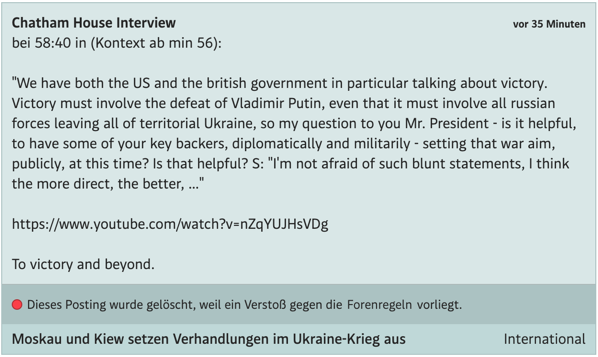
Kontext aus dem Chatham House Interview, vor einer Woche, bei 58:40 in (mehr Kontext ab min 56):
CH: “We have both the United States administration, the Biden administration and the british government in particular talking about victory. Victory must involve the defeat of Vladimir Putin, even that it must involve all russian forces leaving all of territorial Ukraine, so my question to you Mr. President - is it helpful, to have some of your key backers, diplomatically and militarily - setting that war aim, publicly, at this time? Is that helpful to you as president of the Ukraine, or not?”
Selenskyj: “Well, its a very complicated question. I’m not afraid of such blunt statements, I think the more direct, the better, the easier for Ukraine and the european society and the russia society for that matter - for them to understand that if we dont stop this -- lets come back to the allegorical situation - then all the bridges will be burnt [referring to the right now there are still open venues for talks]. So we have to be open discussing that. If there is… Bilaterally [meaning within the western backer infrastructure] we can discuss this without allegories, we diplomatically can only discuss the specific steps. So what victory is for us the notion, for the european union, that is for the UK, for the US [trying to broaden the question to be able to give a more general answer] - for some people it may be Putins defeat - and in our society, there is a big portion of people, thinking exactly that. But for me the victory, … I dont care what happens to some leaders, where they will end up, for me what matters is Ukraines victory. And by Ukraines victory we mean “something that belongs to us” - this is our territory and our people -- for me victory is not to loose 11 million people. Five milion people who have left Ukraine, they have to come back - thats my victory. And I’m thinking about it, because for me victory is at least, bringing the country back economically, at least to the situation when it all started, as a good beginning - but also for the western world to have complete awareness, what is happening here and what the pain is like, they should feel our pain, that will unite them [in pain], and that will never be effected by russian propaganda, and they will help us all the way. And for us, for me, victory is - admission to accession to the European Union, with all the pros and cons, and when we discuss that - and thats the will of the ukrainian people, and this all started in the Maidan , we’ve had revolutions to that effect, and this war is also about, that this can not be in vain, so Ukraine in the EU is not the principle, the major victory, but we can not just disregard the people, who sacrificed their lives for that, so its the dream, its the will, and the steps that we made, and thats what we intend to do, as a nation And if someone from europe, even now, they have already received our refugees, they’ve seen all the footage in the world, they’ve listened to me, to us, they are listening now, they realize what is happening here. In Mariupol people are dying in thousands, but there are still some persons who want to get some oxygen without even attempting to breath, and they want to strike the balance, they want to be in the grey area, stay in the shadow, while some people say its a walk inbetween the drops of rain. And… This is not a rain! It never rains, it pours! as the saying goes, and this is the war of what - there are no drops anymore, we are all wet, by now. Soaking wet. And - this is cynicism, this is the lack of adequacy, in some leaders, in some developed countries. And the adequacy of world [cohesion, doing all that we’d as you to do to be adequate], is also victory for Ukraine. That will influence us, it does influence us, really. And what will happen to some individuals in russia, you know - why should I think about the oder side - the military, their leaders, their president, and what will happen to them - they should be punished for what they did, that is the most important thing, in my book. According to the international law. But if they come here, and even fail to collect their debt, and they dont care about a quick - why should I care? Its them. I have to think about my people, my citizens.”
Alles klar? Und das ist der Grund, weshalb wir Verhandlungen über ein Ende des Krieges vorerst ausgesetzt haben.
Natürlich “Moskau und Kiew” im wording des Standard.
To victory and beyond.
Diese Gesellschaft ist das Letzte.
Achja, und die Standard Zensur in Aktion:
Hier gab es kein Vorgeplenkel. Das war mein erstes posting heute am Tag. Eine Überprüfung der Entscheidung einzuleiten ist mir nicht möglich. Diese Gesellschaft ist das Letzte.
Diese Webseite verwendet Cookies um die Nutzungserfahrung für seine Besucher zu verbessern. Bitte informiere dich bei Gelegenheit darüber wie sich Cookies auf deine Privatsphäre im Web auswirken.