That summer she talked to a family at the american embassy in Moscow, who hired her as a nanny, so she could get a visa extension, and she really looked after a bunch of children this summer, but also “traveled all over the place”.
Oh, and she confirms, that it wasnt Butcha, why the peace negotiations stopped --
Aber aus irgendeinem Grund scheint der Lanz zu glauben die notwendige Aufarbeitung der Journalistischen Performance bei der Berichterstattung über diesen Krieg liese sich mit “schrein wir die Wagenknecht nieder” übertünchen…
- where Zygar can talk about building this really great, honest and true russian opposition, that will run russia in case of a coup…
I hope there are some more Nuland “stingers” (notable moments) in this video, because I’m only about 5 minutes in and already had to document her storytelling - anecdote wise, on how good she taught russian people squaredancing in Odessa, and how well she cared about those children as an Au Pair in Moskow, while traveling all over the country in those six months… - while she was working for a US congressman - back in the US, who allowed her to take this time off… Because it was just too good to let it slide.
And the best part? As she returned back home, she found an invitation from the US state department in her post box to work there.
Love it!
edit: Also of course Victoria Nuland doesnt know the difference between a debt cut and an IMF credit in the 90s, … - but hey at least half of Germany doesnt either, Sondervermögen sei Dank. Gut, der IMF Kredit war in USD nicht in Rubel, aber was macht das schon für einen Unterschied… Dem Zygar fällt da nichts auf. Er ist ja nur legitime russische Opposition.
edit: Sorry, sorry - I have to interject again, the cookies were sandwiches, and Nuland organized them to be handed out to protesters because of “too much slavik instinct”, because “those protesters were 18 and 19 year olds, after a long night of being kettled in by Ukraines (Janukowytschs) police forces”.
Of course Nuland also thought, that leaking the “fuck the EU” phonecall really showed how desperate Putin was, and that he didnt see any other way out of the situation other than “to make me famous”. Nuland thought that was a “move born out of desperation”.
Ah storytelling, I better book a workshop soon to get as good as Nuland!
Verteidigungsminister Boris Pistorius (SPD) hat die Notwendigkeit der schnellstmöglichen Ausstattung der Bundeswehr bekräftigt. Bis 2029 müsse man damit rechnen, dass Russland seine militärische Rekonstitution abgeschlossen haben werde und in der Lage sein könnte, einen militärischen Schlag gegen Nato-Gebiet zu führen, sagte Pistorius angesichts des russischen Angriffskriegs gegen die Ukraine.
Kann man das bitte mal genauer begründen, oder ist schon Vorwahlkampfphase?
Hintergrund: Weder Chatham House, noch Kofman, noch CSIS, noch Gressel, noch… Also niemand hat das bisher auch nur angedeutet.
Selenskyj behauptet Sieg Ende 2025 - gut, hörn wir nicht drauf, der Rest mehr so 3-10 Jahre war of attrition, aber der SPD Kanzlerkandidat in spe…
edit: Ah, schau an - der Pistorius liest Atlantic Council Copy, und BR24 weist das als Eigentleistung aus…
NATO-Russia dynamics: Prospects for reconstitution of Russian military power
Executive summary
The Russian Federation’s full-scale invasion of Ukraine on February 24, 2022, brought war to the North Atlantic Alliance’s doorstep—altering the political-military dynamics between NATO and its neighbor to the east. Since the Russian invasion, NATO has been undergoing a dramatic change that has impacted its plans, command structure, force model, and capabilities requirements. The effectiveness of this change must be gauged against the adversary’s ability to field its forces and resource them in a way that negatively impacts the Supreme Allied Commander Europe’s ability to execute the new regional plans. The delta between how quickly Russia can rebuild its military and how quickly NATO can rearm, especially the European allies, will define the risk level for the Alliance should deterrence fail. A credible assessment of the speed with which Russia can reconstitute and expand its military—especially its land forces component, which has been significantly attritted during the current campaign in Ukraine—is crucial to accurately assessing NATO’s overall force posture and ability to respond should Russia choose to attack a member of the Alliance. Here, the expertise and assessments of the United States’ allies most exposed to the Russian threat along the eastern flank offer valuable insights from the frontline, augmented by their regional expertise and understanding of Russian culture, politics, and military infused with centuries of experience of living next door to Russia.
In support of United States European Command’s Russia Strategic Initiative, the Atlantic Council organized two workshops—in Warsaw, Poland, and in Helsinki, Finland—to gain a better understanding of alternative futures for Russian military reconstitution and its implications for security on the European continent. The workshops were designed to assess (1) how Russia will reconstitute its land forces in response to ongoing developments in Ukraine and NATO force adaptation, (2) the vulnerabilities hindering Russia’s vision for the reconstitution of its military, and (3) the threat of future Russian capabilities to the transatlantic security architecture.
Key takeaways from this line of effort include:
Russia has demonstrated that it can fight and mobilize at the same time.
The pace of Russian military reconstitution has been faster than Western analysts expected, including both refurbished and new equipment and manpower mobilization. Still, the readiness of the Russian armed forces is not likely to be the principal driver of decision-making in Moscow; rather, any decision to attack a NATO member will factor in the “correlation of forces,” with the goal of exploiting the Alliance in a moment of weakness.
Based on production data, the biggest risk of Russia attacking a NATO member will be in 2025–26 when peak production, refurbishment, and training/readiness lines intersect. One analyst projected Russia will produce well over one thousand tanks annually by then.
Moscow will not, however, make decisions based on objective indices of readiness alone. It will decide to move against a NATO state when it deems that the window of opportunity has opened—hence, understanding the political culture that undergirds Russia’s decision-making is as important as having an accurate assessment of its military capabilities.
The West is in a race against time, with the delta between Russian force reconstitution and NATO’s investment in real, exercised military capabilities constituting the level of risk in the European theater in the event of a full-scale war. Closing the gap will require NATO to prioritize rearmament across the board, including its defense industrial base in Europe and the United States.
edit: Oh Wunder, oh Wunder, Chathamhouse sah das noch im Juli ganz anders… Pick your favourite Anlaysts! I KNOW, I KNOW, I’M BORISPISTORIUS, I’M PICKINGANALYSTSFROM Warsaw, Poland, and Helsinki, Finland, THOSEWILLTELLMETHEUNFILTEREDANDBALANCEDTRUTH! (Well in EU terms, you got to listen to the most freaked out members, I guess…)
08 Conclusion
Mathieu Boulègue
Consulting Fellow, Russia and Eurasia Programme
Just as the war in Ukraine has highlighted both weaknesses and resilience in the Russian military, the lessons for the West are equally mixed. Signs of Russian vulnerability offer no grounds for Western complacency – but point to the importance of reducing Russia’s war-making capacity by attrition. Above all, continued Western support for Ukraine will remain crucial.
More than two years into the full-scale invasion of Ukraine, Russia remains able simultaneously to continue to prosecute the war and to effect wartime adaptations to its command structure. With varying degrees of success, the Kremlin has been able to rapidly mobilize reservists, employ private military companies, sustain military-industrial production for basic systems, and heavily militarize the public information space in support of the war.
In terms of command structure, the separation of the Western Military District into Moscow and Leningrad districts in March 2024 is also telling.163 Moscow is now reverting to its ‘comfort zone’, namely Soviet-era command structures in the European theatre. The new Moscow Military District will concern itself exclusively with Ukraine, Belarus and Kaliningrad, which will inevitably be of direct concern to the US and NATO in the Baltic theatre as well as on the eastern flank of the Alliance.
The pace of implementation and the efficiency of continued reforms in the command structure, however, remain to be seen. They will partly depend on the effectiveness or otherwise of the new minister of defence, Andrei Belousov, appointed in May 2024. Similarly, it is unknown if the Russian Armed Forces can be a ‘learning organization’ able to implement genuine changes, whether structural or cultural.164
On top of wartime adaptations in the command structure, the military industry has displayed resilience in its ability to deliver military equipment and hardware in the war against Ukraine. The ongoing reconstitution of military equipment and hardware will inevitably inform the next cycle of the State Armament Programme (GPV) after 2027, as well as future plans regarding modern military technology and military innovation.
The Russian Armed Forces remain a credible threat to NATO and its allies. In Ukraine, the Russian military has shown it can absorb losses and maintain tactical-operational credibility despite strategic failures. Russian forces can count on improved reconnaissance fire and strike complexes equipped with a vast arsenal of long-range precision munitions, as well as larger quantities of improved uncrewed aerial vehicles (UAVs). Russian long-range strike and stand-off munitions, coupled with multi-layered air defence systems, represent the biggest conventional threat to NATO.
The Aerospace Forces (VKS) and the Russian Federation Navy (RFN) remain critical parts of the nuclear and conventional strategic deterrence force, potentially holding NATO assets at risk of destruction. Finally, asymmetric capabilities – especially the use of cyber and information warfare; electronic warfare for counter-UAV and counter-precision-guided-munitions operations; and space-based assets – are still able to offset NATO and US conventional superiority.
Russia’s prospects for regenerating its military machine remain mixed, both in terms of speed and effectiveness. Yet as the war against Ukraine continues, and regardless of the depth of the reconstitution of Russia’s military power, the current Kremlin leadership will remain a threat to European and transatlantic security as well as a strategic competitor to NATO and its allies.
Analysis of Moscow’s nuclear declaratory policy suggests that if Russia were to suffer sufficiently severe degradation of its conventional military power, such that the leadership deemed the existence of the Russian state to be under threat, this would create conditions under which Russia might consider the use of nuclear weapons.165 However, this possibility remains remote, especially while Russia’s air arms, and its naval forces beyond the Black Sea, remain relatively intact.
Furthermore, Russia will continue to exploit its toolkit of asymmetric capabilities and ambiguous sub-threshold tactics. These tools must no longer be analysed as part of a ‘grey zone’ or ‘hybrid’ range of measures aimed at blurring the line between war and peace. They are fundamentally part of Russia’s continued low-intensity warfare against Western interests.
Continued assessments of Russia’s military reform and of its ongoing reconstitution of equipment are vital to understanding in which sectors Moscow still represents a threat to Western interests. Such assessments will be essential for the US and NATO in terms of retaining both a technological and overall deterrence advantage against the Kremlin.
The single most significant factor that can impair Russia’s ability to reconstitute its overall military power and leverage asymmetric capabilities in coming years will be ongoing Western support for Ukraine.
Finally, the single most significant factor that can impair Russia’s ability to reconstitute its overall military power and leverage asymmetric capabilities in coming years will be ongoing Western support for Ukraine. Western countries must continue to work together to provide Ukraine with arms, ammunition, financial support and refugee assistance, and to show moral solidarity with the Ukrainian war effort.
Denying Russia victory and forcing it to continue in a long attritional struggle will further degrade all elements of its war-making capacity, including its ability to invest in and produce cutting-edge technological enablers. Critically, these efforts will also further undermine the Kremlin’s informational strategy both at home and abroad, diminishing its ability to destabilize Western democratic systems and, ultimately, weakening its long-term hold on power.
This House Would Fight for Democracy, Liberty & the Rule of Law Abroad (OxfordUnion)
https://www.youtube.com/watch?v=mEwmtZtOgGo
I counted:
3x Hitler
2x Genocide
1x shame
and
1x neverending war for our children, if we let Russia win
on the side of the “would fight for democracy” fraction.
The unsettling part being, that the majority of people in europe think like me, when it comes to fighting for their country - never mind democracy.
But as we all know, the emotional argument wins -- damit kann der Krieg dann ja endlich weitergehen.
Bonus: The US intervention in Kuwait, according to the proponents for the motion was also to safeguard international rule of law.
Its interesting to see how far back some concepts go.
oder Neuigkeiten auf dem Gebiet der konventionellen und weniger konventionellen Kriegsführung
Reisner schätzt aktuell den Defensivbedarf der Ukraine bei Kampfpanzern und Kampfschützenpanzern auf 300 -- und den Bedarf für eine Offensive die das aktuelle Kriegsziel der Ukraine erfüllen könnte auf “weitere 3000”.
Das Verhältnis Kampfpanzer zu Kampfschützenpanzer ist dabei 1:2 (selbes Videointerview).
Laut statistica.com hat Europa im Jahr 2024 gesamt 4540 Kampfpanzer, von denen die Ukraine in der Defensive demnächst 100 braucht um weiterzukämpfen, und 1000 um nochmal in die Offensive gehen zu können -- um auf dem konventionellen Weg ihre Ziele (Rückeroberung aller ukrainischen Gebiete mit dem Stand vor 2014) zu erreichen.
Das wäre also nochmal ein Viertel aller in Europa verfügbaren Panzer.
Laut wikipedia liegt die Aufstockungsquote in Deutschland bei 39 in vier Jahren, dh 10 Panzern pro Jahr - bei 300 Bestand. Dh. die Ukraine bräuchte von Deutschland so viel, wie Deutschland in 8 Jahren durch Produktion lukrieren kann.
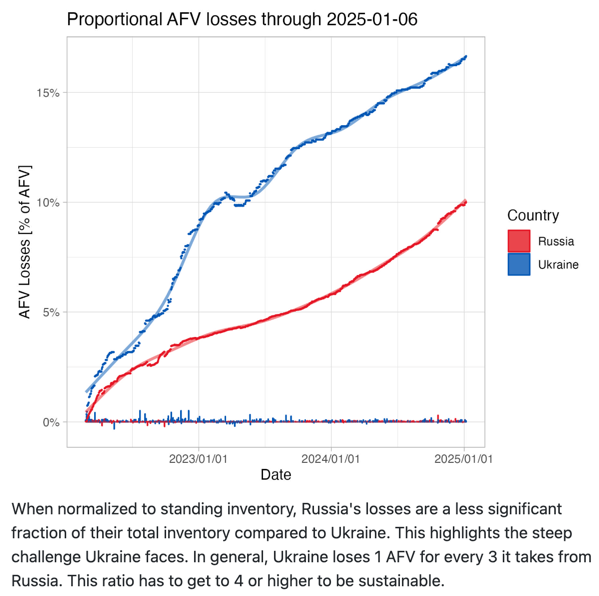
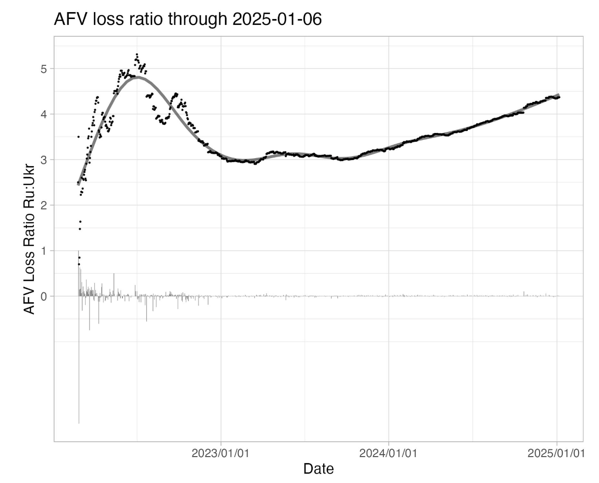
Laut Oryx hat die Ukraine bisher etwa 1000 Panzer und Schützenpanzer verloren. Aktuell hat die Ukraine ebenfalls laut Oryx etwa 2000 Panzer und Kampfschützenpanzer im Einsatz.
Zusammengefasst, für das Potential eines konventionellen Sieges (alles Gebiet zum Stand von vor 2014 zurück) bräuchte die Ukraine 2.5 mal MEHR Panzer als sie derzeit hat -- und das wären ein gutes Viertel aller in Europa derzeit noch verfügbaren Panzer. (Ohne Angabe zur tatsächlichen Einsatzbereitschaft der staatlich angegebenen Zahlen, wir kennen das Problem aus Deutschland. Zumal 1365 von den 4540 in Griechenland stationiert sind.)
(Alles unter dem Vorbehalt, dass die US keine Abrahams mit Turbinenantrieb schicken. (Aktuell warens 31.))
Jetzt zur weniger Konventionellen Kriegsführung:
Laut Zeihan hat die Ukraine möglicherweise die russische Rail Logistik einsehen können und beide Seiten wissens.
Bedeutet - die Ukraine hat ein besseres Verständnis von Russischen Munitionsdepots (Zahl - Ort, Menge) -- und könnte jetzt die Russische Logistik durch Angriffe auf die russische Energieinfrastruktur empfindlich entschleunigen (russische Züge sind zum Großteil elektrifiziert und fahren mit Strom).
edit: Kiev Post Editor in Chief indicates, that Ukraines “winning” is in large part a regime change play, so getting the current regime to topple in russia:
First off - it is amazing to see Fiona Hill show that much restraint. For once. The selective framings are few and far in between if you just look at the statements of Hill and Constanze Stelzenmüller. They are still there, but this time they are very muted.
Of course Hill is still needed to tell the story that this is one persons war - and Putin was so isolated, and mostly worried about his legacy, and that this was a plan that he had for years and planned out meticulously, which of course is disputed by both the initial Naftali Bennett Interview (the isolation part) - as well as Stephen Kotkin, and David Arakhamiia (the head of Selenskyjs party) by now -- but Fiona this time around has downgraded her “isolation” argument to “isolated with the same people” (so didnt talk to the west, during the Corona lockdowns?), which was when Putins decision - according to Fiona - was made to attack Ukraine, because Putin thought mostly about his lifes legacy in those days. Which Fiona of course knows, because she knows how Putin thinks. Because of those four stone statues she saw in his office in 2015 - when she last participated in a Valdai Discussion Club meeting. Thats a very tame version of her story (that still contains double Vladimir btw - which is amazing), but none of her other logic jumps - she previously made, when presenting her “what Putin thinks” story in the past.
Because Kotkin by now states, that the most popular public narrative in the west has now changed from “crazy Putin” to a “this was the goal of the broader russian leadership” one, because the russian people seem ok with it, and because the “crazy Putin narrative” kind of fizzled out over time, making Fionas input, narrative wise, less and less important.
Stephen Kotkin: “So it’s really Putin personal, capricious, whimsical, his personality, his KGB past, all the things that you write about. That explanation was popular until recently when people started to see that it wasn’t only Putin in the war in Ukraine, that Russian elites seemed to fall in line. Not everyone, but many of them.
The Russian people didn’t seem on on mass to oppose the war. Yes, many did and suffered for it, and many are in exile or in prison as a result. But it’s hard to say that this is one person alone. It’s also hard to say that any of the alternatives would’ve been different once they’re in power.
Cause Putin wasn’t today’s Putin when he first came to power. It’s also hard to understand how if they had been different, they would’ve survived. Just because you come to power doesn’t mean you survive in power. You can come to power by accident. But surviving in power for decade after decade is not an accident.
And so this, the second explanation, it’s Putin or predominantly Putin, I don’t think holds water.”
Of course Fiona Hill is also famous for her appearance at the CFR here:
Where she encourages the audience the people in the CFR and journalists to come up with better storytelling, to tell to people in a simple way what has happened, trying to regain them in mass, after having lost them -- referencing the two thirds of the world that might believe in chinas view on the events f.e.
Here the moneyquote:
Fiona Hill: “You know, you’ve lost—forgotten—and this is exactly what he said. You’ve kind of lost humanity. What’s happened to the Americans who go out there and tell a story, you know, that makes it very clear about why people are doing things? And, you know, that’s something that members of the Council on Foreign Relations do. It’s why we’re having this event.
It’s also what people do in journalism, like Serge and, you know, all of his opinion and commentary pieces. But it’s kind of, you know, something that we’re all going to have to do on a regular basis. And, you know, I think some of you might have read just recently in the New York Times the movie of Bulgakov, Master and Margarita, that’s being shown, you know, right now in in Russia and having an impact. We’ve got to start being creative about things like this, about telling stories.
The story of Alexei Navalny dying—you know, somebody of that kind of unspeakable bravery to, you know, do the things that he did, and to sacrifice himself in the way that he did—telling that story and moving it forward.
Because you can’t just leave Vladimir Putin to tell the story. And I think that this documentary is a challenge to all of us about how do we get out there and work on the narrative.”
Thank you Fiona!
Next we look at Constanze Stelzenmüller, who of course, as always, finds it so hard to deal with that fact, that in germany there still isnt this notion, that there is a real war going on right now between the west and china, and that we really ought to take a hint and side with the americans on this -- “because of democracies vs. authocracies”, right?
Right. So - here is why thats so hard for the germans to understand. Because the german economic infrastructure is interwoven with China in a different way, than the one in the US is. So while the US benefits from 100% tarrifs on chinese goods, the german economy actually suffers even from the lower impact tarrifs the EU has by now put on chinese electric vehicles (see, Politico: Germany launches 11th-hour bid to avert trade war with China) but Constanze just cant fathom why thats still the dominant view in germany.
Trying to debunk the two male counterparts on this panel is an excercise in futility, because they flog emotional “US, the shining city on a hill” narratives where about every second sentence is wrong - in a fundamental way -- so I will not even try that to -- for once, keep this posting from exploding into 10 pages of dealing with idiotic gobbledigug.
And there is a final slight, soft framing thats established in the Brookings Institution panel discussion here, that still touches on -- well russia had no real reasons to start this war.
While on the fundamental level thats correct, this seeks to simply outfence all the international policy maneuvers the US and the Ukraine put in place beforehand to essentially free Crimea, which might have been an essential impetus for Russia to start this war -- as Herfried Münkler states here:
And which Angela Merkel also openly alluded to when talking about the nature of Minsk 2.
So take your NATO narrative, and essentially stuff it -- even though this is the tamest and closest version to what will be in our history books ten years from now.
(Putin manipulated russian history as a high priority goal since 2015 - I’m still an equal opportunity take your shit and stuff it kind of guy. (Hopefully.))
Vorurteil 1: Es gibt niemand Dümmeren als die die deutschen Vertreter in der Atlantik Brücke. Punkt.
Vorurteil 2: Jeder redet nur so wies ihms selbst ins Geldsäckl opportuniert. Ich habe dafür eine eigene Kategorie in der Vortragsbewertung die ich mit “give me more money” tituliert habe - was so ziemlich in jedem zweiten Vortrag einer der Haupmotivatioren eines der Vortragenden ist. Ich warte immer sehr gespannt darauf, wanns denn wieder so weit ist. Das ist unabhängig von der Sinnhaftigkeit einer Aussage im Vortrag zu werten, da das Motiv auch unabhängig davon von Leuten zum Einsatz gebracht wird. Jeder will besser leben, und das am Besten ab morgen -- und wenn der Vortrag dem Vortragenden dabei hilft - kommt das zum Einsatz, egal obs im Kontext Vortrags sinnvoll ist, oder nicht.
Vorurteil 3: Wenn du von den US fürs Denken bezahlt wirst, wirst du von den US bezahlt.
Hier nur ein paar kleine Widersprüche in Folge:
“Was glauben sie denn warum Japan Nr. 5 Geldgeber der Ukraine ist!”.
Versucht das Motiv “weil wir uns in einem Krieg Demokratien gegen Autokratien befinden” als Begründung rauszucoaxen, das ist aber an der Stelle Schwachsinn.
Also: Hintergrund -
1. Japan bekommt die Rüstungsquoten im Land nicht so zusammen wie Japan das möchte:
https://www.nzz.ch/meinung/japan-sucht-verzweifelt-soldaten-und-setzt-auf-das-falsche-rezept-ld.1847584
2. Japan setzt (neben China, das politischer Rivale in der Region ist, und zukünftig als Absatzmarkt an Bedeutung verlieren wird) als Exportnation voll auf die US als Absatzmarkt, und das bereits vor dem Ukraine Krieg, weshalb Japan auch zu grottenschlechten Konditionen in US Wirtschaftspartnerschaftsabkommen eingewilligt hat - als es rein um seine ökonomische Zukunft ging. Deutschland nicht. Das macht das ja erst unter Friedrich Merz.
3. China ist nicht Russland nach zweieinhalb Jahren Krieg.
Also - lieber Herr Atlantikbrücken-Vertreter, denk nicht so sehr an den nächsten Mamorbrunnen in deinem Vorgarten, lass Japan als Begründung für “warum wir das in Deutschland auch weiterhin so handhaben sollten” stecken, und schau dir die Sache im Detail an.
Genannte Detailaspekte: “In den nächsten 10-15 Jahren schauts um die Verteidigungsfähigkeit Europas nicht gut aus, sie unterschätzen Russland”.
Wirklich? Sicher?
Also hier ist meine Auffassung von “der Atlantik-Brücke Trottel gibt vor dass wir Russland unterschätzen”:
1. In exakt zehn Jahren hat Russland eine Demographie mit Leuten im einsatzfähigen Alter (Militär), die der von Polen entspricht. Nicht proportional - 1:1. Und das einfach nur nach Demographiedaten gerechnet, nicht nach Kriegstoten im Ukraine Krieg.
2. Die US behaupten seit Anfang des Krieges, dass sie im Falle eines Atomwaffeneinsatzes nicht nur die gesamte Russische Flotte, sondern auch die gesamte aktive Armee vernichten werden.
3. Wir zahlen für die gesamte Unterstützung der US seit Jahrzehnten, auch wenn sie im Zweifelsfall das Geld nicht wert ist - wenns grad innenpolitisch nicht opportuniert, oder die US fürchten müsste aussenpolitisch “over-stretched” zu werden, wenn China beginnt geopolitisch Aktivitäten anzuziehen.
Woraus sich folgende Faktenlage ergibt.
1. “Sie unterschätzen die Lage” ist nichts anderes als “lass doch die Ukrainer sich für uns aufreiben”, mit Waffen die wenig kosten.
2. Das ist spieltheoretisch das schlechteste Szenario für beide Seiten. Also das Idioten Szenario, das im realen Leben nie zustande kommt, weil niemand so blöd ist rein nach spieltheoretischen Kriterien zu agieren. Es ist auch das am wenigsten humanistisch idealtypische.
3. Dahinter steckt nichts anderes als Furcht vor Verantwortung (Aufarbeitung von “wer hat was ausgelöst”, “was waren die Motivationen der anderen Seite”, denn wenn ich meine Zeit bis zur Pensi noch mit “der Putin ist Hitler” rumbekomm, war ich in verantwortlicher Position für fehlerhafte politische Lenkungsentscheidungen nicht schuld. Hurra.) Und ein Stück weit strategisches Kalkül, das einen Abnützungskrieg eigentlich ganz prima sieht, weil er die zukünftige Eskalationswahrscheinlichkeit senkt.
4. Dass Russland dabei bereits heute am Rande einer Demographiefalle steht, wird ausgeblendet (vielleicht zurecht, Autokratien haben andere Möglichkeiten zur internen Stabilisation).
und
5. Unsere offizielle Begründung für unser “integeres Verhalten” im Sinne von “soll die Ukraine nur weiter machen” sind -- die Werte die hier genau an jeder Ecke und Stelle schmerzlich nicht vorhanden sind.
Über diesem Komplex von Theoretisierung und Begründung (“Russland ist ja so enorm gefährlich”) steckt immer nur - einzig und alleine Risk Mitigation (“mehr Abnützungskrieg”).
Der Ansatz “Putin kann man nicht trauen” und “Putin versteht nur Macht” reicht nicht aus - um wie aktuell Tag täglich stattfindend, Ansätze für Verhandlungslösungen zu delegitimieren.
Es sei denn Europa ist wirklich der Meinung (also die jeweiligen Nato Staaten innerhalb Europas) die US würden im Ernstfall rein garnichts beitragen.
Und daher bräuche es noch 10 Jahre um selbst so hoch zu rüsten, dass wir für einen Verhandlungskompromiss eigenständig das Abschreckungspotential stellen können.
Das ist aber nicht der Fall - weshalb die moralische Perspektive des Atlantikbrücken Honchos eine komplette Lüge ist.
Eine einwandfreie, rhetorische Finte.
Aus Sicht der Riskmitigation (auch im Sinne einer höheren Abhängigkeit, falls die US tatsächlich in diesem Sinne noch einmal massiert gegen Russland in Europa vorgehen müssten (*hust* sollten da mal nicht zuerst Atombomben auf Deutschland runtergehen, der Reisner hat da mal so was erwähnt *hüstel*?) ist das aktuelle Agieren Europas verständlich.
Aus moralischen, oder liberalen Handlungsmaximen heraus ist es abartig, und das Hinterletzte.
(Wir wollen kein Risiko eingehen, bei dem am Ende Polen den Krieg weiter führen muss, so gering es nach zwei einhalb Jahren Krieg, und Verhandlungen mit Russland auch ausfallen würde. Und nochmal das wäre nicht das idealtypische Szenario, das wäre das “Russland hat uns erneut gelegt, und das sind die Folgen” Szenario. Spieltheoretisch gäbs beidseitig und auch für die Ukraine bessere.)
Und um das zu kaschieren - wird die Ukraine zu moralischsten Opfer auf Gottes weiter Flur hinstilisiert (ein Krieg von Gut gegen Böse) -- und sie ist ein Opfer eines Angriffskriegs - nur die moralische Überhöhung ist nochmal ein Stückweit etwas anderes - solange sie nur weiterkämpft. (Für demokratische ideale! Für die Werteordnung! Für den Sieg!)
Einschub:
Christina Rebhahn-Roither vor 16 Stunden
Offenbar weitere Personalumstellungen im ukrainischen Verteidigungsministerium
Im ukrainischen Verteidigungsministerium laufen offenbar weitere Personalumstellungen. Übereinstimmenden Medienberichten zufolge wurden zwei Stellvertreter des Militärgeheimdienstchefs Kyrylo Budanow durch Verteidigungsminister Umjerow entlassen. Die Entlassungen seien bereits vergangene Woche ohne Rücksprache mit Budanow erfolgt. Initiator der Personalie soll Präsidentenbürochef Andrij Jermak sein, der damit den Chef des Militärgeheimdienstes schwächen wolle, hieß es in den Berichten.
Dem Nachrichtenportal “Ukrajinska Prawda” zufolge soll Umjerow zudem etwa 20 Generäle und hochrangige Mitarbeiter entlassen wollen oder bereits geschasst haben. Weder Umjerow noch Budanow kommentierten die Berichte.
Selenskyj setzt Erhöhung der Militärausgaben in Kraft
Das ukrainische Militär bekommt im Abwehrkampf gegen Russland mehr Geld. Präsident Wolodymyr Selenskyj setzte per Unterschrift die zuvor vom Parlament beschlossene Erhöhung der Militärausgaben um 500 Milliarden Hrywnja (rund 10,8 Milliarden Euro) in Kraft, wie Medien in Kiew meldeten. Finanziert wird die Erhöhungen demnach durch Schulden, Steuern und durch eine Erhöhung der Abgaben auf Tabak und Treibstoff. Von den Erhöhungen sollen noch in diesem Monat auch Frontzuschläge für Soldaten bezahlt werden.
Die Oberste Rada, das Parlament der Ukraine, hatte am 18. September wegen des andauernden Kriegs einen Nachtragshaushalt verabschiedet. Die Budgetausgaben steigen damit um gut 13 Prozent auf umgerechnet über 81 Milliarden Euro - ein Rekordwert für die Ukraine.
Laut Selenskyj noch keine Zustimmung von USA und Großbritannien zum Einsatz von weiter reichenden Waffen in Russland
Die von der Ukraine erhoffte Zustimmung ihrer westlichen Verbündeten USA und Großbritannien zum Einsatz von weiter reichenden Waffen in Russland steht nach den Worten von Präsident Wolodymyr Selenskyj weiterhin aus. “Weder Amerika noch das Vereinigte Königreich haben uns die Erlaubnis erteilt, diese Waffen auf dem Territorium Russlands einzusetzen, und zwar auf beliebige Ziele in jeder Entfernung”, sagte Selenskyj am Freitagabend in einem Gespräch mit Journalisten in Kiew. Die Aussagen waren erst am Samstag zur Veröffentlichung freigegeben.
Die Zurückhaltung der westlichen Partner erklärte Selenskyj mit der Furcht vor einer “Eskalation” mit Russland. Er versicherte, die ukrainische Armee habe “keine Langstreckenwaffen auf dem Gebiet der Russischen Föderation” eingesetzt. Die Führung in Kiew dringt darauf, weiter reichende westliche Waffen gegen Ziele in Russland einsetzen zu dürfen. Der neue ukrainische Außenminister Andrij Sybiha erklärte jüngst, es sei wichtig, “alle Beschränkungen für den Einsatz amerikanischer und britischer Waffen gegen legitime militärische Ziele in Russland aufzuheben”.
Und um das (solange die Ukraine nur den Abnutzungskrieg weiterkämpft!) als Initialmotivation zu kaschieren - werden wir seit zweieinhalb Jahren mit “Demokratien vs. Autokratien” Narrativen zugeschissen - während wir zur selben Zeit wieder abhängiger von den Golf Staaten werden.
Mit den US, dem guten Freund und Wertepartner, die es uns erlauben das schlechteste spieltheoretische Szenario noch 10 Jahre zu prolongieren.
Weiter risk mitigation. Durch einen weiter andauernden Abnutzungskrieg.
Oder du glaubst an die Werte.
Dann musst du aber wirklich sehr behütet aufgewachsen sein.
Eine Meinung. (Meine Meinung.)
edit: Zusatz, wobei am anderen Ende von “Risk Mitigation” steht dann natürlich ein geschwächtes Russland, und das wär in 15 Jahren ja wieder für Europa sehr opportun, … Nur dass das für meine Generation dann, wirtschaftlich gesehen, komplett egal ist.
Und ich verarsche keine Leute meiner Generation mehr.
Also kann der Krieg ja endlich wieder weitergehen.
TLDR; Der Deutschlandvertreter der Atlantikbrücke bei der Körberstiftung, versucht den Anwesenden von der Bühne aus klar zu machen, dass wir Russlands Militärpotential auch weiterhin unterschätzen und daher noch 10 Jahre Aufreibreibungskrieg brauchen.
Während das Government Office of Sweden gerade folgendes herausgibt:
Selenskyj strebt laut Medienberichten Gespräche mit Moskau für “Siegesplan” an
Der ukrainische Präsident strebt zur Umsetzung seines “Siegesplanes” Gespräche mit Russland an. Der Plan könne zukünftige, effektivere diplomatische Treffen mit Russland ermöglichen, sagt Selenskyj ukrainischen Medien zufolge vor seiner Abreise in die USA, wo er seinen Plan erst Präsident Joe Biden und dann der Weltöffentlichkeit vorstellen will. Es seien drei Punkte darin, über die mit Russland in beliebigen Formaten gesprochen werden solle.
“Der Siegesplan sieht schnelle und konkrete Schritte unserer strategischen Partner vor - in der Zeit vom heutigen Tage bis Ende Dezember”, sagt Selenskyj der Nachrichtenagentur Interfax-Ukraine zufolge. Die Umsetzung sei von den Partnern abhängig. Der Plan solle die Brücke schlagen zu einem zweiten Friedensgipfel, an dem auch Russland teilnehmen solle, sagt er.
Zugleich machte er einmal mehr deutlich, dass Moskau aus seiner Sicht nicht an Friedensgesprächen interessiert sei und den Krieg fortsetzen wolle. Zum ersten Gipfel im Juni in der Schweiz war Russland nicht eingeladen.
Gestern, also im September 2023 sitzt Francis Fukuyama (von heute aus betrachtet) seit drei Jahren auf der Yalta Conference - und singt mit
Kräfte des Sieges: Serhij Zhadan singt auf der YES-Konferenz in Kiew, Timothy Snyder und Jaroslaw Hrytsak sprechen dort über die alte Verbindung von Getreide und Gewalt. Und Francis Fukuyama erkennt, wo man die liberale Demokratie einfach nicht mag.
Die von den US auch bereits seit Juni 2024 wieder mit Waffen versorgt werden dürfen:
On 10 June 2024, the United States Department of State announced the lifting of a ban which previously prevented the Azov Brigade from using weapons supplied by the US, writing in a statement that “Ukraine’s 12th Special Forces Azov Brigade passed Leahy vetting” and that the department found no evidence of human rights violations committed by the unit. This policy shift allows the Azov Brigade to use the same US military equipment as any other unit in the Ukrainian National Guard.[169]
In August 2024, the brigade was reportedly diverted from Lyman to assist in the ongoing fighting around Niu-York.[170]
Der Wertewesten hat ja alles. Vor allem Wissenschaftsfreiheit, darum befragt man ja auch als erstes Garri Kimowitsch Kasparow, den Ukraine Krieg Experten schlechthin.
Es wär doch wirklich grausam, wenn bei uns im Wertewesten Wissenschaft von Politik vereinnahmt werden würde.
Moderator: “Francis Fukuyama, you were just in Ukraine, and we reached a milestone, just this week, with 1 Mio. casulties after two and a half years of war, what are they talking about in Ukraine about how this could end.”
Francis Fukuyama: “There is not a clear conception, except that everyone feels, that the war will not end until they can put more military pressure on russia. And the Ukrainians are very frustrated at the Biden Administration for having put restrictions on the way that some of their long range weapons particularly the ATACAMs, and longer range missiles are constrained to within just a few kilometers off the border. And they FEEL that russia is able to attack them from a safe sanctuary they cant reach, and they are UPSET about that.”
Moderator: “Would you agree with them, or do you think it would be dangerous for the US to allow and the UK to allow its missiles into the russian homeland?
Francis Fukuyama: “I dont think there is any choice there. The constraint has been driven by a fear of escalation on russias part, especially on part of the president. And I think that as the Ukrainians pointed out, they have crossed many red lines where previously we thought, well thats really gonna get the russians upset, and they havent reacted. The latest one the latest one was this incursion into Russia itself near Kursk uh and again the Russians have not um retaliated, so uh you know I think the feeling is that that is we’ve been intimidated unnecessarily by these Russian threats, they’re largely Bluffs and uh we really don’t have a way of pressuring them other than by um you know opening up the the the range of these these weapons.”
Jetzt ist es aber auch gut, wenn einen Tag zuvor Illner live im öffentlich rechtlichen Fernsehen erkennt, dass nicht der Wertewesten eskaliert, sondern Russland:
Propaganda hat wieder niemand entdeckt, was will man machen? Da kannst du genauso gut auf das Ende der Geschichte warten.
Diese Webseite verwendet Cookies um die Nutzungserfahrung für seine Besucher zu verbessern. Bitte informiere dich bei Gelegenheit darüber wie sich Cookies auf deine Privatsphäre im Web auswirken.