“Is that what he is doing?!”
As soon as he does, expert goes babbling. For three minutes.
*concernonmoderatorsfaceintensifies*
“Is that what he is doing?!”
As soon as he does, expert goes babbling. For three minutes.
*concernonmoderatorsfaceintensifies*
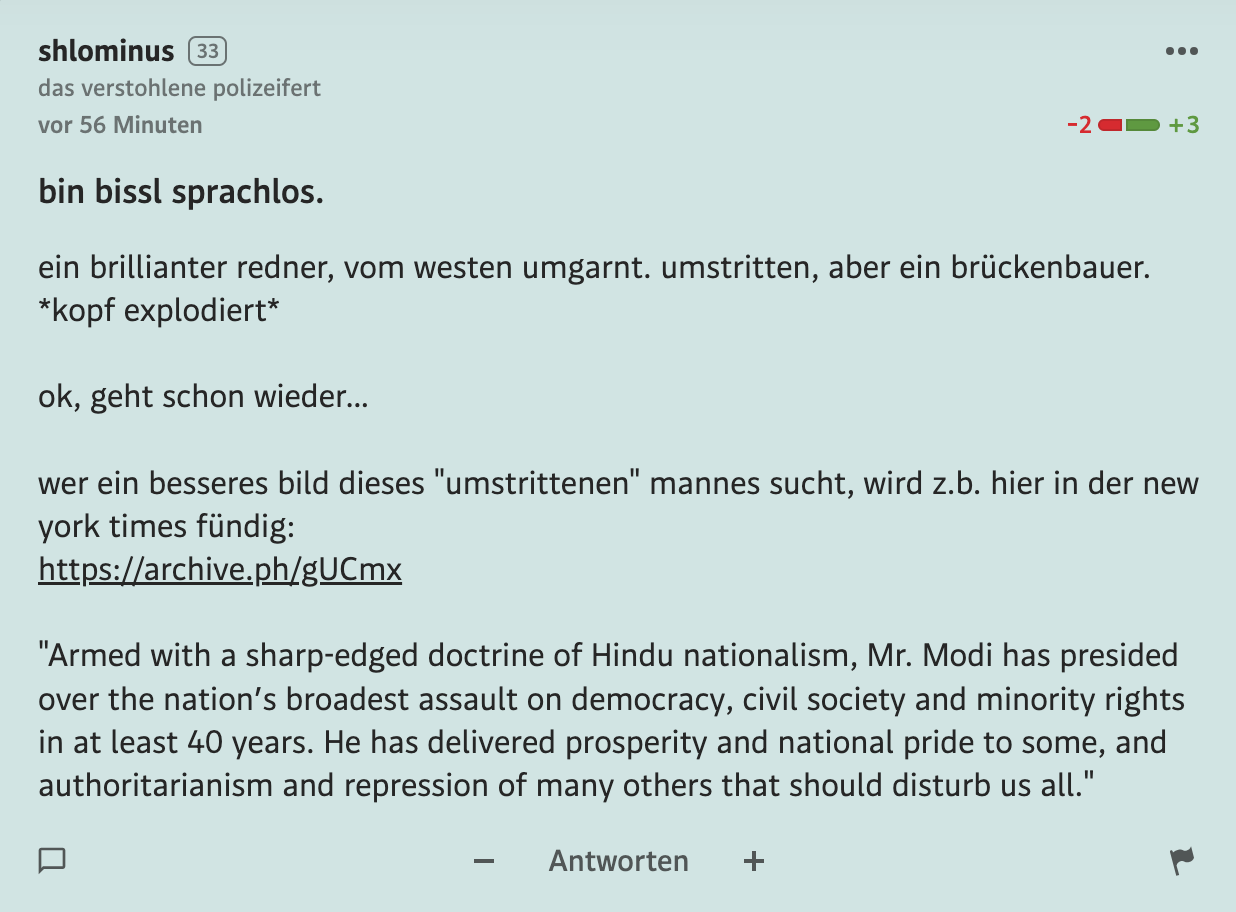
da hat ihm der Standard einen öffentlichen Verehrungsbrief geschrieben.
Diesmal muss ich nicht mal mehr kommentieren - die Groteske wurde auch von Anderen erkannt.
See also: India invokes emergency laws to ban BBC Modi documentary
Diese Gesellschaft ist das absolut grotesk und abartigst Allerletzte.
Amb. Gérard Araud: In the French system parties are allowed to run for the second round, if the candidates are -- really allowed to run for the second round if they got more than 12.5% of the votes in the first round. Which means that usually in our second rounds we have three at the very maximum four candidates, but we usually three candidates - and in these cases on the basis of the first round you we could expect hundreds of what the French called triangulares which means really a second rounds with three candidates. A Centrist, a far right and a leftist and the basis of the - of the first round, the consequence was clearly that the far right was going to win a lot of constituencies and what happened was really, that a lot of actually of candidates - leftist or Centrist decided to step out uh from the race and to call their voters to vote for either the centrist or the leftist, to prevent uh the far right from winning the constituency. And it was really a a general movement, a very general movement so we went from with something like nearly 400 triangulare second rounds to uh more or less only more or less 95-100 and in these cases of this 100 actually uh the centrists and the leftists remained in the race most of the time, because there was no danger of a victory of the far right.
HOLY MOTHER OF JEBUS!
France is divided into 577 constituencies (circonscriptions) for the election of deputies to the lower legislative House
src: click
Thats effective election fixing in 53% of french election districts.
Fuck me…
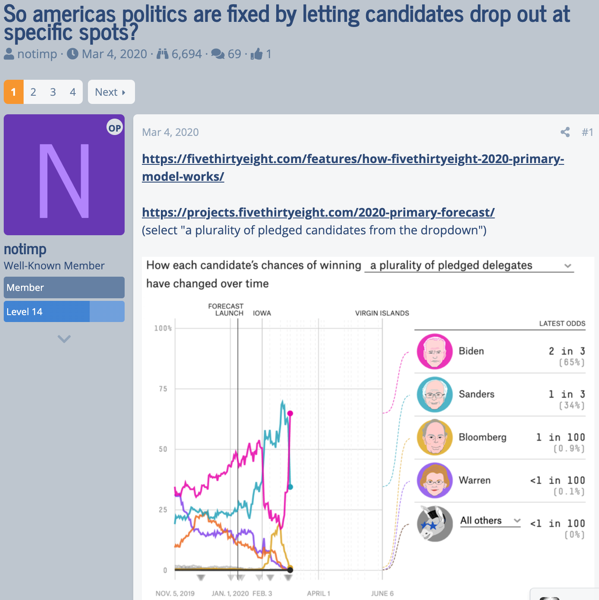
Oh, and btw here is how this works in the US. So - at the democratic candidate selection, you as the donor class buy out the electoral campaigns of four or five, lesser viable candidates, making sure they all campaign like crazy (real percentage of campaign money invested) in the most looked at “indicator” state (Iowa), then if that doesnt grant you your actual horse in the race (the second most popular candidate - you actually prepped up as the one with a real chance) to win the trend deciding Iowa - which to your chagrin Bernie Sanders won, then - in the same week, while your other candidates still have media pull (everybody knows them due to the insane amount of campaign money spent around Iowa), but not much else is going on - you let three lesser viable candidates drop out from the race, coordinately, in exactly the same week and pledge their support to the designated candidate of the donor class.
Then you get probability distributions like these:
src: click
Back, when I actually realized how that works - I actually still opened debate threads with the title “So americas politics are fixed by letting candidates drop out at specific spots?”, but then was calmed down by the notion, that in Europe candidates are actually mostly “designated” into their number one position of their respective parties by a much less transparent decision process -- so I was willing to let it slide.
Now, in 2024 - the actual frech election got “fixed” this way…
Fun.
Again - compare and contrast:
Number of votes in the 2024 french elections:
1st round > 2nd roundNational Rally Alliance (RN): 33.3% > 37.1%
New Popular Front (NFP): 28.6% > 26.3%
Esemble (ENS): 20.9% > 24.7%
Other: 10.6% > 5.6%
Les Républiccains (LR): 6.6% > 6.2%
src: click
So you know, that the public vote wont play out in your favor, so you start the election fixing process.
And that process is so effective, that the second place candidate (based on votes) now “wins” the election, and the first place candidate comes in third. Simply because you fixed 53% of voting districts, by letting the “unlikely winners” drop out in a coordinated fashion.
Lets look at this more closesly why dont we. So this was the Project FiveThirtyEight (FiveThirtyEight, is an American website that focused on opinion poll analysis, politics, economics, and sports blogging in the United States.[2] Founder Nate Silver left in April 2023. On September 18, 2023, the original website domain at fivethirtyeight.com was closed, and web traffic became redirected to ABC News pages.[2]) “Chances of winning a plurality of pledged delegates” forecast for the 2020 US primaries, on the day mid february - shortly after IOWA - when the three candidates with less hope to attain the necessary delegates dropped out of the race in the same week - coordinately - ALL OF THEM endorsing Biden:
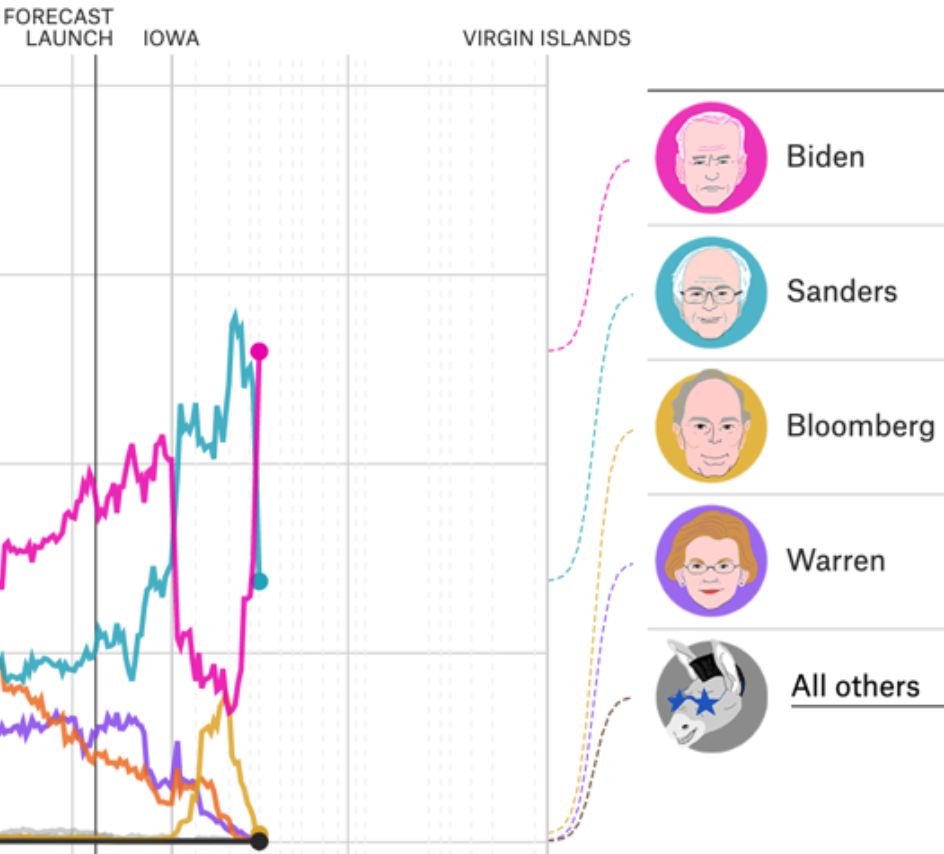
This ladies and gentlemen is what you call election fixing.
So ist der Ausleuchter dessen Aufgabe es bisher war Gregor Gysi bei Spiegel TV ins Halbdunkel zu setzen, wenn er über seine Meinung und seinen Besuch in der Ukraine spricht
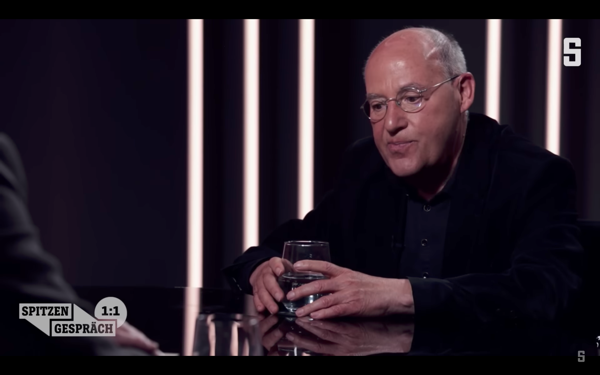
(Das Lichtdesign ändert sich in dem Talk Format natürlich zwei Wochen darauf… Ich meine, warum nicht, mal was ausprobieren…)
- unlängst wohl von Spiegel TV gefeuert worden, durfte aber jetzt dank einem Stage-Hand Rehabilitationsprogramm bereits gleich wieder bei Bild TV reüssieren, und dann gleich noch Victor Orban ausleuchten!
Was für ein Karriere-Leben!
Am Geilsten ist ja das Key light, das hinter Orban vorbei unmotiviert von den Büchern in die Kamera reflektiert. Ich mein, klar - die Bücher müssen so sehr im Licht stehen, dass sie im Frame nur noch ein Lichtfleck sind. Orban hingegen…
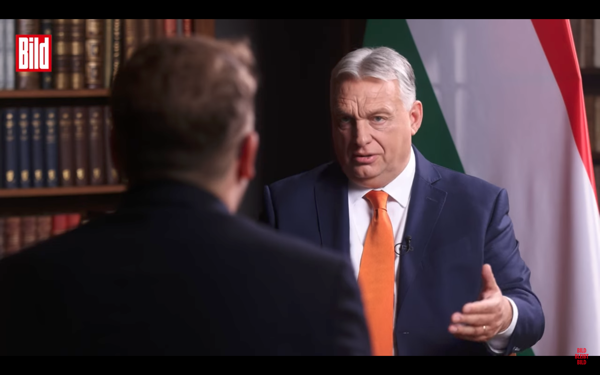
Genial!
Gut, Orban - alter Medienprofi, rückt etwas nach rechts.
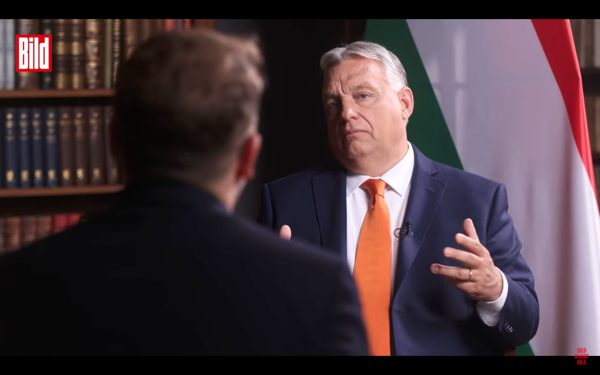
nein - immer noch kein Licht. Und nach links:
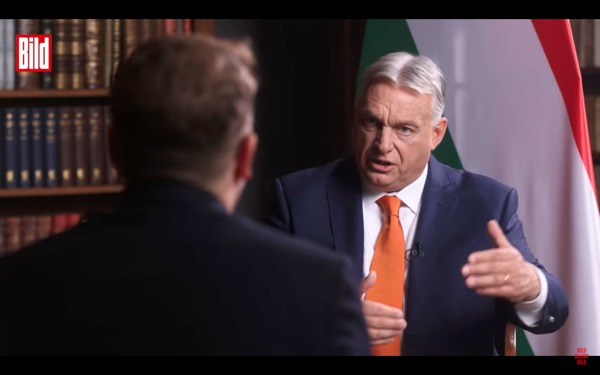
Nein - auch da noch kein Licht.
Aber beim Zuseher kommt der sicher zauberhaft an!
Propaganda hat natürlich wieder niemand entdeckt.
Am Allerwenigsten die Aufnahmeleitung.
edit: Es gibt aber natürlich auch wieder gute Nachrichten:
EU klagt EU-Datenschützer, um weiter Microsoft-Software nutzen zu können
Die Kommission will, dass die Datenschutzbehörde ihren Beschluss aus dem März revidiert, der Microsoft 365 kein gutes Zeugnis ausgestellt hat
src: click
Moderator (Intro): “Which side will back down first, the US and its European allies are providing Ukraine with money with weapons military training and intelligence support, on the other side Russia is insisting on a buffer zone along eastern Ukraine and wants Kiev to abandon aspirations of membership in the NATO alliance - so what does all this mean for Ukraine and its future and how many more months or years of fighting before both sides will sit down at a negotiating table? Today we’re talking with Ian Bremmer, president of the global political risk firm Eurasia group and editor at large at Time Magazine. Ian thank you so much for joining us.”
[…]
Ian Bremmer: “I think that the Russians certainly they’re occupying a lot of Ukrainian territory illegally. They have no right to occupy it uh but uh the ukrainians don’t have the capacity to remove them, so I if you’re just looking at Ukraine itself uh you would say that the Russians are quote unquote winning, or certainly the ukrainians are losing more uh if you look at the world uh and you look at the fact that Putin just made his trip to North Korea because Kim Jong-un and the Iranian supreme leader are the only countries in the world that are willing to provide direct military assistance um to the Russians uh and you see the hundreds of billions of Russian assets that have been frozen and now increasingly functionally seized uh and you see the impact of a stronger expanded NATO you would certainly say the Russians are losing globally. I mean they they are in a much worse position as a country as a military as an economy today than they were on February 22nd uh you know before they started uh this uh massive invasion of Ukraine um so I mean it’s a complicated question uh but thus far you know it’s the ukrainians who who have of course the most challenging position uh in the war.”
Moderator: “Given the steps that we were taking by way of sanctions and whatnot before, given the isolation we thought we were creating for Russia hasn’t it really outperformed most of our uh Western pessimistic um prescriptions or analysis of Russian decline?”
Bremmer: “Not really uh I mean look I I I take your point Steve, I think you’re right that um in the west uh people want to see Russia fail and therefore they portray Russia as failing and of course it should be almost definitional that if your analysis neatly uh lines up with what you want to see happening you should throw your analysis in the bin because it’s propaganda right, I mean that’s that’s never the case uh life is always more complicated now uh it is the real issue um the Russian Russia right now has a war economy and they’ve lost you know roughly a million able-bodied men uh scared of the draft uh who have been traveling to countries like the Emirates and Armenia and Georgia and anywhere they can go which of course really hurts the Russian economy long term this is if you look under the hood of the Russian economy uh this this is a country that is not doing well but but the willingness of the United States and Europe to take economic pain to hurt the Russians is minimal, it’s minimal. So I mean you’ve got sanctions but those sanctions are not stopping the Russians from exporting um oil um and gas to most of the world uh at a discount because the West knows, that if they were to try to stop the Russians from exporting to India and China and and certainly the Americans and Europeans have the capacity to put the secondary sanctions on to make that happen, but it would lead to a global recession which the US and the Europeans don’t want. If you cut off the uranium then who’s going to fuel the nuclear reactors in the west the Americans are still buying uranium from Russia if you cut off the food and the fertilizer then you’re going to see a lot more starvation in the global South, which the Americans and the Europeans don’t want, so the reality is - the willingness of the Americans and Europeans to punish the Russians economically is surprisingly limited, given the rhetoric. It’s understandable but it’s limited and in that context the Russians of course have a much longer leash on being able to continue to prosecute this war against a much smaller much weaker Ukraine. I mean the surprise has been that the ukrainians have been able to get a bunch of their land back and fight the Russians to a standstill. Some of that is Ukrainian um you know sort of uh willingness, morale, because they’re fighting for their land and the Russians aren’t, I mean the Russians are essentially fighting as mercenaries right and part of it has been the willingness of the West to continue to provide a surprising amount of money, Aid and Military Support directly for Ukraine um and and that of course we’ve seen the the greater willingness over time of of NATO to do things that they would have considered red lines even months ago.”
Moderator: “Is there a wobbliness right now both inside Europe and also in the United States frankly that makes the sustainability of this position uh something that might play into Putin’s hands generally speaking?”
Bremmer: “The farther you are from Russia the less you care right, I think that that’s not surprising uh and the longer the war goes on the more other things like the US election, like the war in the Middle East uh go to the headlines and certainly if you talk to the Biden Administration they’ve been spending more time in the last eight months on the Middle East, the senior most officials across the board than they have on Russia/Ukraine so I mean that that that of course also plays a role now the Europeans it may surprise you uh Steve the Europeans overall are providing more money they’re spending more on Ukraine than the Americans are um and again you know that stands to reason they have much more to lose uh but it is true that it took some six months for the Americans to get that $61 billion package through it did have very strong bipartisan support from The Americans on the Democratic and Republican side but no guarantees that would continue certainly not under a Trump Administration and potentially not even under a Biden Administration. It’s also getting a lot harder for the ukrainians to continue to raise young men to be able and willing to fight and to train them uh to be on the front lines Ukraine is a much smaller population than Russia it’s also a democracy. Russia’s an authoritarian regime it’s much easier for Russia to engage in forced uh human trafficking um and to take ethnic minorities from the middle Volga Siberian force them to fight much easier for them to take people from prison, force them to fight, ukrainians have a harder time doing that and it’s a much smaller country so for many reasons if you look over 2025, you would say probably the ukrainians are going to have a harder time maintaining the present front lines, than the Russians are going to have uh the Russians are going to have an easier time taking more land. I think people are worried about that and you also see with these the most recent so-called peace uh meeting in Switzerland that you know there were fewer countries that attended um and the global South, a number of core countries like India for example like China didn’t sign on or didn’t show up um to the eventual memorandum of agreement. As the war persists, you know, ukrainians are getting more skittish about fighting it and the rest of the world is moving more towards “we need a ceasefire” so of course if you’re Putin you you understand that playing the long game is an advantage for you uh which which means that the desire of the West to make Ukraine appear stronger and and able to damage Russia, but at some point move towards negotiations um I think is is in their interest you know.”
Moderator: “NATO’s Secretary General Jens Stoltenberg recently said, these efforts, these recent efforts do not make NATO a party to the conflict, but they will enhance our support to Ukraine to uphold its right to self-defense. So there seems to be a lot of theater around whether NATO is party to the conflict, not party to the conflict, even though many EU member states that are members of NATO are providing these weapons and support and even though Ukraine is going to be a very hot topic right at the center of the NATO uh Summit here in Washington, I’m just interested particularly as we’ve seen new armaments going into Ukraine that can be used for long-term hits inside Russia, how long that fiction is going to last.”
Bremmer: “Um you know it’s true that there are no boots on the ground um that you know NATO is not firing these weapons directly, but they’re providing the weapons, they’re allowing the ukrainians to use them uh on Russia directly in response to Russian invasion of Ukraine, so I mean I think it’s clear that it’s becoming a proxy war um and it’s also clear that NATO is heavily and directly invested in Ukraine being able to defend themselves and take their land back so is it a fiction that NATO is not involved? Yeah! That’s a fiction. Having said that is it a legitimate war for Russia? No. I mean when Russia says how dare you attack Crimea and we’re going to blame you United States for providing the attacks that that you know allowed the ukrainians to hit Crimea… Crimea is Ukrainian territory it was it was annexed illegally by the Russians so I mean, you know the fact that the Russians are making you know the foreign minister Sergey Lavrov is making that argument you know just shows how much in breach of international law the the Russians continue to be, I mean the fact is that the North Koreans and Iranians are two of the only countries in the world that actually support Russia’s position in the war of Ukraine. China does not. China trades with Russia. China’s one of Russia’s best friends and yet the Chinese have consistently said that they fully respect Ukrainian territorial Integrity. The foreign minister has said that includes Crimea, so I mean the fact is that the Russians are fighting an illegitimate, illegal War and the fact that Ukraine is not a member of NATO and has no way to get into nato in the near term makes them weaker, but but NATO is providing direct support for Ukraine in much the way that the Americans under Bush Senior were providing support to Kuwait when Saddam Hussein’s Iraq illegally invaded -- the big difference of course is that Saddam Hussein’s Iraq wasn’t a nuclear power and was a hell of a lot militarily weaker so it was easy to push them out and overrun them that is not the case with Putin’s Russia.”
Moderator “Is there any equation that you’re aware of that would allow NATO members to bring in a Ukraine without defined Borders or without you know internationally accept borders in what is still kind of potentially a high conflict zone?”
Bremmer: “Look my my point here, Steve, is is that I believe that Ukraine will be partitioned uh I don’t think the ukrainians will will agree to that. I don’t think that you know the International Community is going to suddenly respect Russian sovereignty over Ukrainian land but the reality is they’re not going to get their land back um there’s no way to do it uh there isn’t the will and I -- that that saddens me, I think it’s wrong but it’s reality, it’s analysis right, so if Ukraine is going to be partitioned how do you give the ukrainians a future that is both stable and productive for their people, for their country and you need to give them the money to rebuild number one um after the destruction that has occurred and the fact that Russian assets that have been frozen uh that are being seized will be used for that reconstruction is wholly appropriate in my mind. You need to integrate Ukraine fully into the European Union, which will help them become more a democracy which will help them become a stronger economy uh with rules rule of law um that and less corruption uh that the rest of the world can do business with and you need some form of hard guarantees, hard guarantees that in the part of Ukraine that Russia has not occupied that that the West will defend the ukrainians um as an ally and I don’t know exactly what part of Ukrainian territory that will be, will that be the whole 80% that Russia doesn’t occupy right now, will it be some diminished piece - but there has to be some ability that ukrainians know that going forward the Americans and the Allies really have their back in a way that in 2014 and in 2022 they certainly did not. NATO membership is the best way to eventually affect that in my view um but that can probably only occur when we have a ceasefire between Russia and Ukraine, that is not contingent but it nonetheless is a reality, so that that’s what I’m talking about Steve. It can’t just be you know like the The Budapest memorandum, when the Americans and the Brits and the the Russians all said oh if you give up your nuclear weapons we’ll make sure we defend you, but the there’s no guarantees there they gave up their nukes and then the Russians invaded and the West was like oh well oh well right, I mean that really undermines what a commitment from the United States means I mean not Russia because no one takes their commitment seriously, but in principle an American commitment should mean something and to Ukraine over the last couple decades it has not.”
Moderator: “Ian if Donald Trump wins the presidential election in the United States in November, what does that mean for Ukraine? In this equation, well Donald Trump wants to end the war in Ukraine and that means he will tell Selenskyj: “You’ve got to accept the present territorial line or I’m not going to give you any more support.”. So ceasefire, start negotiations uh no more fighting and if the Russians -- he will say the same thing uh you’ve got to accept a ceasefire uh no movement of the territory um or or there’s going to be much tougher sanctions against you, real sanctions on the Central Bank uh, take them out of Swift uh for financial transactions the oil export we talked about before Robert O’Brien uh who was of course Trump’s National Security adviser has been recently opining on that publicly but Trump and and team have been saying this privately for months now. Now the the difference is that the ukrainians are going to be deeply uncomfortable with that reality uh as will many Europeans, while Putin is much more likely to say - great yeah I can, I’m willing to have that conversation so it it does essentially uh give the the where the Russians have gotten to more legitimacy than any other American president democrat or republican would accept.”
Moderator: “You know roughly I mean I don’t want to misstate you, but you know actually - what you just defined Trump is doing, seems to approximate what you think will happen in the end anyway, I mean it’s sort of - am I getting that wrong?”
Bremmer: “Uh you’re getting it wrong, because um I think what Trump will do, will not be coordinated with America’s allies uh Trump is a unilateralist, he doesn’t like a strong Europe, he certainly doesn’t want to work closely with the EU, he liked Brexit, he -- when he speaks with Macron he’s like “when are you going to do a brexit” - right? So Biden’s approach has been very much a multilateral approach that makes NATO stronger because it coordinates with all NATO allies, NATO allies are not convinced that Trump wants NATO to exist and he would make those decisions on Ukraine by himself without the alignment um in fact with opposition from the poles, from the balts and the rest. So I worry that even if the outcome visa Ukraine looks similar, the reality is that the Ukraine war isn’t just about Ukraine, if it was we wouldn’t spend any time on it. It’s much more about the West the transatlantic relationship NATO and Russia and in this regard uh Trump is much more of a threat to the persistence of that relationship of that reality, than a second Biden term.”
Moderator: “Let me ask you quickly about Russia’s Frozen Central Bank assets the majority of which I understand are in Belgium there’s been discussion over there of you know taking the growth and gains as opposed to the principle of those, and using them to support Ukraine others want to take wholesale Russian assets and deploy them to Ukraine and there’s a big split in the kind of global financial sector, I would say - you know we have some former secretary of Treasury in the US Like Larry Summers who are willing to basically take those Russian assets you have others like his former boss secretary Bob Rubin who think that opens up a Pandora’s Box and really creates another destabilization, essentially the commons of the Global Financial architecture -- I’d love to get your take on that.”
Bremmer: “Well it’s it’s already happened uh we saw at the G7 uh meeting in the past weeks that there is an agreement um to basically collateralize uh the Russian assets uh and give a loan of some 50 billion to Ukraine that will be paid off with the interest of those assets that will be guaranteed not paid back to the Russians, the principal for at least 30 years uh when you’re when you’re freezing the principle of someone’s assets for 30 years and you’re using the interest, you’re seizing the assets. So there isn’t actually, I mean this is a it’s a nice - you know sort of a hand waving kind of legal fix um to the disagreement that you spoke of, the reality is that there is greater concern slash urgency from the Europeans than the Americans that what happens if you don’t have long-term support for Ukraine, this is one way to get around that -- that even if Trump says I’m not going to provide more support, you’re going to see long-term support that is paid out on the back of the Russian assets, that have been frozen slash seized and yes that is a precedent it’s a precedent that could weaken the Euro over time, it’s a precedent that could lead the Russians to seize European assets and other assets in Russia that here to for they have not taken, those steps and it also could lead other countries around the world to say, well if you just seized Russia’s assets in contravention to international law, why wouldn’t you seize mine going forward, maybe I’m not as safe as I had been um in your country or countries now the fact that China uh is an authoritarian system um that doesn’t have a a convertible currency and that Russia breaks international law all the time doesn’t necessarily make you feel more comfortable about suddenly putting your assets in those countries, but certainly uh you know this is the kind of thing that could make you think that crypto could see a spike uh you know, things like a Singaporean currency other smaller safe havens, but there just there isn’t a large alternative to the dollar and the euro in a in a rule of law and Democratic space.”
Moderator: “Let me just ask you finally about the NATO Summit in Washington Ian, and I’m interested in how you see this playing out politically inside the United States does NATO become a greater politically divisive uh item in American politics or does uh the White House somehow win by having this Summit in Washington during a presidential election race?”
Bremmer: “Uh I think the fact that the Americans got the money and the arms to Ukraine and that the front lines are pretty stable, makes this a little bit less urgent, than the Middle East war is right now I think that the Netanjahu, the Israeli Prime Minister’s trip, to the United States to speak to Congress on July 24th will have more impact on the race uh than the NATO Summit uh I think the NATO Summit is more important long-term and structurally, but you were asking me specifically about the elections, also keep in mind uh NATO is not only larger now with two new countries in the nordics that have joined uh but also NATO countries are spending a lot more in defense. A big piece of that is because of the Russian invasion but some of that is because of American pressure and if Trump becomes president you know one of the things he can say is yeah NATO is stronger now because of me, he can take credit so it’s not clear to me that a second Trump term will be saying NATO’s no good they’re not spending any money if Trump wants to take credit for some of NATO’s successes, he can.
Moderator: Well, we’ll end it here. Thank you so much founder and president of the Eurasia group Ian Bremmer, really appreciate you joining us today always.”
Bremmer: “Good to see you Steve.”
Moderator: “So what’s the bottom line, the war in Ukraine is about much more than a Russian invasion or Ukraine’s interest in tying itself into Europe and NATO. Ukraine is now the battleground of a classic proxy conflict between the United States and Russia. Yes other allies are involved, but this is fundamentally about the spheres of influence of the US and Russia and we’ve seen this play out over and over again in the past. Sure the Soviet Union lost massive territory and global prestige when its Empire finally collapsed in exhaustion after decades of competition with the West, but the endgame is rarely a clear victory for one side or the other. Everybody says they want peace but nobody wants to surrender so they keep going. Neither side is likely to get all at once. This conflict ends with negotiations with both sides keeping something and both sides losing something that’s what neither side will admit yet and that’s the bottom line.
Bleibt noch eine Frage - wird der Krieg von den Freunden des Wertewestens prolongiert um der Ukraine die Möglichkeit einer besseren Verhandlungsoption in die Hand zu geben, wenn doch Russland long term verhandlungstechnisch in eine bessere Position kommen könnte, oder prolongiert man den Krieg um die Rate der russischen Abnutzung zu erhöhen und damit das Risiko noch einmal einem Angriff ausgesetzt zu sein zu reduzieren. Die Antwort ist meiner Meinung vollkommen eindeutig, wenn man sich einmal Kalas oder Sikorsky angesehen hat.
Grüsse an seine Frau bitte.
at the votes.
When your election system gaming works too well… 🙂
Second round (Seats, Change, Votes)
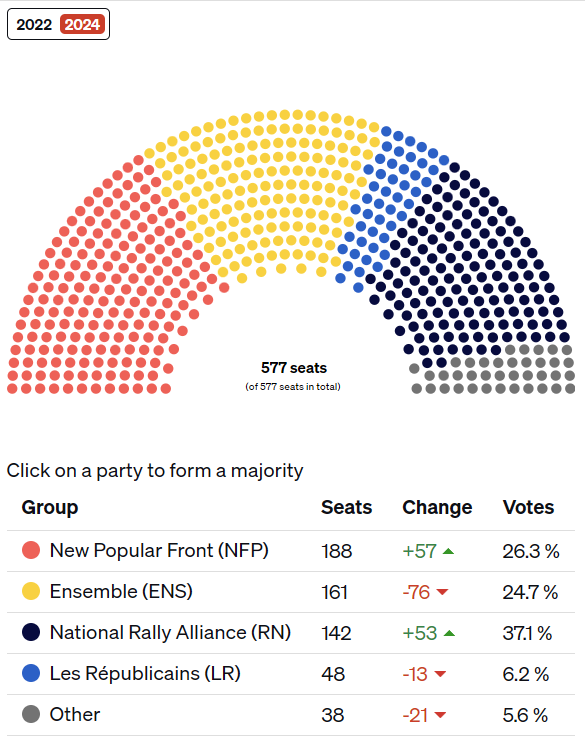
First round (Votes)
National Rally Alliance (RN): 33.3%
New Popular Front (NFP): 28.6%
Esemble (ENS): 20.9%
Other: 10.6%
Les Républiccains (LR): 6.6%

src: click (Politico)
Verdammter hoher Wählerturnout, damit konnte ja bei einer Entscheidungswahl niemand rechnen. 🙂
edit: Achja, der Standard lügt natürlich schon wieder:Das französische Modell taugt für Österreich nicht Zuerst extrem rechts wählen, dann korrigieren, geht im französischen Wahlrecht, nicht bei uns Einserkastl Hans Rauscher 8. Juli 2024, 11:34 401 Postings Das französische Mehrheitswahlrecht mit seinen zwei Durchgängen bietet den Wählerinnen und Wählern die Möglichkeit, es sich noch einmal zu überlegen: Zuerst lässt man seinen Frust über die Situation mit einer Stimme für die extreme Rechte (Marine Le Pens Rassemblement National) raus, dann ist einem die Aussicht auf eine rechtsextreme Regierung doch zu viel und man wählt links oder doch noch einmal gemäßigt traditionell.src: click
Gehört beim Standard zum Beruf, ne zur Berufung.
Stichwort CO2 Bilanz.
Mich hat das gesamte öffentlich zur Schau getragene grüne Gutmenschentum im Standardforum genug angekotzt, dass ichs nochmal nachgerechnet (überschlagen) habe.
Hier am Beispiel Österreichs. 🙂
CO2 Equivalent Emissions:
- Erdgas 500 (gCO2eq/kWh)
- Biomasse 70
- Wasserkraft 22
- Wind Onshore 18
- Solar 56
Quellen:
https://www.verbraucherzentrale.sh/aktuelle-meldungen/energie/photovoltaikanlagen-so-gut-sind-sie-fuer-den-oekologischen-fussabdruck-50972
und
https://www.wegatech.de/ratgeber/photovoltaik/grundlagen/co2-bilanz-photovoltaik/
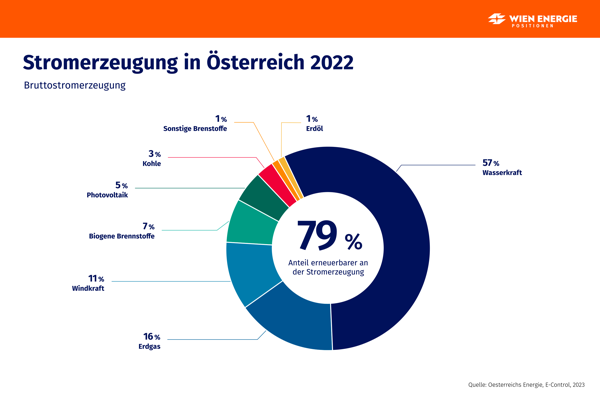
Brutto Stromerzeugung in Österreich:
src: click
Wir rechnen einfachheitshalber: (20*400)[Gas]+(80*23)[Erneuerbare] = 9840 Fantasiepunkte CO2 Equivalent für 100% Bruttostromerzeugung in Österreich. (Gas/Wärmegekoppelte Kraftwerke liegen bei unter 400 deshalb rechne ich nicht mit über 400 für die paar Prozent Erdöl die da im nicht erneuerbaren Teil noch dabei sind und machs mir mit pauschal 400 viel einfacher.)
Und jetzt das selbe für Solar Balkonkraftwerke:
CO2 Equivalent nominal: 56 wir verdoppeln für “in China hergestellt” = 112, und dann gehen wir wegen Balkonanbringung von einem Leistungsmalus von 30% aus. Macht:
146*100 = 14600 Fantasiepunkte CO2 Equivalent.
(Selbst wenn wir nur eine CO2 Bilanzsteigerung von 40% im Falle eines Chinapanels annehmen, landen wir bei: ((56+40%)+30%)*100 = 10192 )
Gut, da fällt vielleicht jemandem auf dass in in dieser Rechnung 100% der Stromerzeugung Österreichs durch Balkonkraftwerke annehme, was dann doch etwas unglaubwürdig ist - also, was wäre da realistisch?
1 Mio Österreicher installieren sich ein Balkonkraftwerk. mit einer Ausbeute von 600kWh netto im Jahr - macht 0,6 Terawattstunden.
Österreichischer Stromverbrauch im Jahr: 71 TWh
(100/72)*0,6 = 0,83
Also im Idealfall ersetzen wir durch Balkonkraftwerke 0.8% des österreichischen Stromverbrauchs.
Dann schauen wir wieder auf die Grafik oben und erkennen, dass das ein Rundungsfehler ist. Dann schauen wir nochmal auf die Grafik oben und erkennen, dass wir damit Gas nicht ersetzen werden, da Flatterstrom.
Dann überlegen wir uns, wie wir damit doch noch was Gutes tun könnten, und speisen den ganzen erzeugten Strom ins Elektroauto, da die CO2 Bilanz dort in jedem Fall besser als die von Benzin oder Diesel ist.
Wobei auch da könnte es knapp werden, denn das E-Auto hat ja nur eine bessere CO2 Bilanz als ein Benziner, wenn wir das mit dem CO2 Equivalent des deutschen Stromnetzes gegenrechnen, das ebenfalls nur 11% Photovoltaik drinnen hat. (Und das aus guten Gründen.)
Abgesehen davon, dass wir mit Balkonkraftwerken kein E-Auto laden.
Himmel, Herrgott, Hirn.
Ist Solar deshalb schlecht? Nein. Man lässt es nur besser dort wo es bei vollem Wirkungsgrad Strom erzeugen kann. (Dann hat man in seinem Land aber kein Polysilizium, und das wird ein Schlüsselrohstoff - also lässt mans die dümmsten aller dummen Boomer über Balkonkraftwerke kaufen (ok, eh nicht, Hausanlagen sind da eigentlich in der Planung angedacht, so dumm in den Szenarien mit Balkonkraftwerken zu rechnen ist niemand)), dann hat mans im Land und damit im Recyclingkreislauf (Rückgewinnungsrate: 70%). Oder packt sichs aufs Dach und lädt damit sein Auto (oder heizt je nach Wirkungsgrad seine Wohnung). Und wenns noch weiter im Preis sinkt darf man dann auf den “Solar Hockeystick” hoffen, dh. den Moment wo die Erzeugung von Solar durch Solarstrom günstiger wird als die Erzeugung durch konventionelle Energie, und damit explodiert dann potentiell die Produktion, und es kommt zu einem lokalen Überangebot, und ab da könnte man sich dann überlegen grünen Wasserstoff herzustellen - aber auch nur wenn wir annehmen, dass es da keinen Monopolisten gibt, der an der Skalierungsschraube dreht, wie - oh beispielsweise China, sobald es volkswirtschaftlich Sinn macht den Preis pro kWh nicht noch weiter fallen zu lassen.
Siehe auch:
edit: Siehe auch:
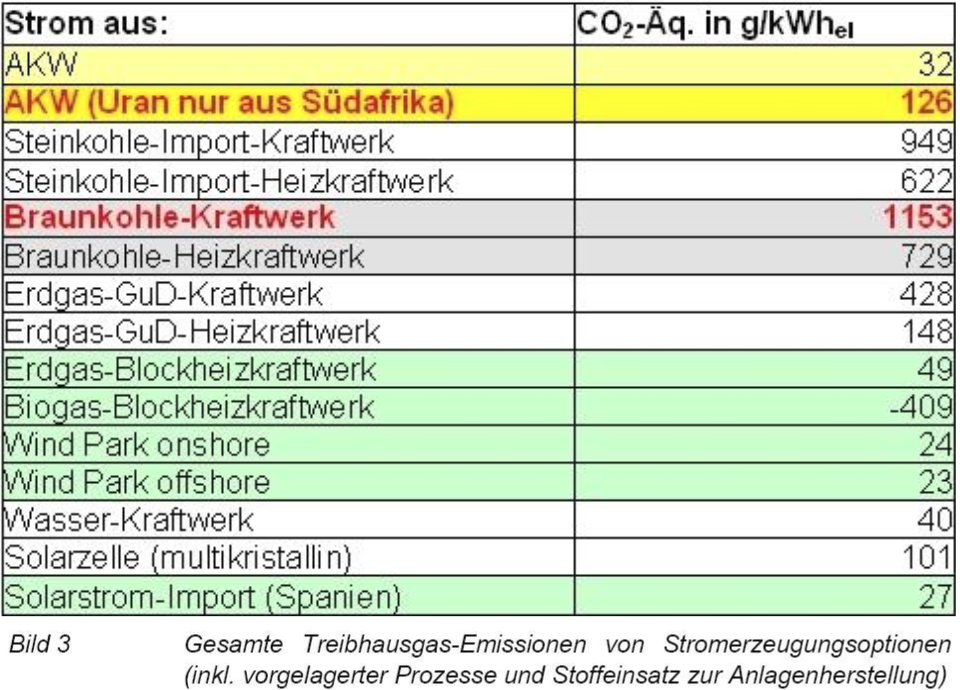
src: click (bundestag.de (Stand: 2007 dh. älter, daher habe ich mir vorrangig andere Quellen gesucht.))
- für sie zu glauben, aber -- stellt sich heraus, es gibt Leute die ziehen nicht gerne in den Krieg. Und es könnte sich um die Mehrheit von Bevölkerungen handeln.
Macht aber nichts, denn Propaganda hat Gott sei Dank wieder niemand entdeckt…
Ein Mobilmachungskommando stößt in Kiew auf Feindseligkeit
Ukraine Pavlo Pimakhov und Yuriy Pikhota sind in der Ukraine unterwegs, um Wehrdienstpflichtige zu erfassen und zur Musterung vorzuladen. Sie stoßen auf Abwehr und Angst. Was sie erleben, widerlegt die Legende von der kriegsentschlossenen Nation
src: click (freitag.de)
Original hier im Guardian.
Ich würd ja Armenviertel und gratis Videospiele empfehlen. (Wie die US denken lernen heißt siegen lernen.)
edit: Turns out the US instructing the Ukrainians are way (ok, one day) ahead of me.. 🙂
Kyiv developers earn $4,000. The foreign programmers have the same median salaries. In Odesa, the median is about to achieve the Kyiv level — $3,900. You can see the medians over $3,000 in the half of Ukrainian cities: for example, Dnipro ($3,550), Ivano-Frankivsk ($3,400), Lviv ($3,760), Chernivtsi ($3,500), and Kyiv suburbs Boryspil and Brovary ($3,200).
src: click
Brovary translating to beerbrewer btw.
So highest concentration of people and lowest incomestructure in the Kiev suburbs?
Time for a recruitment center!
Second recruiting center of Ukrainian army opened in Kyiv region
20:36, 05.07.2024
A Ukrainian army recruiting center has opened in Brovary, Kyiv region, which became the second in the region and the 26th in Ukraine, Deputy Minister of Defense of Ukraine Natalia Kalmykova said.
“It is now possible to get advice and join the Defense Forces in Brovary. The recruitment center operates at the address: 18, Heroyiv Ukrainy Street, in the premises of the Center for providing administrative assistance. It is open from 8:00 to 17:00 from Monday through Thursday, and on Friday from 8:00 to 15:45,” wrote the deputy minister on Facebook.
src: click
Advice the poor away!
Apropos - Kotkin tut sich ein wenig schwer die Zukunft des Krieges und der Nato auszumalen (mit Fokus südchinesisches Meer). Der Wall Street Journal Interviewer zeigt leichte Zweifel. Dabei darf er das doch nicht…
Gut, Propaganda hat wieder niemand entdeckt, was will man machen.
Dear Mr. President, can you step down please?
Dear Mr. President, can you step down please?
Dear Mr. President, can you step down please?
Dear Mr. President, but what if they ask you to step down?
Dear Mr. President, but have your supporters even talked to you recently?
Dear Mr. President, what did your doctors say?
Dear Mr. President, have you deteriorated?
Dear Mr. President, have you looked at your polling numbers?
Dear Mr. President, can you step down please?
Sternstunde der vierten Säule der Demokratie.
Paul Krisai, Außenpolitikexperte, ORF.
Orban in Russland: Bitte um eine Analyse.
Analsye: https://orf.at/stories/3362662/
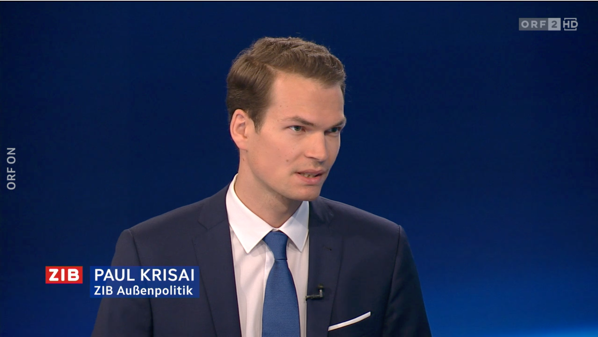
Moderatorin: “Paul, welche Botschaft sendet denn Viktor Orban mit diesem Besuch aus?”
Paul Krisai: “Drei Botschaften eigentlich [Toll! Drei! Sicher dass es nicht vier sind, denn das wär beim Zuseher wieder rhetorisch weniger prägend…]. Aus Orbans Sicht soll das Ganze eine Friedensmission sein, so hat das sein Sprecher erklärt, auch wenn Orban eingeräumt hat, dass er in Moskau in keiner Position ist um für die gesamte EU zu sprechen. Aus Brüsseler Sicht ist das Ganze ein Kniefall vor dem Aggressor. Von noch Ratspräsident Charles Michel abwärts haben sich sehr Viele und sehr klar von diesem Moskau Besuch distanziert, das sorgt für einiges an Unmut und Verwerfung in Brüssel, aber egal wie Orban, oder Brüssel das ganze kommentieren, für Russland zählt am Ende die Botschaft die Vladimir Putin aussenden kann, nämlich: “Seht her, ich bin nicht so isoliert in der Welt, auch im Westen habe ich Gleichgesinnte, und Europa steht überhaupt nicht so geschlossen hinter der Ukraine und gegen Russland, wie es das immer behauptet [stimmt, wir sind ja so geeint, dass wieder kein Blatt Papier zwischen Frankreich schickt gerne Soldaten und Deutschland entschärft Formulierungen im 14. Sanktionspaket passt und dabei waren Makron und Scholz doch noch so demonstrativ auf einer Linie als sie beide noch beschlossen haben, dass die Ukraine auch Ziele in Russland mit den von ihnen gelieferten Waffen angreifen darf, auch wenn das Scholz am Tag davor noch verneint hatte (damals: gemeinsame Position mit Biden), und keine geeigneten Waffen für einen Angriff weit im Russischen Hinterland liefert (Taurus). Gut und die paar Scalp aus Frankreichs Lagerbeständen (French President Emmanuel Macron announced new arms deliveries to Ukraine, including “40 SCALP missiles,” a press conference on 16 January 2024.), ob die jetzt auf der Krim einschlagen, oder in Russland…]. Dieser Besuch eines Russlandfreundes in Moskau ist also vor allem ein Geschenk für Vladimir Putin. Einem Frieden in der Ukraine wird er uns wohl keinen Millimeter entgegenbringen.”
40 Sekunden nur (!) Conjecture ohne jegliche Begründung später:
Moderatorin “Vielen Dank für ihre Analyse, Paul Krisai!”
(Keine Nachfrage der Moderatorin.)
Ich hab mir erlaubt das emotional aufgeladene Messaging fett zu markieren.
Was für ein Glück dass wir noch die öffentlich Rechtlichen haben!
Da wird Meinungsjournalismus noch als Meinungskanon einer Informationseleite individuell erfahrbar!
Gut für meinen Vater wirds reichen, der brauchte in seinem Leben ja noch nie Begründungen und orientierte sich immer an den Meinungen der Leute die gerade im Wahlkampf für “de Werte” waren.
Das geht also heutzutage als hochwertiger Journalismus durch. Wenn man im Anzug in einem TV-Studio sitzt.
Also “ich hab mir auf facebook angschaut wer mit wem Freund is, und dann die Meinung vom Präsidenten übernommen, und jetzt verrat ich sie dir”.
Bitte übernehmen auch sie sie.
Täglich.
Unhinterfragt.
Weiterhin.
Sie hatten ja zu nichts anderem Gelegenheit.
Und außerdem keine Zeit.
Das ist übrigens Form-Kritik, was nicht bedeutet, dass der Kollege inhaltlich falsch liegt.
Er hat nur als Außenpolitik-Resort Leiter nichts davon begründet (abgesehen von “in meinem Twitter Freundeskreis glaubens auch viele!”), also inhaltlich begründet, also werden wirs nie erfahren.
Meine Damen und Herren: Meinungsjournalismus
Behaupt was. Sag high value people sehen das auch so. Sag Putler.
Hab fertig.
Mach Feierabend.
Willkommen im ORF Außenpolitikressort.
Und willkommen beim österreichischen Profil.
Diese Gesellschaft ist und bleibt das absolut grotesk und abartigst Allerletzte.


